


Fire Lily
Keywords: floral · spicy · sweet
Fire Lily: Gloriosa superba, called flame lily and glory lily, is a climbing plant of the family Colchicaceae. It is native to Africa and tropical Asia.
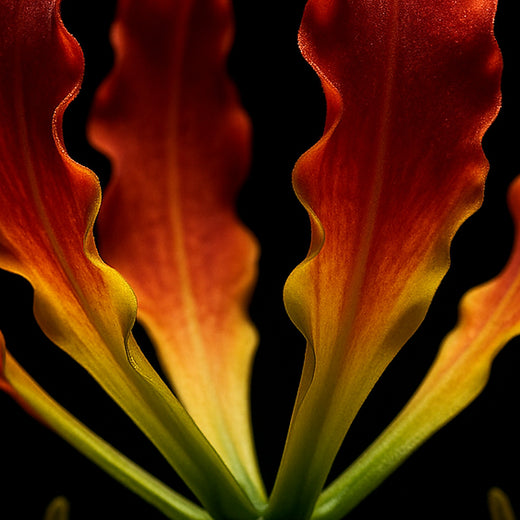
- Olfactive family
- Florals · 782 entries of the glossary in this family Subfamily: Green florals · 144 entries in this subfamily Cluster: Lily-like fresh florals · 67 entries in this cluster
- Material
- Fantasy/Concept Gloriosa superba, a climbing plant of the family Colchicaceae
- Pyramid
- Heart · Volatility: Heart Note
- Strength
- N/A — no measured strength for a fantasy accord Not on the graded scale
- Also called
- Flame lily, Glory lily, Climbing lily, Creeping lily, Christmas flower, Tiger claw, Malabar glory lily
Fire Lily · Facets
Entries of the glossary that carry each facet, of 3,979:
- floral 1,546
- green 1,442
- sweet 1,988
- fruity 1,301
- warm 1,108
- fresh 1,387
Editorial note We own no rights to this material, its name or its trademark. This entry is independent editorial journalism, published under freedom of expression.
Fire Lily · Scent
Evolution over time
Fire Lily: scent over time.
- Immediately
N/A — no documented evolution for a fantasy accord
- After a few hours
N/A
- After a few days
N/A
Fire Lily · In Perfumery
Heart notes, also called middle notes, form the main body of a perfume. A primary scent can be built from several ingredients used together to create an abstract scent that does not resemble a natural ingredient.
Pyramid
Fire Lily: Heart. Entries of the glossary stored at each place of the pyramid, of 4,000 (36 store no place):
- Top 718
- Top · Heart 497
- Heart 1,641
- Heart · Base 514
- Base 594
Role in the formula
Fire Lily: roles in the formula. Entries of the glossary that share each role, of 4,000:
- N/A — no documented formula role 361
Fire Lily · Terroir & Origins
- Producing countries
- India
Fire Lily · Extraction & Chemistry
Colchicine is commercially extracted from Gloriosa superba. Colchicine may be purified from Colchicum autumnale (autumn crocus) or Gloriosa superba (glory lily). In Tamil Nadu the plant is widely cultivated as a cash crop in view of high concentrations of colchicine and its derivatives. Industrial-scale biomanufacturing of colchicine has not yet been established.
Available as
Fire Lily: available as.
- synthetic accord
- fantasy note
Fire Lily · Did You Know?
About 60 mg of colchicine is considered lethal to humans, while deaths have occurred at lower doses. Poisonings also occur as the tubers are mistaken for sweet potato or yam and consumed.
Fire Lily · In Depth
Species and common names
Gloriosa superba is a herbaceous perennial semi-woody climber of the family Colchicaceae. It is native to Africa, tropical regions of South Asia and Southeast Asia, and south-central China. Other common names are glory lily, climbing lily, creeping lily, Christmas flower and tiger claw. Flame lilies are not in the genus Lilium.
Form of the plant
The thin stem measures up to 3 to 4 m in length in climbing plants. The leaf tips form tendrils, which are used for holding on to surfaces. The plant produces large solitary flowers measuring 7.6 to 12 cm in length and 4.5 to 7 cm in diameter. Several color variations are cultivated, including plants producing all white, orange, plum, or yellow flowers. The fruit is a fleshy capsule up to 6 cm long consisting of several red seeds.
Colchicine and toxicity
Most parts of the plant are toxic, especially the seeds and the tubers, because of the colchicine they contain. Colchicine is used in the treatment of gout and other inflammatory disorders. In 32 populations collected across 11 states of India, the colchicine content of the tubers ranged from 2.12 to 7.58 mg per gram. Populations from the Eastern Himalayan region at higher altitudes had significantly more colchicine than those from the Western Himalayan regions and the Indo-Gangetic plains. Seeds and field-grown rhizomes contain approximately 0.9 and 0.3% colchicine, respectively.
Ornamental and medicinal use
It is grown as an ornamental plant for its varied colored flowers. It is considered a cash crop like sugarcane and cotton because of its high returns. Its most popular and widespread use in traditional medicine is against rheumatism and gout. It is also used to treat ear ache in Tanzania and tooth ache in Zimbabwe.
National flower and name
Gloriosa superba is the national flower of Zimbabwe. It is the state flower of the Indian state of Tamil Nadu. The genus name comes from the Latin word gloriosus, which refers to the flower.
Related: Orange Blossom · Jasmine · Iris · Tuberose · Violet · Lilybelle®
Fire Lily · History
In 1947, Elizabeth II received a diamond brooch in the shape of the flower for her twenty-first birthday while traveling to Rhodesia. In 2003 the Liberation Tigers of Tamil Eelam designated the flower as the national flower of the de facto state of Tamil Eelam.
Fire Lily · Technical Sheet
Identity
- Botanical
- Gloriosa superba
- Taxonomy
- Liliales order › Colchicaceae family › Gloriosa genus · GBIF
- Botanical records
- Gloriosa superba: POWO, Gloriosa superba · IPNI, Gloriosa superba · GBIF, Gloriosa superba · Wikidata, Gloriosa superba · Wikipedia, Gloriosa superba · IUCN Least concern (LC), Gloriosa superba
- IPNI
- Gloriosa superba L., Sp. Pl. 1: 305 (1753) — Carl Linnaeus (1707–1778)
- Type
- Accord
- Category
- Flowers
- Note
- Fire lily (Gloriosa superba) has no standard commercial essential oil; fragrance note based on headspace analysis.
In Nature
- Growth form
- Herb · POWO
- Native range
- West Tropical Africa · West-Central Tropical Africa · Northeast Tropical Africa · East Tropical Africa · South Tropical Africa · Southern Africa · Western Indian Ocean · China · 3 more regions · POWO
- Introduced to
- 18 regions · Pacific 9 · Australasia 3 · Southern America 3 · Africa 1 · Tropical Asia 1 · Northern America 1
- Flowering
- peak in August–October · north of the equator · iNaturalist
- Recorded altitude
- 0–1,500 m · median 300 m · 1,080 records with an altitude · GBIF
- Wild or cultivated
- 9 native · 114 introduced · 49 cultivated among 10,831 records (the rest carry no such mark) · GBIF
- Recorded in
- 98 of 512 squares of the world grid; a brighter dot holds more records · GBIF
In Print
- In English books
- most mentioned in the 1840s · Google Books Ngram
Classification
- Chemical class
- Fantasy note
Chemical data
- Formula
- N/A — olfactory accord; the plant itself contains colchicine C₂₂H₂₅NO₆
Performance and rules
- IFRA status
- No IFRA Standard for the material itself (51st Amendment)
Fire Lily · See Also
Entries related to Fire Lily, by their place in the pyramid. “shared” marks a scent word Fire Lily has too.
Heart notes

Lilybelle®
floral (shared) · fresh (shared) · green (shared) Florals / Same cluster / Synthetic
Crinum Lily
floral (shared) · tropical · sweet (shared) Florals / Same cluster / Fantasy/Concept
Daylily
floral (shared) · sweet (shared) · fresh (shared) Florals / Same cluster / Fantasy/Concept
Calla Lily
floral (shared) · sweet (shared) Florals / Same cluster / Fantasy/Concept
Orange Blossom
floral (shared) · honeyed · citrus Florals / Natural
Jasmine
floral (shared) Florals / Natural
Tuberose
floral (shared) · narcotic · creamy Florals / Natural
Violet
floral (shared) · violet Florals / Natural & Synthetic


Base notes

Iris
powdery · earthy · violet Florals / Natural

Fire Lily · Sources
- GBIF Gloriosa superba
- BMC Plant Biology (2021) Screening the elite chemotypes of Gloriosa superba L. in India for the production of anticancer colchicine: simultaneous microwave-assisted extraction and HPTLC studies
- BMJ Case Reports (2019) Fatal colchicine intoxication by ingestion of Gloriosa superba tubers
- Frontiers in Plant Science (2017) Biorhizome: A Biosynthetic Platform for Colchicine Biomanufacturing
- IFRA Standards, 51st Amendment
- Wikipedia Gloriosa superba
- Wikipedia Colchicine
- Wikipedia Lilium
- Wikipedia Note (perfumery)
- Wikipedia Perfume
Cite as PREMIEREPEAU Glossary, “Fire Lily”, https://premierepeau.com/
