Hair Perfume: Alcohol First, a Powder Tax in 1795, and What Keratin Keeps
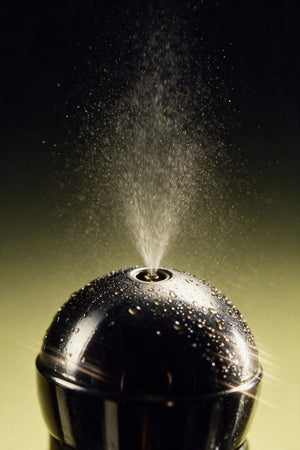
A hair perfume, or hair mist, is a fragrance spray made for the hair. The ingredient lists of four hair mists all begin with denatured alcohol, with water second on three. The fragrance industry's safety rules treat it as a hair product, not as a perfume.
What is hair perfume?
A hair perfume, or hair mist, is a fragrance spray made to be worn in the hair. The ingredient lists of four hair mists all begin with denatured alcohol, and water comes second on three of them. Small amounts of conditioning ingredients, such as panthenol or argan oil, follow the fragrance. In the fragrance industry's safety rules it is a hair product, with its own limits, and not a fine fragrance.
In May 1795 the British government put a tax on powdered heads. Anyone who wore hair powder owed one guinea for a stamped certificate, and after a month a penalty of twenty pounds for wearing powder without one. A family with "more than Two unmarried Daughters" had to take a double certificate. The powder was starch or flour, and perfumers scented it: violet, rose, ambergris, musk and civet.
The bottle sold today as hair perfume is the latest answer to a very old habit. Hair has been scented with powder, with oil, with smoke and now with a mist, and the chemistry of why it works was measured in 1983.
What is a hair mist made of?
Alcohol first. The ingredient lists of four hair mists from four makers agree. European law requires such a list to run "in descending order of weight," and lets ingredients below 1% follow in any order.
| Hair mist | First | Second | Third | Then |
|---|---|---|---|---|
| A, with honey | Alcohol denat. | Water | Fragrance | A solubiliser, honey, argan oil |
| B, with orris | Alcohol denat. | Water | Fragrance | An emollient, iris root extract, panthenol |
| C, with lavender | Alcohol denat. | Water | Propylene glycol | Fragrance, emollients |
| D, with rose | Alcohol denat. | Soaps of palm oil | Soaps of palm kernel oil | Water, fragrance, glycerin, almond oil |
The order gives no percentage, and none is printed in the lists. It does answer one question. One maker's guide describes hair perfume as "generally water-based," with "just a trace amount of alcohol." On the four lists, alcohol comes first. What separates these bottles from a perfume is what follows the fragrance: a little honey, a little oil, a provitamin, the ingredients of a hair-care label added to the formula of a light scent. The body mist is built the same way.
Hair perfume vs perfume: the real difference is in the rules
A hair perfume is not a weaker perfume. It is a perfume held to other limits. IFRA, the association of the fragrance industry, sorts every scented product into categories by where it touches the body, and sets a ceiling for each restricted material in each category. Fine fragrance is in category 4. Leave-on hair products, "hair sprays of all types," are in category 7B.
| Material, rule | In perfume | In a leave-on hair spray |
|---|---|---|
| Longifolene, IFRA example | 1.5% | 3.1% |
| OTNE, IFRA example | 20% | 0.67% |
| Methyl salicylate, European regulation of 2023 | 0.6% in alcohol-based fragrances | 0.009% |
| Fragrance allergens to be named on the label, European regulation of 2023 | Above 0.001% | Above 0.001% |
The ceilings do not all move the same way. One material is allowed at twice the dose in hair. Another, sold as Iso E Super, at a thirtieth. A product sold for both uses is caught by the stricter figure: in IFRA's words, for "a fine fragrance & hair mist it would be necessary to apply the more restrictive of the two different categories." The journal has the longer history of these rules in IFRA.
Does hair hold perfume?
It does, and by a mechanism simple enough to fit in a sentence of 1983. Two researchers treated human hair with a shampoo solution carrying seven fragrance materials and measured what stayed. The hair took up between 0.13 and 0.72 milligrams of material for each gram of hair. After 24 hours of drying in air, 0.01 to 0.08 milligrams remained. "The mechanism appears to be a simple partitioning of the organic molecules between the water phase and keratin, the effect being wholly reversible as the molecules evaporate when left in air."
The state of the hair changes the result. A study of 2018 found that "the more bleached the hair, the higher is the amount of sorbed substances during shampoo washing," and that damaged hair then loses its scent faster. Both studies used shampoo. No study measures an alcohol mist on hair, or compares hair with skin.
Are hair perfumes good for your hair, and does alcohol dry it?
Neither claim has a trial behind it. The makers' pages say that ordinary perfume dries the hair and that their mists do not. The four lists above show mists that are themselves alcohol first. The oils, the honey and the provitamin are on the label and are small: on every list they come after the fragrance.
Two centuries of powder, and a tax
The perfumer Eugene Rimmel dates hair powder to "the end of the sixteenth century" and gives the fashion "about two centuries." At its height the quantities were military. A writer of 1866 reckoned that each soldier used "fully a pound of flour per week," which for the army came to "6,500 tons per annum."
The scent was a trade in itself. A London perfumer's guide of 1822 gives the recipe.
| Lillie's guide, 1822 | Recipe |
|---|---|
| Ambergris, musk and civet, or violet hair powder | 12 pounds of starch powder to 3 pounds of the perfume, sifted twice |
| Rose perfume for hair powder | 2 pecks of fresh damask rose petals layered with 16 pounds of hair powder in a wooden box |
| Pulvill | Powdered moss of apple trees, grey ambergris, 30 grains of musk, 20 grains of civet |
| Keeping | Good for "upwards of seven years, if closely stopped" |
One part of perfume to four of starch. After the powder came the oils. Piesse, in 1857, lists the huiles antiques, flower oils on a base of olive or ben oil, and a Parisian unguent of wax and flower oils called Philocome, "a friend to the hair." He also records what a bad one did: a hair dressing made with sperm oil "renders the head scurfy; indeed, the crystals of sperm may be combed out of the hair in flakes."
Scenting hair with smoke
Another method needs no bottle. Qatar's tourism office describes it as hospitality: "it's a traditional gesture to pass bukhoor among guests, so they can scent their hair, clothing and hands." Rimmel found the oil in India, where women "anoint it with perfumed oil," and the Romans, he writes, applied their perfumes to the hair and "to the whole of the body, even to the soles of their feet." The journal follows the smoke in bakhoor.
Frequently Asked Questions
What is a hair mist?
A hair mist is the same product as a hair perfume: a light fragrance spray for the hair. In the ingredient lists of four hair mists the first ingredient is denatured alcohol, followed on three of them by water, then fragrance and small amounts of ingredients such as panthenol, honey or argan oil.
Are hair perfumes good for your hair?
No study measures a benefit. Makers point to conditioning ingredients such as oils and panthenol, which come after the fragrance on the ingredient lists, so in small amounts. The one measured effect concerns scent: bleached hair takes up more fragrance than untreated hair and loses it faster.
Can you spray regular perfume in your hair?
People do, and the claim that it dries the hair has no trial behind it in either direction. The four hair mists checked are themselves alcohol first. The difference that is documented lies in the rules: the fragrance industry sets other limits for leave-on hair products than for fine fragrance.
Does hair perfume have alcohol?
The four hair mists checked do, as their first ingredient, ahead of water. European law requires ingredients to be listed in descending order of weight, so alcohol is the largest single ingredient in each. Alcohol-free mists are also sold: one European house describes its hair and body mists that way.
How long does hair perfume last?
In a study of 1983, hair washed in a scented solution took up 0.13 to 0.72 milligrams of fragrance material per gram and kept 0.01 to 0.08 after 24 hours in air. The scent is held by the keratin and leaves by evaporation.
What are the downsides of using hair perfume?
No study measures a downside. The regulated concern is allergens: a 2023 European regulation requires fragrance allergens above 0.001% in a leave-on product to be named on the label. The industry's own rules also set some limits lower for hair sprays than for perfume.
Is hair perfume regulated differently from perfume?
Yes, by the fragrance industry's standards. Fine fragrance is in IFRA's category 4 and leave-on hair products in category 7B, with different ceilings for restricted materials, and a product sold for both uses takes the stricter one. European law sets methyl salicylate at 0.6% in alcohol-based fragrances and 0.009% in leave-on hair sprays.
Did people perfume their hair in the past?
For centuries. A London guide of 1822 scents hair powder at three pounds of perfume to twelve of starch, in violet, rose, ambergris or musk and civet. Britain taxed the wearing of hair powder at one guinea in 1795. In Qatar, guests are still offered incense smoke for their hair.
Sources
- The London Gazette, 1795, issue 13780, page 503, and issue 13795, page 733: notices of the Stamp Office on the duty on hair powder certificates.
- Charles Lillie, The British Perfumer, Snuff-Manufacturer, and Colourman's Guide, London, 1822, pages 169 to 179. Read in full text at the Internet Archive.
- G. W. Septimus Piesse, The Art of Perfumery, 1857, pages 38 to 39, 221 and 223 to 224. Eugene Rimmel, The Book of Perfumes, London, 1865, pages 109, 158 to 160 and 208 to 209. Arnold J. Cooley, The Toilet and Cosmetic Arts in Ancient and Modern Times, London, 1866, pages 73 to 74.
- J. M. Blakeway and M. Seu-Salerno, "Substantivity of perfume materials to hair", International Journal of Cosmetic Science 5(1), 15 to 23, 1983. DOI 10.1111/j.1468-2494.1983.tb00600.x.
- A. Medice and others, "Fragrance Retention in Virgin and Bleached Caucasian Hair", Journal of Cosmetic Science 69(5), 363 to 370, 2018.
- IFRA and RIFM, Guidance for the Use of IFRA Standards, 51st Amendment, 30 June 2023: table of categories and the example of category 4 against category 7B.
- Commission Regulation (EU) 2023/1545 of 26 July 2023, recitals 5 to 7 and annex entry 324. Regulation (EC) No 1223/2009, article 19(1)(g).
- Ingredient lists of four hair mists as recorded by the INCIDecoder database. Gisou, "What Is Hair Perfume + How Do You Use It?", for the guide quoted. Rituals, on its hair and body mists. Read on 19 November 2026.
- Visit Qatar, "Bukhoor". Read on 19 November 2026.
Nuit Élastique
Extrait de parfum at 20%. 8 notes, including magnolia, black olive and green olive.
Read also
3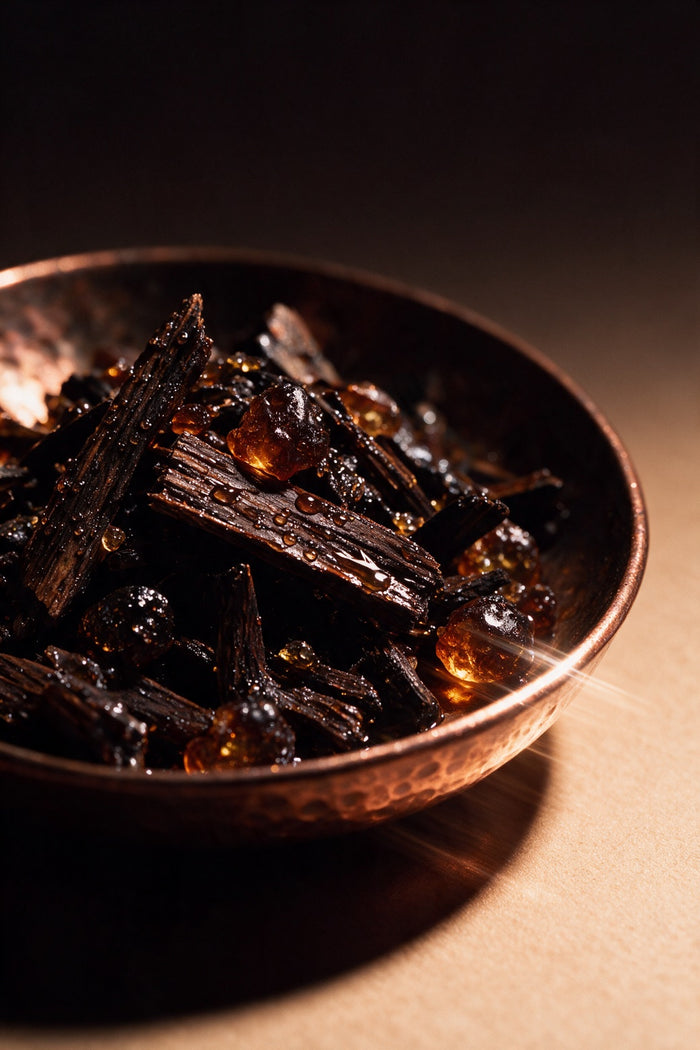
Bakhoor: The Ancient Scenting Ritual The West Forgot
The sources call it smouldering, and the oldest English eyewitness saw its smoke wafted to the face and beard. What bakhoor is made of, how it was used in Cairo and in Qatar, what the studies of its smoke report, and ...

Where to Spray Cologne and How to Apply It
The two-spray rule is in no paper, standard or perfumer's text we read. What is measured: the neck is the warmest of 15 skin regions, and the wrist was not tested. What is only claimed: the rest.
IFRA, or How Bureaucracy Erased a Century of Perfumery
In 1917, Francois Coty composed a fragrance that would define an entire family for the next century.
Next
Perfumery Journal
Bakhoor: The Ancient Scenting Ritual The West Forgot
14.09.25