


Santal: The French Word That Names a Wood, a Note and a Molecule
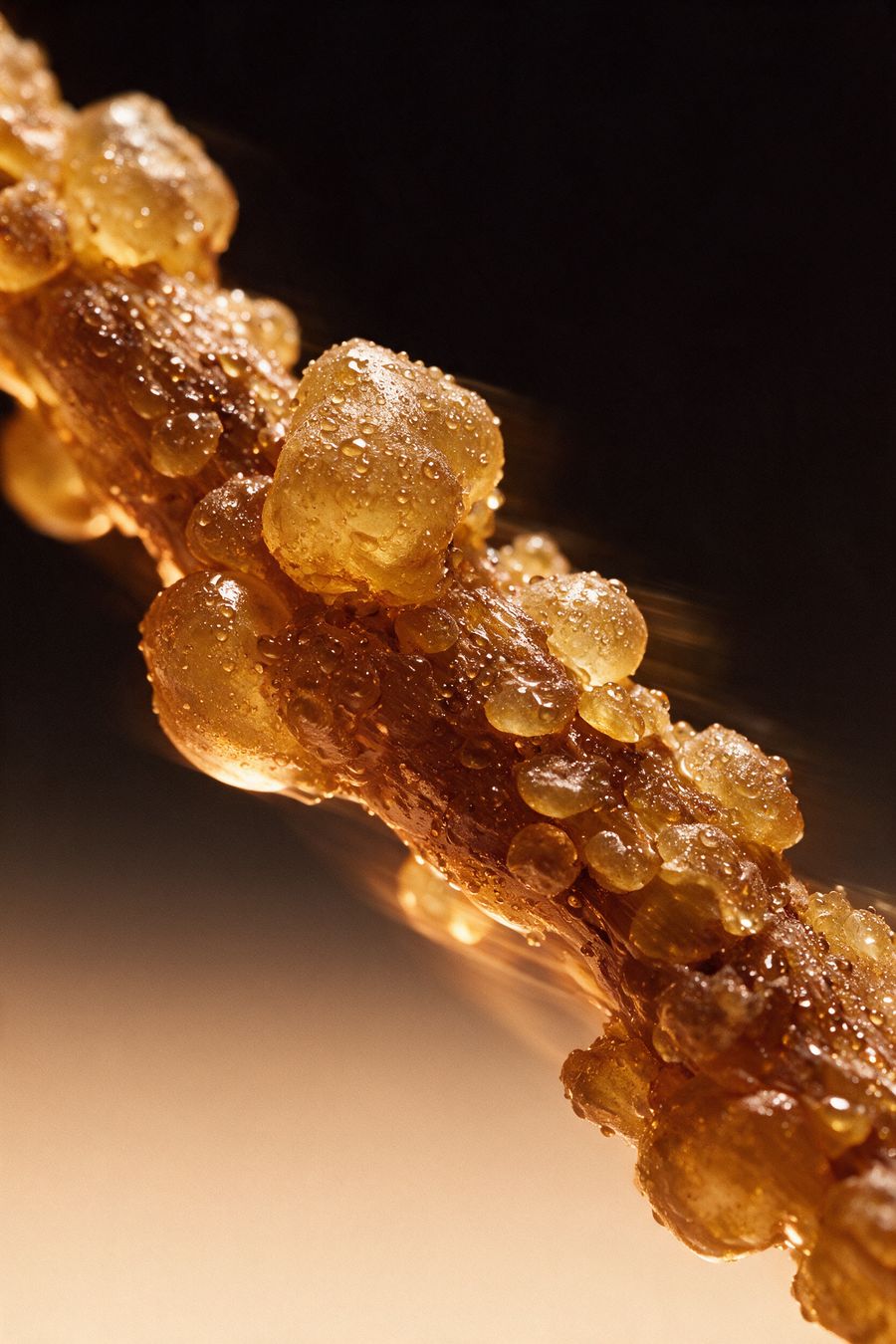
Santal is the French word for sandalwood, from Low Latin santalum, Arabic sandal and Sanskrit chandana; French printed le Santal by 1554. On a perfume label it names the sandalwood note, which may come from the oil of Santalum trees or from synthetic molecules such as Sandalore, Polysantol, Ebanol and Javanol.
What is santal?
Santal is the French word for sandalwood, the scented heartwood of Santalum trees. On a perfume label it names the sandalwood note, which can come from the oil of the wood or from synthetic molecules made to smell like it. The word reached French from Sanskrit chandana, by way of Arabic, Greek and Latin.
On Google's first page for "santal", nearly every result is a bottle, a candle or a shop. The one encyclopedia entry on the page is about the Santal people of India, another subject entirely. The shops lean on a word they rarely explain. A trade database of perfume notes files "santal" as one of the names of sandalwood, and marks the note "natural or synthetic." Both halves of that answer have a history.
Santal meaning: from chandana to santal
Henry Yule and Arthur Burnell traced the word in Hobson-Jobson, their dictionary of Anglo-Indian words, in 1886. Sandal comes from the Low Latin santalum, which came through Greek from the Arabic sandal, "and that from Skt. chandana." The dictionary also prints the earliest witnesses it found, and they show the word travelling with the wood.
How French came to say santal
Garcia da Orta, writing in Goa in 1563, gave the trade's own version: "The Sandal grows about Timor, which produces the largest quantity, and it is called chundana; and by this name it is known in all the regions about Malaca; and the Arabs, being those who carried on the trade of those parts, corrupted the word and called it sandal." The French form was printed by then. The old French version of Matthioli, quoted by Yule from 1554, opens on "Le Santal," counts three kinds of it, and ranks them: "le plus pasle est le meilleur," the palest is the best, the white next, and the red last, because it has no smell.
| Date | The word | Where, as quoted in Hobson-Jobson |
|---|---|---|
| About 545 | Sandal-wood among "the imports to Taprobane" | Cosmas, on the trade of Taprobane, Sri Lanka |
| About 1390 | Saunders, a colouring for rice boiled in almond milk | An English recipe; the colouring wood of medieval cookery, by the authorities Yule cites |
| 1554 | Le Santal, in three kinds | The French version of Matthioli |
| 1563 | Chundana, made sandal by the Arab traders | Garcia da Orta, Goa |
| 1753 | Santalum album | Linnaeus, Species Plantarum, as recorded by IPNI |
French still names the tree with the word. GBIF records "santal blanc," "santal des Indes," "santal indien" and "bois de santal" for Santalum album.
White, yellow and red santal
The three kinds of Matthioli were known to every apothecary. "Three woods bearing the name santalum, white, yellow, and red, were in officinal use in the Middle Ages," write Yule and Burnell. The white and the yellow were the fragrant wood. The red was usually another tree: the name had long been given "to the wood of Pterocarpus santalina, L., a tree of S. India, the wood of which is inodorous." Yule adds that it was exported as a dye wood and that, by Hanbury and Flückiger, it was "so much used in the cookery of the Middle Ages for colouring sauces." He also leaves a doubt: "It is possible that sometimes the one and sometimes the other was meant."
1813: the deeper the colour, the higher the perfume
The merchants had their own reading of the colours. In 1813 William Milburn described the trade in his Oriental Commerce. The felled logs were buried "in a dry place for two months, during which period the white ants will eat the outer wood without touching the sandal." Then the wood was sorted. "The deeper the colour, the higher is the perfume; and hence the merchants sometimes divide sandal into red, yellow, and white; but these are all different shades of the same colour."
What does santal smell like?
It smells like the oil of the wood, and the wood differs by species. Our glossary describes Santalum album oil as "clean and substantive, with a milky, creamy, mellow woody note." The oil of the Western Australian species, Santalum spicatum, is described "with the words dry, soft woody, balsam, sweet, myrrh and creamy," and by another account as "milky and creamy with a peppery top note, and a dry wood effect with a touch of green and metallic." Scento's record for the note reads: "Creamy, milky and softly sweet wood, smooth as polished timber."
| Sandalwood oil, scent over time | What our glossary records |
|---|---|
| Immediately | "Soft, creamy warmth arriving without fanfare" |
| After a few hours | "The creaminess thickens. A buttery, nearly edible sweetness surfaces" |
| After a few days | On fabric, a dry, warm, sweet-woody residue |
| Tenacity | "400 hours for undiluted Santalum album oil" |
Two molecules make up much of the oil, alpha-santalol and beta-santalol. The Good Scents records describe the first as "woody, sandalwood" and the second simply as woody, and the Leffingwell records give beta-santalol "animal, woody." How much of each a good oil should hold, and how often the bottles fall short, is told in sandalwood: the tree and its oil.
Santal on a label: the wood or the molecule
The word on a bottle does not say which. Perfumers have a family of synthetic molecules built to smell of sandalwood, and our glossary keeps an entry for each. A 2013 report in Perfumer & Flavorist dates their discovery.
| Molecule | CAS | Discovered | What our glossary records |
|---|---|---|---|
| Sandalore | 65113-99-7 | 1976 | "a rich, warm, natural sandalwood character" |
| Polysantol | 107898-54-4 | 1984 | "sandalwood with musk and cedarwood aspects"; "not found in nature" |
| Ebanol | 67801-20-1 | 1986 | "musky, leathery and fruity nuances" |
| Javanol | 198404-98-7 | 2000 | "a rich, natural, creamy sandalwood with some rosy nuances" |
What a bottle called sandalwood oil may hold
A test of six oils sold as sandalwood oil, published in Molecules in 2021, shows how far a name can drift. One sample held the two santalols of Santalum album. Three were dominated by the oil of another tree, amyris. One was mostly benzyl benzoate, and one was a mix of "synthetic alcohols, such as javanol, polysantol and ebanol." In the authors' words, "The product label only gave correct information in three cases."
The trees called santal
Linnaeus named the Indian tree Santalum album in 1753. Western Australia has its own species, Santalum spicatum, and Hawaii has others, among them Santalum paniculatum and Santalum freycinetianum. Both of the main perfume species are rated Vulnerable on the IUCN Red List. Where Santalum album is native is disputed: Kew's checklist lists India among the places where it was introduced, while the Catalogue of Life gives its Indian states without that mark and marks Java and the Lesser Sunda Islands instead.
| Tree | Where the checklists place it | Note |
|---|---|---|
| Santalum album, Indian sandalwood | India, Sri Lanka, Indonesia and northern Australia, native range disputed | Vulnerable on the IUCN Red List |
| Santalum spicatum, Australian sandalwood | Western Australia | Vulnerable on the IUCN Red List |
| Santalum paniculatum, a Hawaiian sandalwood | Hawaii | |
| Pterocarpus santalinus, red sanders | Southern India, by Yule | Not a Santalum; "inodorous" by Yule |
Other woods with their own long histories, agarwood among them, are told in agarwood and in the Ranjatai.
Frequently Asked Questions
What does santal mean?
Santal is the French word for sandalwood. Hobson-Jobson, the dictionary of 1886, derives the English sandal from Low Latin santalum, which came through Greek from the Arabic sandal and from the Sanskrit chandana. A French version of Matthioli printed le Santal by 1554, and French still says santal blanc and bois de santal.
Is santal the same as sandalwood?
Yes, as a word: santal is the French name of sandalwood, and a trade database of perfume notes files santal as one of the names of the sandalwood note. As a material, a perfume called santal may use the oil of Santalum trees, synthetic sandalwood molecules, or both. The name alone does not say which.
What does santal smell like?
It smells of sandalwood. Our glossary describes Indian sandalwood oil as clean and substantive, with a milky, creamy, mellow woody note, and Australian oil as drier, balsamic and creamy. Scento calls the note creamy, milky and softly sweet wood. Alpha-santalol, its main molecule, is recorded as woody and sandalwood.
Is santal natural or synthetic?
Either. Scento marks the sandalwood note natural or synthetic, and perfumers have synthetic sandalwood molecules discovered between 1976 and 2000, among them Sandalore, Polysantol, Ebanol and Javanol. In a 2021 test of six oils sold as sandalwood oil, only one held the two santalols of Santalum album.
What is red sandalwood?
Red sandalwood, or red sanders, is mostly the wood of Pterocarpus santalinus, a tree of southern India that Hobson-Jobson calls inodorous: it has no scent. It was a dye wood, used in medieval cookery for colouring sauces. The fragrant sandalwood is Santalum album and its relatives, which are different trees.
Where does santal come from?
From Santalum trees: Santalum album, the Indian sandalwood, whose native range Kew's checklist and the Catalogue of Life read differently; Santalum spicatum of Western Australia; and Hawaiian species such as Santalum paniculatum. Both main perfume species are rated Vulnerable on the IUCN Red List.
Why did merchants sort sandalwood by colour?
Because colour told them the perfume. In 1813 William Milburn wrote that the buried logs were sorted into three kinds and that the deeper the colour, the higher the perfume, so merchants divided sandal into red, yellow and white, though these were all shades of the same colour.
What are the synthetic sandalwood molecules?
The best known are Sandalore, discovered in 1976, Polysantol in 1984, Ebanol in 1986 and Javanol in 2000, by a 2013 report in Perfumer and Flavorist. Our glossary describes Javanol as a rich, creamy sandalwood with rosy nuances and Ebanol as sandalwood-like with musky, leathery and fruity nuances.
Sources
- H. Yule and A. C. Burnell, Hobson-Jobson: a glossary of Anglo-Indian colloquial words and phrases, London, 1886, entry Sandal, with its quotations of Cosmas, the recipe of about 1390, Matthioli (1554), Garcia da Orta (1563) and Milburn (1813). Read in full text at the Internet Archive.
- IPNI, Santalum album L., Species Plantarum 1: 349, 1753. GBIF, Santalum album and Santalum spicatum, common names and IUCN Red List categories. Kew, World Checklist of Vascular Plants, and the Catalogue of Life, distributions.
- M. Kucharska and others, "A Comparison of the Composition of Selected Commercial Sandalwood Oils with the International Standard", Molecules 26(8), 2249, 2021. DOI 10.3390/molecules26082249.
- "Sandalwood Notes in Perfumery", Perfumer & Flavorist 38(5), 2013, timeline of the synthetic sandalwood notes.
- PREMIEREPEAU glossary, entries sandalwood, Sandalore, Polysantol, Ebanol and Javanol. Scento, note sandalwood. Good Scents and Leffingwell records for alpha- and beta-santalol, through the Pyrfume data.
- Google's first page for the word "santal" in the United States, read on 19 November 2026.

Simili Mirage
Extrait de parfum at 20%. 8 notes, including olibanum, thyme and white thyme.
Read also
3
Sandalwood: The Tree That Takes Thirty Years to Smell
A tree in the forests of southern India that spends the first three decades of its life in a state of quiet accumulation. Its bark is unremarkable.
Hinoki: The Japanese Cypress Behind the Temple Wood Smell
Hinoki is the cypress of Japanese temples and baths, famous for a lemony, green wood smell. Its name is often read as fire tree, a reading a garden source calls probably incorrect.

The Ranjatai: A Piece of Wood Cut Eleven Times in Twelve Hundred Years
In the Shosoin Repository, a wooden storehouse raised on stilts behind the Great Buddha Hall of Todai-ji temple in Nara, Japan, there is a log of aromatic wood. It is approximately 1.5 meters long and 37 centimeters i...
Next
Perfumery Journal
Sandalwood: The Tree That Takes Thirty Years to Smell
05.01.26








