


Solid Perfume: Wax, Oil and a Myth From Egypt
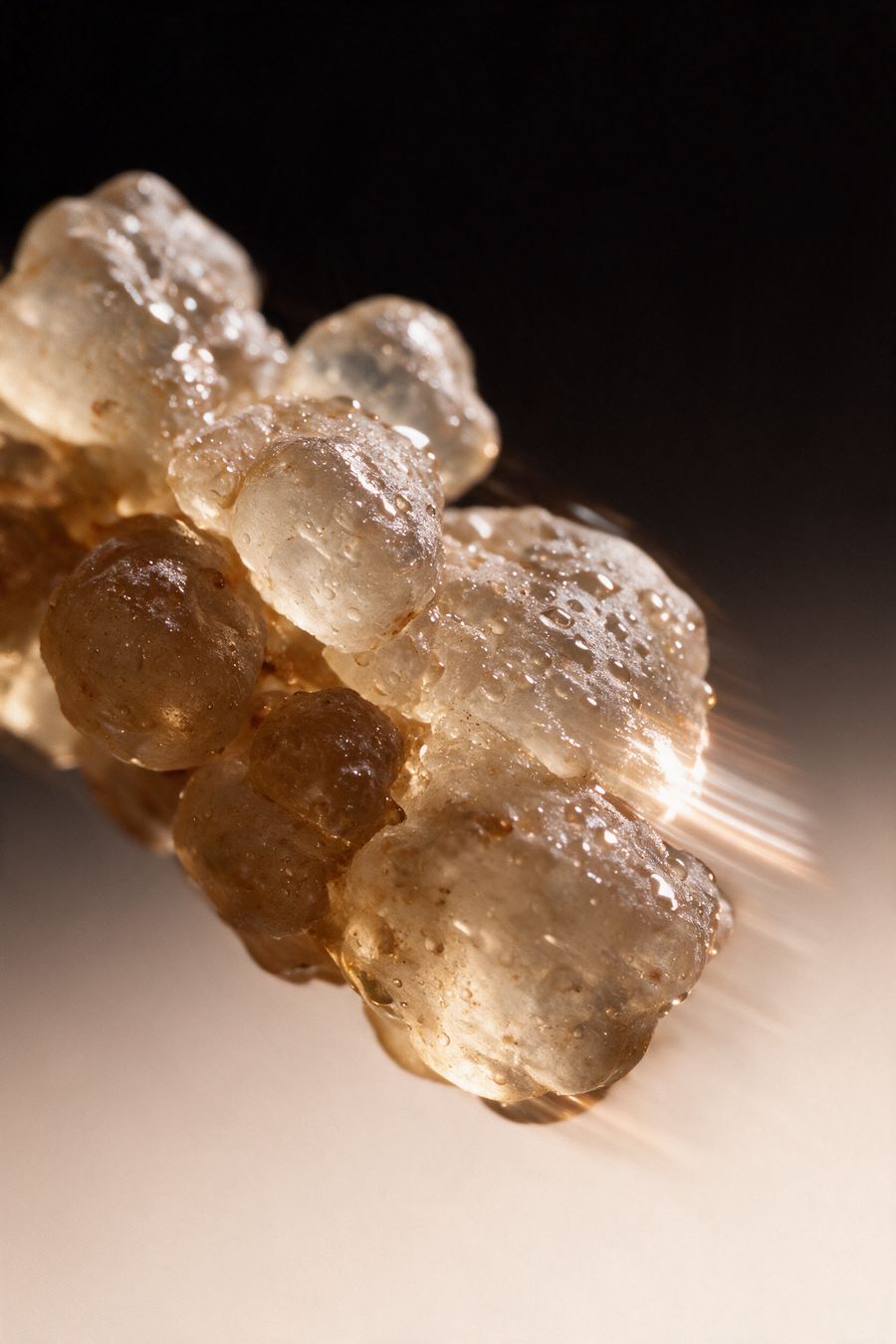
Solid perfume is fragrance set in a wax and oil base, most often beeswax, rubbed on the skin from a tin or a tube. The first dated recipe we found is an 1863 paraffin cake. Egyptian melting cones are not shown: the first real ones, found in 2019, are wax from burials. Published recipes differ eightfold on the wax share.
What is solid perfume?
Solid perfume is fragrance set in a wax and oil base, most often beeswax, so that it can be rubbed on the skin from a tin or a tube instead of sprayed. The wax gives it body, a liquid oil keeps it soft, and the scent is mixed in while the base is warm. The oldest printed recipe we found is from 1863, and it used paraffin.
The story most pages tell about solid perfume begins in Egypt, with guests at a banquet wearing cones of scented fat that melted down over their wigs. It is a good image. It is also an image for which no physical object existed until 2019, and the first objects found do not read as melting perfume at all.
Did the ancient Egyptians wear melting cones of solid perfume?
An article in the Journal of the Society of Cosmetic Chemists on the cosmetic arts of ancient Egypt states the belief as a fact. The cone of ointment was placed on the head, and at the festivities "from the warmth of the body it melted and ran down not only on his elaborate wig but even upon his garments." The same page concludes that the purpose of the cone was probably scent.
The record is thinner. Tomb paintings do show people with cones on their heads, but for a long time nobody had held one. National Geographic reported in December 2019 that "No archaeologist had ever excavated one of the enigmatic objects," which led some scholars to read the cones as purely symbolic. Lise Manniche, an Egyptologist writing in the UCLA Encyclopedia of Egyptology, had already read the banquet scenes as probably "an indication from the artist that the guests were heavily perfumed with otherwise invisible scent."
Then came Amarna. Anna Stevens and three colleagues published the first physical head cones in the journal Antiquity on 10 December 2019. They came from excavated cemeteries at Amarna, and they were wax. The abstract says that "Spectroscopic analyses indicate that their primary constituent is a biological wax, and not fat or incense, as sometimes speculated." The authors "tentatively suggest" that the cones were symbols meant to enhance the rebirth or personal fertility of the dead in the afterlife.
| What is claimed | What the sources show |
|---|---|
| Guests wore cones of scented fat that melted on the head | Painted cones are real. Manniche reads them as probably the artist's sign of heavy, invisible scent |
| The cones are known from finds | None had been excavated before the 2019 Amarna publication |
| The cones were fat or incense | The first ones are mainly a biological wax, according to the spectroscopy |
| They were worn at banquets and melted | The Amarna cones come from burials, and the authors read them tentatively as symbols of rebirth. Whether the living wore melting cones is not shown |
The honest summary is that it is not shown, which is weaker than refuted. What the record does document is a scented fat. Manniche writes that "Perfume in Egypt was fat-based," with frankincense, myrrh, cinnamon, cassia and cardamom the ingredients most often named in texts. Her list of bases includes fat of ox, sheep or fowl for a more solid unguent, beside liquid oils. That is a fair ancestor of a solid perfume. A wearer's cone that melts is not part of it.
The fat has a reason. The cosmetic chemists' article says that, lacking alcohol, "the next best vehicle for initially absorbing and carrying a scent is fat or oil."
Who made solid perfume first? The 1863 paraffin cake
The earliest known printed claim is not Egyptian and not a balm. M. Young, a New York publisher of recipe books, wrote in his Great Book of Secrets that the firm introduced a "Solidified Perfume" in 1863. The copy quoted was entered for copyright in 1878. It says: "Although we introduced it in 1863, we have not manufactured it continually during that time."
The recipe sells itself as a trade. Young tells the buyer to "Procure A 1 Paraffine wax from any wholesale druggist," melt it over a slow fire, and stir in a mixture of two ounces of oil of lemon grass, half an ounce of oil of cloves and a quarter ounce of oil of lavender flowers. The scented wax is poured about a quarter inch deep into oiled pie pans and stamped into square cakes, which go into gilt boxes. Young prices them: "They are worth 15 to 25 cents retail."
The wax must not be hot when the oils go in. In Young's words, "The heat drives out the perfume."
This is a seller's claim in a book that sells the recipe, and no earlier printed use is known. The date is the firm's own. What it does show is that the first dated solid perfume on record was a paraffin cake in a box, not a beeswax balm in a locket.
How to make solid perfume
Two modern recipes, from two sites that rank for the question, give the same method. Melt the wax into the oil, take it off the heat, let it cool a few minutes, stir in the scent, and pour it into a tin or a tube. One of them, a blog of an herb supplier, puts it plainly: "In a double boiler, melt the beeswax pastilles into your carrier oil mix." The other, a perfume-making blog, adds that the result is ready at once but "solid perfumes tend to smell amazing after they have sat untouched for a week." That is a maker's observation, not a measurement.
The same blog gives a way to divide the scent. For 40 drops of essential oil it uses 2 parts base, 1 part heart and 1 part head, which is 20, 10 and 10 drops. It also says what to do when the batch fails: "If your perfume comes out mushy that means you might not have added enough beeswax." For the same melted-and-scented logic in a spirit base, see how to make perfume.
The two recipes do not agree on how much wax goes with the oil.
| Recipe | Wax | Oil | Wax to oil by volume | Scent |
|---|---|---|---|---|
| Herb supplier's blog | 2 tablespoons of beeswax pastilles, about 0.6 oz | Half a cup of sunflower oil | 1 to 4 | 80 to 120 drops of essential oil and a quarter teaspoon of vitamin E, for about 5 oz |
| Perfume-making blog | 1 tablespoon of beeswax | 1.5 teaspoons of jojoba or sweet almond oil | 2 to 1 | 40 drops of essential oil |
| Young, New York, 1863 recipe in the book of 1878 | Hard paraffin wax, about four quarts | None added | Wax only | 2 oz lemon grass oil, half an oz clove oil, a quarter oz lavender oil |
The ratios in the third column are our arithmetic from the quantities printed. Half a cup is 8 tablespoons, so two of wax against eight of oil is 1 to 4. One tablespoon is 3 teaspoons, so three of wax against 1.5 of oil is 2 to 1. The second recipe holds eight times the wax share of the first. Both are published as working recipes, which tells you that no standard ratio exists, only a choice between a soft balm and a hard stick. The second blog says a mushy result means too little beeswax, so the wax share sets how firm the balm is.
Nothing in the pages read gives a shelf life or a way to store the finished tin. For perfume in general, see how to store perfume.
What is solid perfume made of?
A wax, a liquid oil and scent. A 2026 review in the International Journal of Molecular Sciences describes it as "a lipid-based matrix composed of over 300 constituents, including wax esters, hydrocarbons, and free fatty acids." The same review flags "paraffin adulteration and pesticide contamination" as quality concerns for beeswax. Paraffin is what Young poured in 1863.
The recipes name jojoba, sweet almond and sunflower. A 2026 oxidation study of four pure oils found that jojoba had the longest induction period at 373 K, followed by olive, sunflower and rosehip. It tested the oils alone, not a perfumed solid.
Beeswax is itself a perfumery material. Our glossary describes its absolute as "sweet and honeyed, with balsamic, waxy, hay, tobacco and spice notes." That is the absolute, described on our beeswax absolute page, not the pale wax melted into a tin.
The European Commission's CosIng database, which lists cosmetic ingredients, carries beeswax under two names, BEESWAX and CERA ALBA, with functions that include binding, viscosity controlling, fragrance and, for CERA ALBA, perfuming. It lists jojoba oil, as SIMMONDSIA CHINENSIS SEED OIL, with skin and hair conditioning functions. These are listings of what the ingredients are used for, and they are not a safety verdict.
How to apply solid perfume
Glamour, which tested about a dozen in February 2026, reports that "Every fragrance pro recommends applying a solid perfume by warming it up with your fingertips and then rubbing it onto the pulse points." It names the wrists, the neck and the inner elbow. The same piece quotes the chief executive of a perfume house on carrying the matching solid through the day to revive a morning eau de parfum "as needed, always with discretion."
Layering is the other use. A fragrance founder quoted by Glamour applies the solid first and sprays on top: "The solid anchors the scent to the skin, while the spray adds lift and diffusion." That is an expert's opinion and no measurement stands behind it. For the spray half of the pair, see how to apply cologne, and for the choice between the two formats, our article on perfume oil against spray.
Do solid perfumes work? The disadvantages
They work as a scent that stays close. The same founder says solids "remain present, subtle, and consistent throughout the day," a "slow, intimate wear rather than a dramatic one." The same article is less kind. Glamour's own line is that "Unlike sprays, solid perfumes don’t have as much coverage, so it may be limiting." A perfumer it quotes puts the reason simply: people who spray walk through the mist for even coverage on hair and clothes. A solid has no mist, so the sillage is smaller, and that is what we would expect from a rubbed-on base. It is an inference, not a measurement.
Two of the seven picks come with the same complaint. One review says "you do really have to rub on a lot to get a decent scent." Another says that "you really have to rub in a lot to get a significant fragrance on you." The budget pick is listed with "Thicker texture can be messier; tube is hard to pack away; not as long-lasting as others." Those are one editor's experiences.
How long does it last? No measured duration is on record. The only wear test printed is the editor's: she applied each solid every morning for a couple of days and sniffed her pulse points every hour. No hours are reported for any product. An herb supplier's blog says that the texture of solid perfumes "also helps them stay on the skin longer," with no duration given. Longer wear is a claim, and no test turns it into a finding.
Many pages add that solid perfume is gentle because it has no alcohol. Glamour's wording is "Many solid perfumes are made of natural ingredients and don’t contain alcohol," listed under sensitive skin. No regulator, review or standard stands behind that sentence, so it is a claim. For how concentration is measured in the sprayed kind, see perfume concentration levels.
How much does solid perfume cost?
In February 2026 the seven picks of that test cost from 18 to 76 US dollars each. They are small. The tubes and tins hold 0.11 to 0.3 ounces, so a dollar price per ounce shows the gap better than the sticker. The products are not named here. The labels are Glamour's own.
| Glamour's label | Size (oz) | Price (USD) | Price per oz (USD) |
|---|---|---|---|
| Best budget | 0.3 | 18 | 60 |
| Best overall | 0.24 | 42 | 175 |
| Best warm, a jelly balm | 0.14 | 26 | 186 |
| Best fresh scent | 0.2 | 65 | 325 |
| Best skin scent | 0.11 | 35 | 318 |
| Best long-lasting | 0.11 | 68 | 618 |
| Best musk, refillable | 0.11 | 76 | 691 |
Glamour's article gives the sizes and prices. The price per ounce is our arithmetic, rounded to the dollar, and the dearest runs above eleven times the cheapest. In 1863 the cake in a gilt box sold for 15 to 25 cents, by the seller's own figure. The cost of making your own is left out.
Can you take solid perfume on a plane?
The US Transportation Security Administration's rule covers "liquids, aerosols, gels, creams and pastes" in carry-on bags, limited to containers of 3.4 ounces, or 100 milliliters, or less per item. The page adds that "Any liquid, aerosol, gel, cream or paste that alarms during screening will require additional screening." It does not name solid perfume, and it does not say solids are exempt.
The seven tubes in the test above hold 0.11 to 0.3 ounces, far under the size limit. Glamour lists freedom from the liquids rule among the benefits of solids. What that means at a checkpoint for a soft balm that a screener might read as a paste is not stated on the page. Other countries have their own rules.
Frequently Asked Questions
How to make solid perfume?
Melt beeswax into a carrier oil in a double boiler, let it cool a few minutes, stir in the essential oils and pour it into a tin. Published recipes disagree on the ratio: one blog uses 2 tablespoons of beeswax pastilles to half a cup of oil, another 1 tablespoon to 1.5 teaspoons.
Do solid perfumes work?
They work as a scent that stays close to the skin. Glamour's 2026 tester found two of her seven picks needed heavy application, and her article says solids do not have as much coverage as sprays. No measured wear time is on record, so longer wear stays a claim.
What are the disadvantages of solid perfume?
Less coverage than a spray, in Glamour's words. Two of its seven picks needed heavy rubbing, and the budget pick was listed as messier and not as long-lasting. The tubes are small, 0.11 to 0.3 oz, so the price per ounce runs from $60 to $691 in that test.
What is the formula for solid perfume?
A wax, a liquid oil and scent. One blog uses half a cup of sunflower oil, 2 tablespoons of beeswax pastilles, a quarter teaspoon of vitamin E and 80 to 120 drops of essential oil. Another uses 1 tablespoon of beeswax, 1.5 teaspoons of jojoba or sweet almond oil and 40 drops.
Which solid perfume is considered the best?
No measured best exists. Glamour's February 2026 test of about a dozen solids named seven picks from $18 to $76, judged by applying each every morning for a couple of days and sniffing pulse points every hour. That is one editor's opinion, not a laboratory ranking.
Is solid perfume allowed in carry-on luggage?
The TSA rule covers liquids, aerosols, gels, creams and pastes in containers of 3.4 oz (100 ml) or less, and its page does not name solid perfume. The seven tubes in Glamour's test hold 0.11 to 0.3 oz, and any such item that alarms gets additional screening.
Did the ancient Egyptians wear melting cones of solid perfume?
Not shown. Tomb paintings show cones, and Manniche reads them as probably the artist's sign of heavy scent. The first real cones, found at Amarna and published in 2019, are mainly a biological wax from burials, tentatively read as symbols of rebirth. Whether the living wore them melting is unproven.
Who made solid perfume first?
Fat-based scented unguents are documented in ancient Egypt. The first dated solid perfume we could read is a paraffin wax cake that the New York recipe publisher M. Young says he introduced in 1863, scented with lemon grass, clove and lavender oils. We found no earlier printed claim, though the record is thin.
Sources
- M. Young, M. Young's Great Book of Secrets, New York, catalogued 1878, pp. 35-36. Full text (OCR) at the Internet Archive, id myoungsgreatbook00youn. Read 19 November 2026.
- Lise Manniche, "Perfume", UCLA Encyclopedia of Egyptology, 2009. Read as a PDF.
- "The Cosmetic Arts in Ancient Egypt", Journal of the Society of Cosmetic Chemists 10(3), p. 167 (author and year not shown on the page read). library.scconline.org.
- Anna Stevens, Corina E. Rogge, Jolanda E.M.F. Bos, Gretchen R. Dabbs, "From representation to reality: ancient Egyptian wax head cones from Amarna", Antiquity 93(372), 2019. DOI 10.15184/aqy.2019.175. Abstract read; the full text is paywalled.
- Erin Blakemore, "Ancient Egyptian 'head cone mystery' solved by archaeologists", National Geographic, 11 December 2019.
- Jenifer Calle, "7 Best Solid Perfumes for Long-Lasting Scent, According to Fragrance Experts", Glamour, 25 February 2026.
- Blog of an herb supplier, "Solid Perfume Recipes (Calming & Revitalizing Blends)", blog.mountainroseherbs.com/solid-perfume. JT Siems, "How to Make Solid Perfume", Immortal Perfumes blog, immortalperfumes.com. Both read 19 November 2026.
- TSA, "Liquids, Aerosols, and Gels Rule", tsa.gov. European Commission, CosIng database, records 92344, 32492 and 58617.
- K. Huanbutta and others, "Beeswax in Pharmaceutical Sciences", International Journal of Molecular Sciences 2026, DOI 10.3390/ijms27083486. C. Fagoaga and others, "Oxidative Stability and Kinetics of Oxidation of Rosehip, Sunflower, Olive and Jojoba Oils", Antioxidants 2026, DOI 10.3390/antiox15050646. Abstracts read at Europe PMC.
- PREMIEREPEAU glossary, entry beeswax absolute (odour words only). Google's first page for "solid perfume" in the United States, read through Ahrefs on 19 November 2026.

Albâtre Sépia
Extrait de parfum at 20%. 8 notes, including incense and white truffle.
Read also
3
Perfume Oil vs Spray: The Format War
No study read measures whether oil outlasts spray. The record does hold how attar is made, what it costs, what the skin studies found and why two solid perfume recipes disagree.

How To Make Perfume: Kitchen to Lab Guide
How to make perfume is a question with two honest answers. The first: you can do it this weekend with five ingredients, a kitchen scale, and a bottle of high-proof ethanol. The second: to do it well enough that the...
Perfume Storage: Stop Ruining Your Bottles
Retail pages say well-stored perfume lasts three to five years and cite nothing. Where to keep a bottle, what the Osmothèque does, the fridge question, the EU label rules and what air does to limonene and linalool.
Next
Perfumery Journal
Where to Spray Cologne and How to Apply It
27.10.25








