Vanillin: What the Wood Pulp Story Leaves Out
Vanillin is the molecule that gives vanilla most of its smell and taste, 4-hydroxy-3-methoxybenzaldehyde. The French chemist Gobley crystallised it from vanilla pods in 1858, and it was first made from conifer sap in 1874. A 2019 review says more than 85% of world supply comes from petroleum-derived guaiacol. Wood-pulp vanillin is real and a minority.
What is vanillin?
Vanillin is the molecule that gives vanilla most of its smell and taste. Its chemical name is 4-hydroxy-3-methoxybenzaldehyde, and it is the same substance whether it comes from a vanilla pod, a clove, rice bran or oil. A French chemist crystallised it from the pods in 1858. Today most of it is made from petroleum.
Search the word and the same story comes back. A food site of 2021 wrote that "wood pulp and coal tar are key ingredients in making this" imitation vanilla. A food site of 2024 titled a section "Imitation vanilla comes from wood pulp." A vanilla extract maker wrote that "Common synthetic vanillin substrates are wood pulp." The record is narrower. Wood-pulp vanillin is real and it is the smaller share. The first synthesis, in 1874, started from conifer sap, and the sources show no coal tar route.
Is vanillin the same as vanilla?
No. Vanilla is the cured pod of an orchid and the extract made from it. Vanillin is one molecule inside it: C8H8O3, molecular weight 152.15, CAS 121-33-5, PubChem compound 1183.
A 2019 paper on bacterial vanillin describes natural vanilla as a mixture of more than 200 molecules, with vanillin present in cured pods at 1.0 to 2.0% of their weight. A pod is mostly other matter. In the green pod the vanillin is held as a glucoside, and a curing of months frees it, according to a 2019 review by Ciriminna and colleagues in ChemistryOpen.
It is not vanilla extract either. American rules define vanilla extract as "the solution in aqueous ethyl alcohol of the sapid and odorous principles extractable from vanilla beans," with at least 35% alcohol by volume. A bottle that adds vanillin must say so. It is then a vanilla-vanillin extract, it must read "contains vanillin, an artificial flavor (or flavoring)," and it may hold no more than 1 ounce of added vanillin per unit of vanilla constituent (21 CFR 169.175 and 169.180).
The Good Scents record lists the smell as sweet, vanilla, creamy and chocolate, and Leffingwell as creamy and vanilla. Our glossary describes vanillin as smelling of vanilla, "sweet, balsamic and pleasant." The first chemist to see it wrote in 1858 that it has "une odeur aromatique très-forte qui rappelle puissamment le parfum de la vanille."
Who discovered vanillin?
Gobley did, in Paris. In December 1858 he read his paper, "Recherches sur le principe odorant de la vanille," to the École and the Société de pharmacie. It appeared in the Journal de pharmacie et de chimie. He treated vanilla with alcohol and ether, took the aromatic principle into boiling water and purified the crystals with animal charcoal. They came out colourless, as long needles with four faces, and they smelled strongly of vanilla. He proposed a name for the substance, vanilline.
The paper also ends an old mistake. Pods that carry a white crust are called "vanille givrée," frosted vanilla, and the frost had been read as benzoic acid by the chemists Bucholz and then Vogel the elder. Gobley found it to be the same crystalline substance he had just isolated. He added that the best pods give far more of it than the poor grade, vanillon, though he printed no number.
| Date | What happened | Source |
|---|---|---|
| 1858 | Gobley isolates vanilline from vanilla pods and shows the frost is the same substance | Gobley, Journal de pharmacie et de chimie |
| 1861 | Hartig finds coniferin in the cambium juice of the larch | Sawer, Odorographia, 1892 |
| 1874 | Tiemann and Haarmann make vanillin from coniferin | Sawer, 1892, and a 2019 review |
| 1876 | Patents for vanillin from clove oil, in France on 18 March and in England on 20 April | Sawer, 1892 |
| 26 July 2023 | The EU adds vanillin to its list of labelled fragrance allergens, entry 346 | Regulation (EU) 2023/1545 |
The first synthesis came from pine sap, not coal
Coniferin is a glucoside found in the cambium, the living layer under the bark of conifers. Hartig first found it in 1861 in the larch, according to Sawer's Odorographia of 1892, a trade book that summarises the German papers. Sawer writes that the crust of vanilla pods was "first prepared artificially by Tiemann and Haarmann from Coniferin," which "occurs in the cambium sap of the fir-tree." They oxidised it with chromic acid. Haarmann's English patent is dated 25 February 1874.
A 2019 review gives the starting material differently, as coniferyl alcohol from pine bark. Both accounts agree on the year, on Germany and on the two chemists. They agree that the source was a conifer. The review adds that the two men founded a company at Holzminden, Haarmann's Vanillinfabrik, which by 1876 was joined by Reimer.
The claim that pages repeat today is already there. Sawer prints a statement of those years that says "The vanillin obtained and purified in either way is proved in all cases completely identical to the natural vanillin."
The route changed within two years. Sawer prints that a French patent was taken by de Laire on 18 March 1876 for vanillin from eugenol, the main constituent of clove oil, and that "A patent was taken out in England for the production of vanillin from oil of cloves by Dr. Tiemann on the 20th of April, 1876." Tiemann also tied vanillin to ferulic acid, and in Sawer's day vanillin was being prepared from asafoetida. Ferulic acid is the starting point of the natural-grade route described below.
Is vanillin made from wood pulp?
Partly, and less than the story says. Vanillin made from lignin, the wood constituent left over from pulping, exists. The Journal of Chemical Education carried a paper in 1997 titled "Vanillin: Synthetic Flavoring from Spent Sulfite Liquor," which shows the route was taught as a standard industrial case. A vanilla extract maker writes that "Historically, lignin, a byproduct of the paper industry, was used as a starting block."
The weight has moved. The 2019 review puts world demand at around 20,000 tons a year. It is met almost entirely, above 85%, by vanillin from petroleum-derived phenol, converted into guaiacol, and glyoxylic acid. Lignin makes the remainder. A maker of wood-based vanillin counts from its side: "around 88% of vanilla flavourings come from synthetic vanillin derived from crude oil," and "11,5% is plant-based vanillin, and 0,5% comes from the vanilla bean." The same page says that "Wood is a significant source of plant-based vanillin with rice and cloves being the other two," and that "Production of synthetic vanillin made from petroleum started as recently as the 1980s."
| Source of vanillin | 2019 review | A wood-based vanillin maker's own page |
|---|---|---|
| Petroleum, through guaiacol and glyoxylic acid | More than 85% of about 20,000 tons | Around 88%, from crude oil |
| Plants: wood, rice, clove | Lignin makes "the remainder" | 11.5% |
| Vanilla pods | About 5% of the vanilla and vanillin market, a figure the Frontiers paper takes from IMARC Group, 2019 | 0.5% |
The counts do not match to the decimal. They agree on the order: oil first, wood a minority, pods very small. The 5% and the 0.5% for pods cannot both be right, and the sources do not decide between them.
The coal tar part has no support in the documents read. The 1892 account starts from conifer sap. The guaiacol of the modern route is made from petroleum. For the other animal rumour about vanilla flavouring, see the castoreum article.
How vanillin is made today
Guaiacol. Guaiacol and glyoxylic acid react in two steps, a condensation promoted by base and then an oxidative decarboxylation catalysed by copper(II) at 80 to 130 degrees C. Vacuum distillation and recrystallisation purify the crude vanillin. The review counts five plants, three in China, one in France and one in the US, and says the product sells at $10 to $20 per kilogram, mainly to ice cream and chocolate makers and to flavor and fragrance companies.
Lignin. An alkaline solution of lignin is treated with oxidants at high temperature and pressure. The crude vanillin comes mixed with acetovanillone and syringaldehyde, which are hard to separate.
Ferulic acid. Ferulic acid is pulled from rice bran and converted by bacteria. A practitioner quoted in the review says "one needs 1000 kg of rice bran to produce 1 kg of vanillin." It names "three main producers, one based in Europe and two in China," each making 400 to 500 tons a year, with the product reportedly sold at $400 to $600 per kilogram.
Biotechnology and pods. A review of 2015 by Gallage and Moller describes biotechnology that makes vanillin from ferulic acid, eugenol or glucose, using bacteria, fungi and yeasts. How the orchid itself makes it is not fully charted. A 2003 review by Walton, Mayer and Narbad says the chain-shortening of ferulic acid known in Pseudomonas bacteria "may not be representative" of what happens in vanilla and other plants.
Why real vanilla costs more than vanillin
The 2019 review puts cured vanilla beans at about $25 per kilogram before 2012 and $515 per kilogram in early June 2018. It adds that cured beans hold only about 2% of extractable flavor, and that a bad season in Madagascar and the plan of the world's largest single user of synthetic vanillin to drop it from US chocolate took prices to roughly $225 per kilogram by mid 2015.
| Material | Price per kilogram, in dollars | As reported in |
|---|---|---|
| Cured vanilla beans | About 25 before 2012 | 2019 review |
| Cured vanilla beans | 515 in early June 2018 | 2019 review |
| Vanillin from guaiacol | 10 to 20 | 2019 review |
| Vanillin from rice bran ferulic acid | 400 to 600, reportedly | 2019 review |
Our article on the permanent crisis of Madagascar vanilla tells the price side of the story.
Is vanillin natural or artificial?
The law sorts it by source and process, not by the molecule. European flavouring law defines a natural flavouring substance as "a flavouring substance obtained by appropriate physical, enzymatic or microbiological processes from material of vegetable, animal or microbiological origin." A flavouring described as natural with a named source must come "exclusively or by at least 95 % by w/w from the source material referred to" (Regulation (EC) No 1334/2008, Articles 3 and 16).
American rules work from the origin too. A natural flavor is a product containing flavoring constituents derived from a spice, fruit, vegetable, herb, bark, root, leaf or similar plant material, or from fermentation products of them, "whose significant function in food is flavoring rather than nutritional." Artificial flavor "includes the substances listed in §§ 172.515(b) and 182.60 of this chapter except where these are derived from natural sources." Vanillin is on the 182.60 list.
This page does not sort each commercial vanillin as natural or not.
| Question | What the text says | Text read |
|---|---|---|
| US vanilla extract | Aqueous ethyl alcohol solution of what can be extracted from vanilla beans, at least 35% alcohol by volume | 21 CFR 169.175 |
| US vanilla-vanillin extract | No more than 1 ounce of added vanillin per unit of vanilla constituent, and a statement that it contains vanillin, an artificial flavor | 21 CFR 169.180 |
| EU "natural" with a named source | At least 95% by weight from that source | Regulation 1334/2008, Article 16 |
Is vanillin good or bad for you, and what are its hazards?
Three records answer three questions, and none is a verdict on a person.
Food in the US. The federal list of synthetic flavouring substances generally recognized as safe for their intended use includes "Vanillin." Ethyl vanillin has its own line (21 CFR 182.60).
Cosmetics in the EU. Commission Regulation (EU) 2023/1545 of 26 July 2023 added vanillin, CAS 121-33-5, as entry 346 of Annex III to the Cosmetics Regulation. The text says "The presence of the substance shall be indicated in the list of ingredients" when it exceeds 0.001% in leave-on products and 0.01% in rinse-off products. The recitals tie the new entries to fragrance allergens identified by the Scientific Committee on Consumer Safety in 2012, which "have clearly caused allergies in humans." Footnote 4 reads that products not complying "may be placed on the Union market until 31 July 2026 and made available on the Union market until 31 July 2028." The first date has now passed. The European cosmetics database CosIng lists vanillin with the function fragrance and the restriction reference III/346. ECHA lists it as REACH registered. These are listings, not safety verdicts.
Company notifications. PubChem sums up reports sent to the ECHA classification inventory. Of 2,387 reports, 83.5% give H319, "Causes serious eye irritation," and 14.3% give H317, "May cause an allergic skin reaction." Another 1.8%, 42 reports, say the chemical does not meet the criteria for hazard classification. These are what companies reported about their own product, not a decision by a regulator.
Is it banned? None of the records listed here bans it. The first two records place it on a food safety list and on a cosmetics labelling list.
Vanillin vs ethyl vanillin
They are two molecules. Ethyl vanillin is 3-ethoxy-4-hydroxybenzaldehyde, C9H10O3, molecular weight 166.17, CAS 121-32-4, PubChem compound 8467. An ethoxy group replaces vanillin's methoxy group. Trade names on its PubChem record include Bourbonal, Ethovan and Vanillal. The two share a smell family. The trade lists ethyl vanillin as sweet, vanilla, creamy and caramel, and Leffingwell as sweet and vanilla.
| Vanillin | Ethyl vanillin | |
|---|---|---|
| Name | 4-hydroxy-3-methoxybenzaldehyde | 3-ethoxy-4-hydroxybenzaldehyde |
| Formula | C8H8O3 | C9H10O3 |
| CAS | 121-33-5 | 121-32-4 |
| US food list, 21 CFR 182.60 | Own line | Own line |
| EU cosmetics database CosIng | Fragrance, restriction III/346 | Fragrance and soothing, no restriction reference |
The last row comes from the database record, not from an exhaustive search of the regulation. Both sit in the family of sweet gourmand materials. How much of either goes into a given perfume is not stated.
For more on the same family of questions, read synthetic against natural and the story of coumarin, the molecule Gobley compared his crystals with.
Frequently Asked Questions
Is vanillin the same as vanilla?
No. Vanilla is the cured pod of an orchid and its extract. Vanillin is one molecule inside it, C8H8O3. A 2019 paper describes natural vanilla as more than 200 molecules, with vanillin at 1.0 to 2.0% of a cured pod's weight. Vanillin can also be made from other materials and is the same molecule.
Is vanillin the same as vanilla extract?
No. US rules define vanilla extract as an aqueous ethyl alcohol solution of what can be extracted from vanilla beans, at least 35% alcohol by volume. Added vanillin must be declared. A vanilla-vanillin extract may hold at most 1 ounce of added vanillin per unit of vanilla constituent and must say it contains vanillin, an artificial flavor.
Is vanillin good or bad for you?
Three records say different things. The US lists vanillin among synthetic flavouring substances generally recognized as safe. The EU makes cosmetics name it above 0.001% in leave-on products. PubChem notifiers mostly report eye irritation, 83.5%, and some skin sensitisation, 14.3%. These are listings and reports, not advice.
Is vanillin made from wood pulp?
Partly, and less than the story says. Lignin from pulping makes vanillin, and a 1997 paper taught that route. But a 2019 review puts more than 85% of about 20,000 tons a year on petroleum-derived guaiacol with glyoxylic acid, and says lignin makes the remainder. A wood-based maker counts around 88% from crude oil.
Who discovered vanillin?
Gobley, a French chemist, crystallised it from vanilla in December 1858 and proposed the name vanilline. He showed that the white frost on good pods is the same substance, not benzoic acid. In 1874 Tiemann and Haarmann first made it, from coniferin, a glucoside of conifer sap, in Germany.
Why is real vanilla so expensive?
A 2019 review gives cured vanilla beans at about $25 per kilogram before 2012 and $515 per kilogram in June 2018. Only about 2% of a cured bean is extractable flavor. Vanillin from guaiacol sells at $10 to $20 per kilogram, mainly to ice cream and chocolate makers and to flavor and fragrance companies.
Does vanillin have to be listed on cosmetic and perfume labels in the EU?
Yes for cosmetic products. Entry 346 of Annex III, added by Regulation 2023/1545, requires it in the ingredient list above 0.001% in leave-on and 0.01% in rinse-off products. Non-compliant products could be placed on the market until 31 July 2026 and made available until 31 July 2028.
What is the difference between vanillin and ethyl vanillin?
They are two molecules. Ethyl vanillin, CAS 121-32-4, is 3-ethoxy-4-hydroxybenzaldehyde, C9H10O3, with an ethoxy group where vanillin has a methoxy group. The US food list names them on separate lines. The EU cosmetics database gives only vanillin the entry 346 restriction reference.
Sources
- Gobley, "Recherches sur le principe odorant de la vanille", Journal de pharmacie et de chimie, 3rd series, vol. 34, December 1858, pp. 401 to 405. Read in full text at the Internet Archive.
- J. C. Sawer, Odorographia, vol. 1, London, 1892, chapter Vanilla, with its extracts of Tiemann and Haarmann, the 1874 and 1876 patents and the table of vanillin in pods. Read in full text at the Internet Archive. The original 1874 paper was not found.
- R. Ciriminna and others, "Vanillin: The Case for Greener Production Driven by Sustainability Megatrend", ChemistryOpen, 2019. DOI 10.1002/open.201900083. Read in full text at Europe PMC.
- A paper on the bioconversion of vanillin by E. coli, Frontiers in Bioengineering and Biotechnology, 2019. DOI 10.3389/fbioe.2019.00279. Read in full text at Europe PMC.
- N. J. Walton, M. J. Mayer and A. Narbad, "Vanillin", Phytochemistry, 2003, and N. J. Gallage and B. L. Moller, "Vanillin-bioconversion and bioengineering of the most popular plant flavor", Molecular Plant, 2015. Abstracts read at Europe PMC. M. B. Hocking, "Vanillin: Synthetic Flavoring from Spent Sulfite Liquor", Journal of Chemical Education 74, 1997, title read at Crossref.
- Commission Regulation (EU) 2023/1545 of 26 July 2023, Annex entry 346; Regulation (EC) No 1334/2008, Articles 3 and 16. Read at the Publications Office of the EU. CosIng and ECHA records, read through the public data.
- 21 CFR 101.22, 169.175, 169.180 and 182.60, eCFR, version of 10 November 2026.
- PubChem, vanillin (CID 1183) and ethyl vanillin (CID 8467), including the GHS classification summary. Good Scents and Leffingwell odour descriptors through the Pyrfume data.
- Web pages of a food site (Mashed, 9 April 2021 and 8 June 2024), a vanilla extract maker (14 November 2023) and a maker of wood-based vanillin, read on 19 November 2026. PREMIEREPEAU glossary, entry vanillin, odour words only.

Albâtre Sépia
Extrait de parfum at 20%. 8 notes, including incense and white truffle.
Read also
3
Vanilla from Madagascar: Anatomy of a Permanent Crisis
A garden's page sends a botanist to Mexico to learn which bee pollinates vanilla. His own paper names none. Hand fertilisation, curing, and a customs value per kilogram that fell from 457 to 51 dollars.
Castoreum: The Beaver Secretion That Smelled of Leather
Castoreum is the secretion of the castor sacs, pouches near the base of a beaver's tail, which the animal uses to mark its territory. Dried and extracted in alcohol, it gives perfumery a warm, leathery, smoky note. It...

Coumarin: The Banned Molecule That Invented Modern Perfumery
Coumarin is a fragrant plant molecule, C9H6O2, that smells of hay. It was first isolated from the tonka seed in the 1820s, and William Henry Perkin made the same molecule in a laboratory in 1868. Perfume rules restric...
Next
Perfumery Journal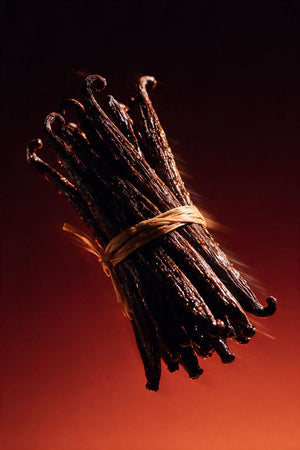
Vanilla from Madagascar: Anatomy of a Permanent Crisis
04.01.26