


1-Decanol
Keywords: fatty · waxy · floral
1-Decanol is a primary fatty alcohol with a sweet, waxy and floral odour. It is a colourless liquid used in the perfume industry.
- Olfactive family
- Florals · 785 entries of the glossary in this family Subfamily: Classic florals · 314 entries in this subfamily Cluster: Rose-like florals · 146 entries in this cluster
- Material
- Natural & Synthetic
- Pyramid
- Heart Note
- Strength
- Medium Step 3 of 5 · shared by 1,469 of 2,161 graded entries Graded entries at each step, from 1 to 5: 4, 117, 1,469, 507, 40. 24 more sit between two steps.
- Also called
- Decyl alcohol, n-Decyl alcohol, n-Decanol, Capric alcohol, Alcohol C-10, Primary decyl alcohol
1-Decanol · Facets
Entries of the glossary that carry each facet, of 3,979:
- fatty 266
- waxy 209
- floral 1,551
- oily 231
- rose 215
- sweet 1,990
1-Decanol · Scent
The odour is fatty and waxy, sweet and floral, with a rose and lily character. It is sweet and slightly fatty-oily, waxy and floral, mainly rosy, and also reminiscent of lily and orange blossom, but fresher.
1-Decanol · In Perfumery
It is used in the perfume industry and serves as a chemical intermediate in the production of esters and fragrances. Its sweet, waxy and floral odour is mainly rosy, and also reminiscent of lily and orange blossom.
Pyramid
1-Decanol: Heart. Entries of the glossary stored at each place of the pyramid, of 4,000 (35 store no place):
- Top 718
- Top · Heart 501
- Heart 1,646
- Heart · Base 512
- Base 588
1-Decanol · Extraction & Chemistry
It is made by high-pressure catalytic hydrogenation of the esters of capric acid, or by oligomerization of ethylene using aluminum alkyl technology. It is also made by reduction of coconut-oil fatty acids.
- Appearance
- Clear, colourless liquid
1-Decanol · In Depth
Identity
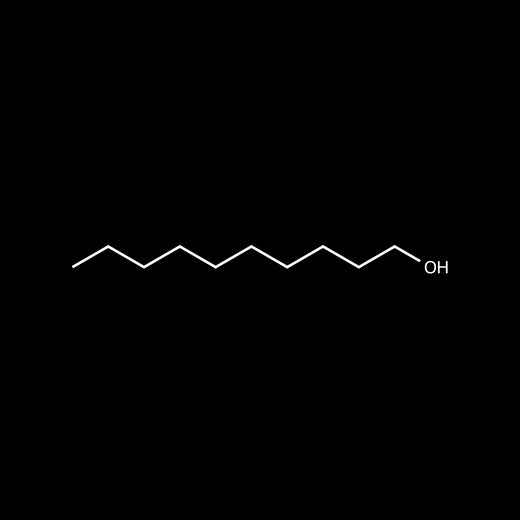
1-Decanol has the CAS number 112-30-1, the formula C₁₀H₂₂O and a molecular weight of 158.28 g/mol. Its IUPAC name is decan-1-ol. It is a fatty alcohol with a hydroxy function at C-1 of an unbranched saturated chain of ten carbon atoms, and it belongs to the primary alcohols. Among its roles are those of a metabolite, a pheromone and a protic solvent.
Odour
The odour is fatty and waxy, sweet and floral, with a rose and lily character. At 100 % the odour is described as fatty, waxy, floral, orange, sweet, clean and watery. It is sweet and slightly fatty-oily, waxy and floral, mainly rosy, and also reminiscent of lily and orange blossom, but fresher. Its odour resembles orange flowers. Its odour strength is medium. Its substantivity is 104 hours at 100 %.
Occurrence in nature
It has been found in Aesculus hippocastanum, Alpinia hainanensis, Boswellia carteri, Boswellia sacra and Citrus deliciosa.
Production
It is made by high-pressure catalytic hydrogenation of the esters of capric acid, or by oligomerization of ethylene using aluminum alkyl technology. It is also made by reduction of coconut-oil fatty acids.
Use in perfumery
It is used in the perfume industry. It serves as a chemical intermediate in the production of esters and fragrances. In cosmetics it is used as a viscosity controlling agent and an emollient. Its cosmetic uses include emollients, foam boosting agents and masking agents.
Use in flavours
It is used as a flavouring agent in foods. Its taste is slight and characteristically fatty. Its flavour profile is fat and oil. There is no safety concern at current levels of intake when it is used as a flavouring agent.
Properties
It is a colourless to water-white, moderately viscous and strongly refractive liquid. Its boiling point is 229 °C. It melts at 6 to 7 °C. Its flash point is 82 °C. Its logP (o/w) is 4.57. It is soluble in alcohol, fixed oils and paraffin oil, and insoluble in glycerin. It is also less dense than water and insoluble in water. Its vapour pressure is 0.00851 mmHg at 25 °C.
Safety and IFRA
In the 51st Amendment of the IFRA Standards, no IFRA Standard covers this material itself. Its INCI name is DECYL ALCOHOL, and its functions are skin conditioning emollient, surfactant foam boosting, fragrance, surfactant cleansing and viscosity controlling. Its EC number is 203-956-9, and it is registered under REACH.
1-Decanol · Technical Sheet
Molecular weight
158.28 g/mol Heavier than 266 of the 887 other entries at the same place of the pyramid that store a weight; 3 weigh the same
2,572 entries store a molecular weight. By place in the pyramid: Top 547, Top · Heart 411, Heart 888, Heart · Base 454, Base 272.
Identity
- Type
- Ingredient
- Category
- Aroma chemicals
Classification
- Chemical class
- Alcohol
Chemical data
- Formula
- C10H22O
- CAS
- 112-30-1
- PubChem CID
- 8174, compound record on PubChem
- InChIKey
- MWKFXSUHUHTGQN-UHFFFAOYSA-N
Physical properties
- Boiling point
- 231 to 232 °C at 760 mmHg
- Melting point
- 6 to 7 °C at 760 mmHg
- Flash point
- 82 °C (180 °F)
- Vapour pressure
- 0.00851 mmHg at 25 °C
- Log P
- 4.57
- Tenacity
- 104 hour(s) at 100 %
Performance and rules
- Odour threshold
- 770 ppt in air · Abraham et al. 2012
- Available as
- synthetic
- IFRA status
- No IFRA Standard for the material itself (51st Amendment)
1-Decanol · See Also
Entries related to 1-Decanol, by their place in the pyramid. « shared » marks a scent word 1-Decanol has too.
Top notes

1-Nonanol
rose (shared) · fatty (shared) · floral (shared) Florals / Top · Heart / Same cluster / Natural & Synthetic / 144.25 g/mol
2-Nonanol
green · fruity · waxy (shared) Green / Top · Heart / 144.25 g/mol
(+-)-2-Undecanol
citrus · fatty (shared) · fruity Citrus / 172.31 g/mol
3,5,5-Trimethyl-1-hexanol
green · herbal · oily (shared) Aromatic / Top · Heart / 144.25 g/mol
Tetrahydromyrcenol
citrus · floral (shared) · lime Citrus / 158.28 g/mol


Heart notes

3-Decanol
fatty (shared) · mushroom · musty Earthy / 158.28 g/mol

1-Decanol · Sources
- PubChem 1-Decanol
- ChEBI 1-Decanol: chemical classification record
- Pyrfume Arctander, Perfume and Flavor Chemicals: odour descriptions (Pyrfume archive)
- Pyrfume Good Scents odour data (Pyrfume archive)
- Pyrfume Leffingwell odour data (Pyrfume archive)
- The Good Scents Company Information System 1-Decanol: data sheet
- Wikidata (LOTUS natural products data) 1-Decanol: organisms it is reported in, with the papers
- IFRA Standards, 51st Amendment
- European Commission, CosIng 1-Decanol: cosmetic ingredient record
- European Chemicals Agency 1-Decanol: substance record
Cite as PREMIEREPEAU Glossary, “1-Decanol”, https://premierepeau.com/pages/glossary-terms/1-decanol Updated 2026-11-20
