


2-Phenylpropionic acid
Keywords: floral · honey · balsamic
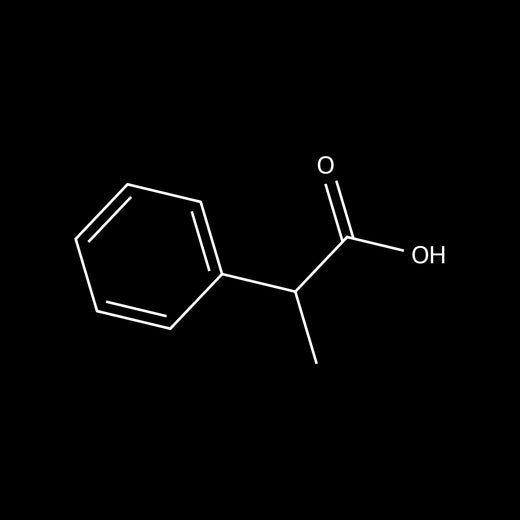
2-Phenylpropionic acid is a 2-arylpropionic acid with a phenyl group at position 2, and it smells floral, honey-like and balsamic.
2-Phenylpropionic acid · Facets
Entries of the glossary that carry each facet, of 3,979:
- floral 1,547
- honey 97
- balsamic 344
- green 1,442
- mimosa 8
- woody 790
2-Phenylpropionic acid · Scent
2-Phenylpropionic acid smells floral, honey-like and balsamic, with green and woody touches.
2-Phenylpropionic acid · In Perfumery
It is a fragrance ingredient with a floral, honey-like and balsamic character.
Pyramid
2-Phenylpropionic acid: Heart. Entries of the glossary stored at each place of the pyramid, of 4,000 (35 store no place):
- Top 718
- Top · Heart 496
- Heart 1,644
- Heart · Base 513
- Base 594
2-Phenylpropionic acid · In Depth
Identity
2-Phenylpropionic acid has the CAS number 492-37-5 and the formula C₉H₁₀O₂. Its molecular weight is 150.17 g/mol and its IUPAC name is 2-phenylpropanoic acid. It is a 2-arylpropionic acid carrying a phenyl group at position 2, and it is also called hydratropic acid. It is a metabolite of α-methylstyrene, a volatile hydrocarbon, and acts as a human xenobiotic metabolite.
Odour
It smells floral, honey-like and balsamic, with green and woody touches. Its odour can be powerful and dry, green-floral and balsamic-woody, of the mimosa-gardenia type, with moderate to poor tenacity. It can also be a heavy-sweet floral, honey-like odour of good tenacity but not very powerful.
Occurrence in nature
It occurs in Aloe africana, Alpinia officinarum, Escherichia coli, Fragaria, Glycyrrhiza glabra, Hoya australis, Hoya bandaensis, Hoya bella, Hoya cinnamomifolia, Hoya coronaria, Hoya crassipes and Hoya diversifolia.
Use in flavours
It is used as a flavouring agent.
Properties
Its logP is 1.8.
Safety and IFRA
In the 51st Amendment in force, no IFRA Standard covers this material itself. Its EC number is 207-752-0. It causes skin irritation (H315, 98% of reports) and serious eye irritation (H319, 98%), and may cause respiratory irritation (H335, 86%).
2-Phenylpropionic acid · Technical Sheet
Molecular weight
150.17 g/mol Heavier than 36 of the 885 other entries at the same place of the pyramid that store a weight; 16 weigh the same
2,572 entries store a molecular weight. By place in the pyramid: Top 547, Top · Heart 406, Heart 886, Heart · Base 455, Base 278.
Identity
- Type
- Ingredient
- Category
- Aroma chemicals
Classification
- Olfactive family
- Gourmand · 495 entries of the glossary in this family
- Subfamily
- Honeyed notes · 23 entries in this subfamily
- Cluster
- Honeyed gourmands · 22 entries in this cluster
- Chemical class
- Carboxylic acid
Chemical data
- Formula
- C9H10O2
- CAS
- 492-37-5
- PubChem CID
- 10296, compound record on PubChem
- InChIKey
- YPGCWEMNNLXISK-UHFFFAOYSA-N
- Wikidata
- Q27121253, item on Wikidata
Physical properties
- Log P
- 1.8
Performance and rules
- Pyramid
- Heart Note
- IFRA status
- No IFRA Standard for the material itself (51st Amendment)
2-Phenylpropionic acid · See Also
Entries related to 2-Phenylpropionic acid, by their place in the pyramid. « shared » marks a scent word 2-Phenylpropionic acid has too.
Heart notes

Ethyl 3-phenylpropionate
fruity · honey (shared) · hyacinth Florals / 178.23 g/mol
Dimethyl phenethyl carbinyl isobutyrate
fruity · tropical · herbal Fruity / Heart · Base / 234.33 g/mol
1-Ethyl-1-methyl-3-phenylpropyl acetate
floral (shared) · green (shared) · hyacinth Florals / Heart · Base / 220.31 g/mol


2-Phenylpropionic acid · Sources
- PubChem 2-Phenylpropionic acid
- ChEBI 2-Phenylpropionic acid: chemical classification record
- Pyrfume Arctander, Perfume and Flavor Chemicals: odour descriptions (Pyrfume archive)
- Pyrfume Leffingwell odour data (Pyrfume archive)
- European Chemicals Agency 2-Phenylpropionic acid: substance record
- Wikidata (LOTUS natural products data) 2-Phenylpropionic acid: organisms it is reported in, with the papers
- IFRA Standards, 51st Amendment
Cite as PREMIEREPEAU Glossary, “2-Phenylpropionic acid”, https://premierepeau.com/pages/glossary-terms/2-phenylpropionic-acid Updated 2026-11-20
