


Hydroxycitronellol
Keywords: floral · rose · sweet
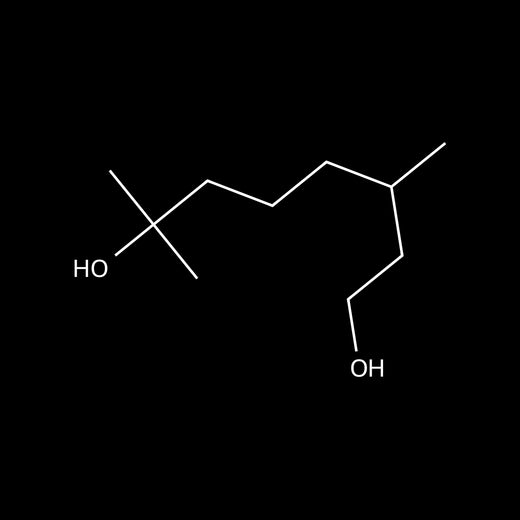
Hydroxycitronellol is an aliphatic diol, a colourless and very viscous liquid with a mild floral odour of lily and peony.
- Olfactive family
- Florals · 779 entries of the glossary in this family Subfamily: Classic florals · 313 entries in this subfamily
- Pyramid
- Heart · Volatility: Heart Note
- Strength
- Low Step 2 of 5 · shared by 119 of 2,156 graded entries Graded entries at each step, from 1 to 5: 4, 119, 1,473, 498, 39. 23 more sit between two steps.
- Also called
- 7-Hydroxy-3,7-dimethyloctan-1-ol, 3,7-Dimethyloctan-1,7-diol, 3,7-Dimethyl-7-hydroxy octyl alcohol
Family, subfamily and cluster: PREMIEREPEAU house classification, version 2026‑11.
Hydroxycitronellol · Facets
Entries of the glossary that carry each facet, of 3,979:
- floral 1,546
- rose 212
- sweet 1,988
- clean 65
- green 1,442
- peony 3
Hydroxycitronellol · Scent
It smells mildly floral, with clean, green, lily and peony facets.
Hydroxycitronellol · In Perfumery
It is a fragrance and perfuming ingredient with a mild, clean floral odour and lily, green and peony facets.
Pyramid
Hydroxycitronellol: Heart. Entries of the glossary stored at each place of the pyramid, of 4,006 (42 store no place):
- Top 718
- Top · Heart 497
- Heart 1,641
- Heart · Base 514
- Base 594
Hydroxycitronellol · In Depth
Identity
Hydroxycitronellol is an aliphatic alcohol. Its IUPAC name is 3,7-dimethyloctane-1,7-diol, its CAS number is 107-74-4, its molecular formula is C₁₀H₂₂O₂ and its molecular weight is 174.28 g/mol.
Odour
Hydroxycitronellol smells mildly floral, with clean, green, lily and peony facets. The liquid has a mild sweet odour. Its odour strength is low and its substantivity is 248 hours at 100 %.
Use in perfumery
It is a fragrance ingredient, and its function in cosmetics is perfuming.
Use in flavours
It is used as a flavouring agent, with a floral flavour profile. It tastes sweet and powdery, with floral, green, dusty, clean and bitter nuances. The Joint FAO/WHO Expert Committee on Food Additives found no safety concern at current levels of intake when it is used as a flavouring agent.
Properties
It is a colourless, very viscous liquid. It boils at 263 °C, or at 156 °C at 15 mmHg. Its density is 0.922 to 0.93 and its refractive index is 1.455 to 1.46. Its flash point is above 100 °C in a closed cup, and its logP is 1.55. It is slightly soluble in water and soluble in alcohol and oils, and 1 ml dissolves in 1 ml of 60 % alcohol.
Safety and IFRA
In the 51st Amendment, no IFRA Standard covers this material itself. Its INCI name is HYDROXYCITRONELLOL, its function is perfuming and its EC number is 203-517-1.
Hydroxycitronellol · Technical Sheet
Molecular weight
174.28 g/mol Heavier than 514 of the 860 other entries at the same place of the pyramid that store a weight; 3 weigh the same.
2,515 entries store a molecular weight. By place in the pyramid: Top 537, Top · Heart 403, Heart 861, Heart · Base 452, Base 262.
Identity
- Type
- Ingredient
- Category
- Aroma chemicals
Classification
- Cluster
- Classic florals · 245 entries in this cluster
- Chemical class
- Alcohol
Chemical data
- Formula
- C10H22O2
- CAS
- 107-74-4
- PubChem CID
- 249494, compound record on PubChem
- InChIKey
- FPCCDPXRNNVUOM-UHFFFAOYSA-N
- Wikidata
- Hydroxycitronellol: Q27287607, item on Wikidata
Physical properties
- Appearance
- Colourless, very viscous liquid
- Boiling point
- 124 to 125 °C at 1 mmHg
- Flash point
- > 100 °C (> 212 °F), closed cup
- Density
- 0.922–0.930
- Refractive index
- 1.455–1.460
- Vapour pressure
- 0.001 mmHg at 25 °C (estimated)
- Log P
- 1.55
Performance and rules
- Tenacity
- 248 hours at 100 %
- IFRA status
- No IFRA Standard for the material itself (51st Amendment)
Hydroxycitronellol · See Also
Entries related to Hydroxycitronellol, by their place in the pyramid. “shared” marks a scent word Hydroxycitronellol has too.
Heart notes

Phenylacetaldehyde glyceryl acetal
green (shared) · rose (shared) · floral (shared) Florals / Same subfamily / Synthetic / 194.23 g/mol
3,7-Dimethyl-1-octanol
rose (shared) · sweet (shared) · waxy Florals / Same subfamily / 158.28 g/mol
Hydroxycitronellal
floral (shared) · lily · green (shared) Florals / Synthetic / 172.26 g/mol
Hydroxycitronellal propyleneglycol acetal
floral (shared) · lily · muguet Florals / Heart · Base / Synthetic / 230.34 g/mol
4-Propylguaiacol
spicy · balsamic · floral (shared) Spicy / 166.22 g/mol


Base notes

Hydroxycitronellal diethyl acetal
floral (shared) · muguet · green (shared) Florals / Synthetic / 246.39 g/mol

Hydroxycitronellol · Sources
- PubChem 3,7-Dimethyl-1,7-octanediol
- ChEBI 3,7-Dimethyl-1,7-octanediol: chemical classification record
- The Good Scents Company Information System 3,7-Dimethyl-1,7-octanediol: data sheet
- Pyrfume Good Scents odour data (Pyrfume archive)
- Pyrfume Leffingwell odour data (Pyrfume archive)
- European Commission, CosIng 3,7-Dimethyl-1,7-octanediol: cosmetic ingredient record
- IFRA Standards, 51st Amendment
Cite as PREMIEREPEAU Glossary, “Hydroxycitronellol”, https://premierepeau.com/
