


3-Phenylpropyl propanoate
Keywords: floral · hyacinth · balsamic
3-Phenylpropyl propanoate is a compound of the benzenes class that forms a colourless liquid with a heavy floral, balsamic odour. Its character is that of lily, rose and hyacinth.
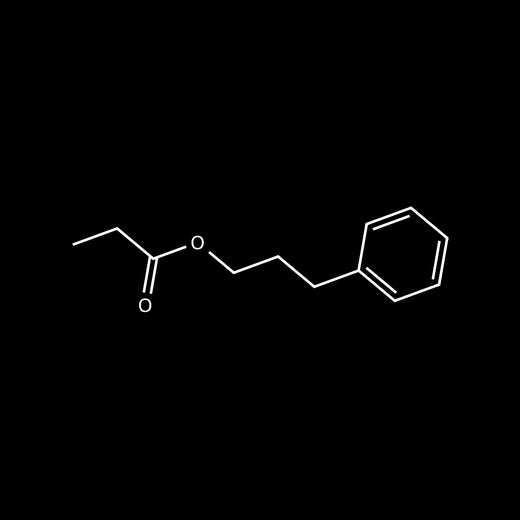
3-Phenylpropyl propanoate · Facets
Entries of the glossary that carry each facet, of 3,979:
- floral 1,546
- hyacinth 30
- balsamic 343
- lily 27
- rose 212
- fruity 1,301
3-Phenylpropyl propanoate · Scent
A heavy, sweet but pleasant floral odour of the lily, rose and hyacinth type, with a balsamic side.
3-Phenylpropyl propanoate · In Perfumery
It is a perfuming ingredient in cosmetics and brings a floral, balsamic character of lily, rose and hyacinth.
Pyramid
3-Phenylpropyl propanoate: Heart. Entries of the glossary stored at each place of the pyramid, of 4,006 (42 store no place):
- Top 718
- Top · Heart 497
- Heart 1,641
- Heart · Base 514
- Base 594
3-Phenylpropyl propanoate · In Depth
Identity
3-Phenylpropyl propanoate has the CAS number 122-74-7 and the molecular formula C₁₂H₁₆O₂. Its molecular weight is 192.25 g/mol. It belongs to the benzenes class and is also named 3-phenylpropyl propionate.
Odour
It smells floral, balsamic and hyacinth-like, with lily, rose and fruity facets. The odour is heavy and sweet but pleasant, of the lily, rose and hyacinth type, with moderate tenacity.
Use in perfumery
It has a perfuming function in cosmetics.
Use in flavours
It is used as a flavouring agent and its flavour profile is floral. An international expert committee on food additives found no safety concern at current levels of intake when it is used as a flavouring agent.
Properties
It is a colourless liquid that boils at 279 to 280 °C at 760 mmHg. Its density is 0.995 to 1.005 and its refractive index is 1.488 to 1.495. It is insoluble in water, soluble in oils and miscible with ethanol. Its flash point is above 100 °C and its estimated logP is 3.356. Its estimated vapour pressure is 0.004 mmHg at 25 °C.
Safety and IFRA
No IFRA Standard covers this material itself. Its INCI name is HYDROCINNAMYL PROPIONATE and its EC number is 204-571-9. Of 274 reports, 235 do not classify it as hazardous under the GHS, while 14.2% give H315, H319 and H335, for skin, eye and respiratory irritation.
3-Phenylpropyl propanoate · Technical Sheet
Molecular weight
192.25 g/mol Heavier than 754 of the 860 other entries at the same place of the pyramid that store a weight; 20 weigh the same.
2,515 entries store a molecular weight. By place in the pyramid: Top 537, Top · Heart 403, Heart 861, Heart · Base 452, Base 262.
Identity
- Type
- Ingredient
- Category
- Aroma chemicals
- Also called
- 3-Phenylpropyl propionate, 3-Phenyl-1-propanol propionate, Phenylpropyl n-propionate, beta-Phenylpropyl propionate
Classification
- Olfactive family
- Florals · 779 entries of the glossary in this family
- Classified by
- PREMIEREPEAU house classification, version 2026‑11
- Subfamily
- Fresh florals · 104 entries in this subfamily
- Cluster
- Lily-like fresh florals · 67 entries in this cluster
- Chemical class
- Ester
Chemical data
- Formula
- C12H16O2
- CAS
- 122-74-7
- PubChem CID
- 61052, compound record on PubChem
- InChIKey
- GTNCESCYZPMXCJ-UHFFFAOYSA-N
- Wikidata
- 3-Phenylpropyl propanoate: Q27275172, item on Wikidata
Physical properties
- Appearance
- Colourless liquid
- Boiling point
- 279 to 280 °C at 760 mmHg
- Flash point
- > 100 °C (> 212 °F)
- Density
- 0.995–1.005
- Refractive index
- 1.488–1.495
- Vapour pressure
- 0.004 mmHg at 25 °C (estimated)
- Log P
- 3.356 (estimated)
Performance and rules
- Pyramid
- Heart Note
- IFRA status
- No IFRA Standard for the material itself (51st Amendment)
3-Phenylpropyl propanoate · See Also
Entries related to 3-Phenylpropyl propanoate, by their place in the pyramid. “shared” marks a scent word 3-Phenylpropyl propanoate has too.
Heart notes

1-Ethyl-1-methyl-3-phenylpropyl acetate
floral (shared) · green · hyacinth (shared) Florals / Heart · Base / Same cluster / Synthetic / 220.31 g/mol
3-Phenylpropyl formate
floral (shared) · hyacinth (shared) · honey Florals / Same cluster / 164.2 g/mol
Dimethyl phenethyl carbinyl isobutyrate
fruity (shared) · tropical · herbal Fruity / Heart · Base / Synthetic / 234.33 g/mol
2-(3-Phenylpropyl)
pyridine
earthy · green · herbal Earthy / Heart · Base / Synthetic / 197.27 g/mol
3-Phenylpropyl isovalerate
fruity (shared) · plum · strawberry Fruity / Heart · Base / 220.31 g/mol
3-Phenyl propyl hexanoate
fruity (shared) · green · sweet Fruity / Heart · Base / 234.33 g/mol
3-Phenylpropyl acetate
balsamic (shared) · floral (shared) · fruity (shared) Spicy / 178.23 g/mol
3-Phenylpropyl isobutyrate
fruity (shared) · balsamic (shared) · sweet Fruity / Heart · Base / 206.28 g/mol


Base notes

3-Phenylpropyl cinnamate
sweet · apricot · spicy Fruity / 266.3 g/mol

3-Phenylpropyl propanoate · Sources
- PubChem 3-Phenylpropyl propanoate
- ChEBI 3-Phenylpropyl propanoate: chemical classification record
- Pyrfume Arctander, Perfume and Flavor Chemicals: odour descriptions (Pyrfume archive)
- European Commission, CosIng 3-Phenylpropyl propanoate: cosmetic ingredient record
- European Chemicals Agency 3-Phenylpropyl propanoate: substance record
- Pyrfume Good Scents odour data (Pyrfume archive)
- Pyrfume Leffingwell odour data (Pyrfume archive)
- The Good Scents Company Information System 3-Phenylpropyl propanoate: data sheet
- IFRA Standards, 51st Amendment
Cite as PREMIEREPEAU Glossary, “3-Phenylpropyl propanoate”, https://premierepeau.com/
