


Andiroba
Keywords: earthy · sweet
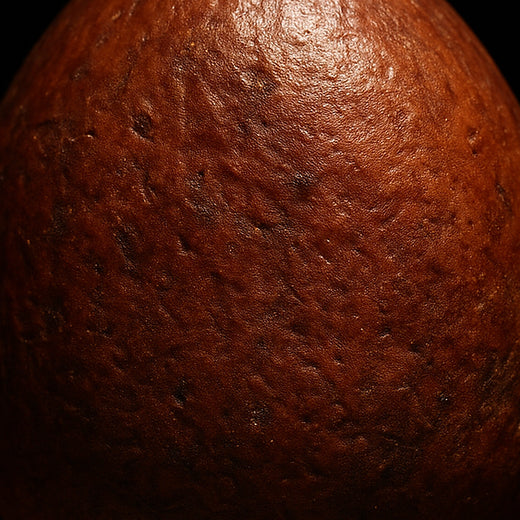
Andiroba is the oil produced from the seeds of Carapa guianensis, a tree of the family Meliaceae. Its odor is sweet and earthy.
- Olfactive family
- Earthy · 85 entries of the glossary in this family Subfamily: Tropical woods · 2 entries in this subfamily Cluster: Classic resins · 66 entries in this cluster
- Material
- Natural Seed oil
- Pyramid
- Base Note
- Strength
- High Step 4 of 5 · shared by 507 of 2,161 graded entries Graded entries at each step, from 1 to 5: 4, 117, 1,469, 507, 40. 24 more sit between two steps.
- Also called
- Andiroba oil, crab oil, carap oil
Andiroba · Facets
Entries of the glossary that carry each facet, of 3,979:
- woody 794
- floral 1,551
- earthy 657
- warm 1,109
- roasted 133
- sweet 1,990
Andiroba · Scent
Andiroba oil has a sweet and earthy odor.
Evolution over time
Andiroba: scent over time.
- Immediately
A sweet odor.
Scent words: sweet - After a few hours
A sweet and earthy odor.
Scent words: sweet · earthy - After a few days
An earthy odor.
Scent words: earthy
- Tenacity
- > 200 hours
Andiroba · In Perfumery
One commercial grade of andiroba oil is offered as a massage oil, as a carrier oil for treatment products and as a moisturizing base for skin care formulations. Suggested use levels for one commercial grade are 5 - 10 % in natural insect repellents and balms, 3 - 10% in lotions and creams, and 2 - 5% in hair conditioners.
Pyramid
Andiroba: Base. Entries of the glossary stored at each place of the pyramid, of 4,000 (35 store no place):
- Top 718
- Top · Heart 501
- Heart 1,646
- Heart · Base 512
- Base 588
Role in the formula
Andiroba: roles in the formula. Entries of the glossary that share each role, of 4,000:
- Fixative 341
- Modifier 1,168
- Signature note 898
- Blender 1,041
- Volume builder 780
- Carrier oil fewer than 40 entries
Andiroba · Terroir & Origins
- Producing countries
- Brazil
Pará Andiroba
Pará — Brazil
In a study with seeds from two sites in Pará, a terra firme site and the floodplain (várzea) site of Ilha do Combú, seeds from the várzea area were more productive for oil extraction.
In that study, oil from Ilha do Combú had the larger average production, 3,680 mL. Oil from seeds collected at Santo Antônio do Tauá had a more intense colour than oil from Ilha do Combú.
- Extraction
- Seeds rested 30 days after cooking give the highest oil yield
- Climate
- Annual rainfall above 2,500 mm, mean annual temperature 26 °C (two study sites in Pará)
- Altitude
- 15 m (two study sites in Pará)
Andiroba · Extraction & Chemistry
There are two methods of extracting andiroba oil: an artisanal one, carried out by extractors from communities in the North region, and an industrial one, which uses mechanical pressing. The artisanal process can be divided into three stages: collecting and selecting seeds, preparing the dough, and extracting the oil. Selected seeds are washed and cooked at about 90 °C. The pressing can be cold, and it gives an amount of oil that rarely exceeds 30% of the seed weight at 8% moisture.
Available as
Andiroba: available as.
- standard form
- oil
- Appearance
- Light yellow oil
Andiroba · Did You Know?
Carapa guianensis is a large tree able to grow up to about 55 m tall. Below 25 °C its oil solidifies to a consistency like that of petroleum jelly.
Andiroba · In Depth
Andiroba is the common name of Carapa guianensis, a tree of the family Meliaceae that is also called crabwood. The name andiroba comes from the Nheengatu nhandi rob, meaning bitter oil. The tree is native to the Amazon and is used by the indigenous populations of the northern region of Brazil. The oil is extremely bitter.
The Tree
Carapa guianensis is a tall tree with dense foliage that usually grows in the tropical rainforest along the edge of rivers. It grows in the Amazon region, Central America and the Caribbean. The tree is found in the soil-rich regions and swamps of countries such as Brazil, Peru, Ecuador, Colombia, Venezuela, French Guiana and Suriname, and on several islands in the Caribbean.
In the Brazilian Amazon it is found mainly in seasonal floodplains and wetlands along igapós (flooded forests). The timber is used in furniture and flooring. The wood is not classified as genuine mahogany, but it is related to the mahogany family and is similar in appearance. The bark can be used for tanning purposes.
Origin and Production
The oil is extracted from light brown seeds that are collected from beaches and rivers, where they float after being shed by the trees, or from the forest ground. The oil is one of the main non-wood forest products exported to the United States and to European countries such as Germany, Spain and France.
Chemistry
The oil contains olein, palmitic, stearic and linoleic acids. The unsaponifiable fraction of the seeds is composed mainly of limonoids. Limonoids are tetranortriterpenoids found primarily in the Meliaceae family. Among the limonoids found in the seed oil are gedunin, andirobin and methyl angolensate.
Uses
In Brazil, Indigenous people have used the tree as an insect repellent and in the treatment of various diseases. The oil and fats of the almond are extracted and used for the production of insect repellent and compounds for traditional medicine. Andiroba oil is one of the most commonly used medicinal oils in the Amazon.
To repel mosquitoes, an oilseed cake is formed into balls and burned, or mixed with annatto and formed into a paste applied to the body to protect against bites. Carapa guianensis produces an oil with similar uses to neem oil. Andiroba oil has physical properties like those of soybean and cottonseed oils, such as density, viscosity and calorific value, which makes it a viable alternative for producing biodiesel.
Andiroba · Technical Sheet
Identity
- Botanical
- Carapa guianensis
- IPNI
- Carapa guianensis Aubl., Hist. Pl. Guiane Suppl. 32 (t. 387) (1775) — Jean Baptiste Christophore Fusée Aublet (1720-1778)
- Type
- Ingredient
- Category
- Woods and mosses
In Nature
- Growth form
- Tree · POWO
- Native range
- Central America · Caribbean · Northern South America · Western South America · Brazil · POWO
- Recorded altitude
- 0–1,500 m · median 300 m · 1,299 records with an altitude · GBIF
- Wild or cultivated
- 245 native · 3 cultivated among 6,051 records (the rest carry no such mark) · GBIF
- Recorded in
- 24 of 512 squares of the world grid; a brighter dot holds more records · GBIF
In Print
- Timeline
- first described 1775 · earliest aroma paper in Europe PMC, 2001
- In English books
- most mentioned in the 1940s · Google Books Ngram
Classification
- Chemical class
- Triacylglycerols with a limonoid-rich unsaponifiable fraction
Chemical data
- Formula
- Complex natural mixture (key constituents: gedunin C₂₈H₃₄O₇; andirobin)
- CAS
- 223748-14-9; 352458-32-3; 68956-68-3
- INCI names (CosIng)
- CARAPA GUIANENSIS SEED OIL (DENATURANT, SKIN CONDITIONING - MISCELLANEOUS)CARAPA GUIANENSIS OIL PEG-8 ESTERS (SKIN CONDITIONING - EMOLLIENT, SURFACTANT - EMULSIFYING)CARAPA GUIANENSIS OIL POLYGLYCERYL-6 ESTERS (SKIN CONDITIONING - EMOLLIENT)CARAPA GUIANENSIS SEED POWDER (ABRASIVE, EXFOLIATING)
Physical properties
- Density
- 0.9169–0.9183 g/cm³
- Refractive index
- 1.4593–1.4603 (nD, 40 °C)
- Oil density
- 0.92-0.93 g/cm³
- Acid value
- 3-10 mg KOH/g
- Saponification value
- 195-210 mg KOH/g
Performance and rules
- IFRA status
- No IFRA Standard for the material itself (51st Amendment)
Andiroba · See Also
Entries related to Andiroba, by their place in the pyramid. « shared » marks a scent word Andiroba has too.
Heart notes

Brazilian Rosewood
woody (shared) · floral (shared) Woods / Natural
Tucumã
nutty · creamy · warm (shared) Fruity / Natural


Base notes

Shea Butter
vegetable fat · odourless to mild Earthy / Natural
Sandalwood
woody (shared) · floral (shared) Woods / Natural
Oud
woody (shared) · animalic · smoky Woods / Natural
Cedarwood
woody (shared) · dry · clean Woods / Natural
Patchouli
Woods / Natural
Javanol
woody (shared) · creamy · clean Woods / Synthetic
Blackwood
woody (shared) · warm (shared) · earthy (shared) Woods / Natural
Buddha Wood
woody (shared) · mossy · smoky Woods / Natural
Argan
nutty · warm (shared) · rich Gourmand / Natural
Jojoba
nutty Gourmand / Natural


Andiroba · Sources
- Current research in toxicology (2023) Bioactive limonoids from Carapa guianensis seeds oil and the sustainable use of its by-products
- BioMed research international (2018) Carapa guianensis Aublet (Andiroba) Seed Oil: Chemical Composition and Antileishmanial Activity of Limonoid-Rich Fractions
- Oxidative medicine and cellular longevity (2018) Antioxidant Activity and Genotoxic Assessment of Crabwood (Andiroba, Carapa guianensis Aublet) Seed Oils
- National Parks Singapore Carapa guianensis
- PubChem Gedunin
- IFRA Standards, 51st Amendment
- Wikipedia Carapa guianensis
- Wikipedia Carapa
Cite as PREMIEREPEAU Glossary, “Andiroba”, https://premierepeau.com/pages/glossary-terms/andiroba Updated 2026-11-18
