


Ascorbyl Palmitate
Keywords: citrus
Ascorbyl Palmitate is a fatty acid ester that forms a white or yellowish-white powder with a citrus-like odour.
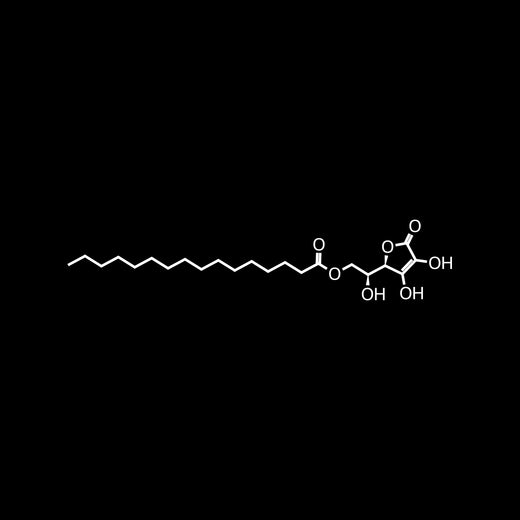
Ascorbyl Palmitate · Facets
Entries of the glossary that carry each facet, of 3,979:
- citrus 487
Ascorbyl Palmitate · Scent
Ascorbyl Palmitate smells of citrus.
Ascorbyl Palmitate · In Perfumery
Ascorbyl Palmitate is a fragrance ingredient with a citrus-like odour, and in cosmetics it also acts as an antioxidant.
Pyramid
Ascorbyl Palmitate: Base. Entries of the glossary stored at each place of the pyramid, of 4,006 (42 store no place):
- Top 718
- Top · Heart 497
- Heart 1,641
- Heart · Base 514
- Base 594
Ascorbyl Palmitate · In Depth
Identity
Ascorbyl Palmitate is a fatty acid ester, also named 6-O-palmitoylascorbic acid. Its CAS number is 137-66-6, its molecular formula is C₂₂H₃₈O₇ and its molecular weight is 414.5. Its IUPAC name is [(2S)-2-[(2R)-3,4-dihydroxy-5-oxo-2H-furan-2-yl]-2-hydroxyethyl] hexadecanoate.
Odour
Ascorbyl Palmitate has a citrus-like odour.
Use in perfumery
It is used as a fragrance ingredient.
Use in flavours
It is used as a food preservative and as an antioxidant in oils, fats and pharmaceuticals. It is a source of vitamin C and also serves as a stabiliser and an emulsifier.
Properties
It melts at 112 °C and boils at 546 to 547 °C at 760 mmHg. Its flash point is 177.78 °C and its estimated logP is 6.868. Its specific optical rotation is +23 degrees at 20 °C, with c = 1 in ethanol. It is soluble in alcohol, animal oil and vegetable oil, and slightly soluble in water.
Safety and IFRA
No IFRA Standard covers this material itself, as of the 51st Amendment. Its INCI name is ASCORBYL PALMITATE, its functions are antioxidant and fragrance, and its EC number is 205-305-4. It is registered under REACH. Some hazard reports class it as causing serious eye irritation (H319) and as harmful to aquatic life with long lasting effects (H412).
Ascorbyl Palmitate · Technical Sheet
Molecular weight
414.5 g/mol Heavier than 256 of the 261 other entries at the same place of the pyramid that store a weight.
2,515 entries store a molecular weight. By place in the pyramid: Top 537, Top · Heart 403, Heart 861, Heart · Base 452, Base 262.
Identity
- Type
- Ingredient
- Category
- Aroma chemicals
- Also called
- L-Ascorbyl 6-palmitate
Classification
- Olfactive family
- Citrus · 152 entries of the glossary in this family
- Classified by
- PREMIEREPEAU house classification, version 2026‑11
- Subfamily
- Zesty citrus · 110 entries in this subfamily
- Cluster
- Lemon-lime sharp citrus · 78 entries in this cluster
- Chemical class
- Ester
Chemical data
- Formula
- C22H38O7
- CAS
- 137-66-6
- PubChem CID
- 54680660, compound record on PubChem
- InChIKey
- QAQJMLQRFWZOBN-LAUBAEHRSA-N
- Wikidata · Wikipedia
- Ascorbyl Palmitate: Q424521, item on Wikidata · Wikipedia, English article
Physical properties
- Appearance
- White or yellowish-white powder
- Boiling point
- 546 to 547 °C at 760 mmHg
- Melting point
- 112 °C
- Flash point
- 177.78 °C (352 °F)
- Log P
- 6.868 (estimated)
Performance and rules
- Pyramid
- Base Note
- IFRA status
- No IFRA Standard for the material itself (51st Amendment)
Ascorbyl Palmitate · See Also
Entries related to Ascorbyl Palmitate, by their place in the pyramid.
Base notes

Ethyl palmitate
waxy · sweet · greasy Gourmand / 284.5 g/mol
Isopropyl Palmitate
fatty · oily · bland Green / 298.5 g/mol


Ascorbyl Palmitate · Sources
- PubChem Ascorbyl Palmitate
- ChEBI Ascorbyl Palmitate: chemical classification record
- Pyrfume Good Scents odour data (Pyrfume archive)
- European Commission, CosIng Ascorbyl Palmitate: cosmetic ingredient record
- European Chemicals Agency Ascorbyl Palmitate: substance record
- The Good Scents Company Information System Ascorbyl Palmitate: data sheet
- IFRA Standards, 51st Amendment
Cite as PREMIEREPEAU Glossary, “Ascorbyl Palmitate”, https://premierepeau.com/
