


Butanedione
Keywords: buttery · oily · sweet
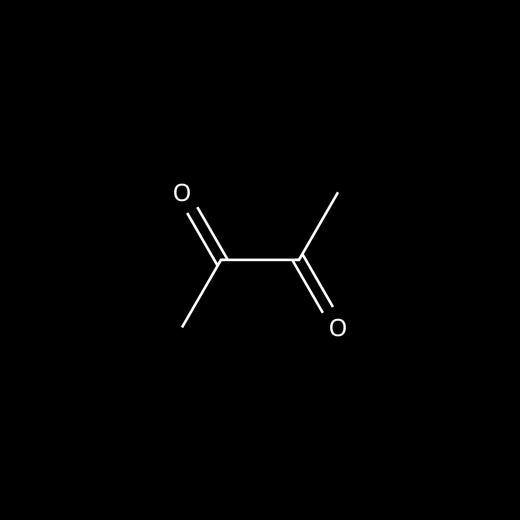
Butanedione is an alpha-diketone with a powerful, buttery odour in very dilute solution.
- Olfactive family
- Gourmand · 495 entries of the glossary in this family Subfamily: Creamy gourmands · 92 entries in this subfamily Cluster: Classic gourmands · 181 entries in this cluster
- Material
- Natural & Synthetic
- Pyramid
- Top Note
- Strength
- High Step 4 of 5 · shared by 501 of 2,149 graded entries Graded entries at each step, from 1 to 5: 4, 118, 1,462, 501, 40. 24 more sit between two steps.
- Also called
- 2,3-Butanedione-13C2
Butanedione · Facets
Entries of the glossary that carry each facet, of 3,979:
- buttery 82
- oily 239
- sweet 1,987
- caramellic 112
- creamy 404
- pungent 91
Butanedione · Scent
A very powerful, pungent, buttery odour that turns oily-buttery in extreme dilution.
Butanedione · In Perfumery
It is used as a fragrance ingredient with a high-strength buttery, sweet and creamy character.
Pyramid
Butanedione: Top. Entries of the glossary stored at each place of the pyramid, of 4,000 (35 store no place):
- Top 718
- Top · Heart 496
- Heart 1,644
- Heart · Base 513
- Base 594
Butanedione · Extraction & Chemistry
It is made from methyl ethyl ketone, which is converted to the isonitroso compound and then decomposed to diacetyl by hydrolysis with hydrochloric acid, or by a special fermentation of glucose via methylacetylcarbinol.
- Appearance
- Yellow to yellow-green liquid
Butanedione · In Depth
Identity
It is an alpha-diketone, a butane carrying oxo groups at positions 2 and 3, and it is also called diacetyl. Its systematic name is butane-2,3-dione and its CAS number is 431-03-8. Its formula is C₄H₆O₂ and its molecular weight is 86.09 g/mol. It is a metabolite produced during malolactic fermentation, and a metabolite of Saccharomyces cerevisiae and Escherichia coli.
Odour
It smells buttery and sweet, with creamy, oily, caramellic and pungent facets. The odour is very powerful and diffusive, pungent and buttery, chlorine-like and quinone-like in high concentration, and oily-buttery in extreme dilution. Its odour strength is high, and it is best smelled in a 1 % solution or less. Its substantivity is 44 hours at 10 % in dipropylene glycol.
Occurrence in nature
It has been found in Carica papaya, Coffea arabica, Helianthus tuberosus, Manilkara zapota, Psidium guajava, Sesamum indicum, Vaccinium macrocarpon, Vaccinium vitis-idaea, Zanthoxylum schinifolium and Zea mays, and in the worm Caenorhabditis elegans.
Production
It is made from methyl ethyl ketone, which is converted to the isonitroso compound and then decomposed to diacetyl by hydrolysis with hydrochloric acid, or by a special fermentation of glucose via methylacetylcarbinol.
Use in perfumery
It is used as a fragrance ingredient.
Use in flavours
It is mainly important as a flavour component with a buttery taste, used in low concentration in ice cream, baked goods and margarine. It carries the aroma of butter, vinegar, coffee and other foods. At 50 ppm its taste is sweet, buttery, creamy and milky, and its flavour profile is butter, pastry and yeast. The expert committee on food additives found no safety concern at current levels of intake when it is used as a flavouring agent.
Properties
It boils at 87 to 88 °C at 760 mmHg and melts at −2.4 °C. Its flash point is 7.22 °C. Its logP is −1.34 and its vapour pressure is 56.8 mmHg at 25 °C. It is soluble in alcohol, fixed oils and glycerin, and insoluble in paraffin oil.
Safety and IFRA
Its INCI name is DIACETYL, its function is perfuming, and its EC number is 207-069-8. It is registered under REACH. As of the 51st Amendment, no IFRA Standard covers this material itself. Its hazard signal word is Danger.
Butanedione · Technical Sheet
Molecular weight
86.09 g/mol Heavier than 84 of the 546 other entries at the same place of the pyramid that store a weight; 3 weigh the same
2,572 entries store a molecular weight. By place in the pyramid: Top 547, Top · Heart 406, Heart 886, Heart · Base 455, Base 278.
Identity
- Type
- Ingredient
- Category
- Aroma chemicals
Classification
- Chemical class
- Ketone
Chemical data
- Formula
- C4H6O2
- CAS
- 431-03-8
- PubChem CID
- 650, compound record on PubChem
- InChIKey
- QSJXEFYPDANLFS-UHFFFAOYSA-N
Physical properties
- Boiling point
- 87 to 88 °C at 760 mmHg
- Melting point
- −2.4 °C at 760 mmHg
- Flash point
- 7.22 °C (45 °F)
- Vapour pressure
- 56.8 mmHg at 25 °C
- Log P
- −1.34
- Tenacity
- 44 hour(s) at 10 %
Performance and rules
- Odour threshold
- 50 ppt in air · Abraham et al. 2012
- Available as
- synthetic
- IFRA status
- No IFRA Standard for the material itself (51st Amendment)
Butanedione · See Also
Entries related to Butanedione, by their place in the pyramid. « shared » marks a scent word Butanedione has too.
Top notes

2,3-Pentanedione
buttery (shared) · oily (shared) · sweet (shared) Gourmand / Same cluster / Natural & Synthetic / 100.12 g/mol

Butanedione · Sources
- PubChem Butanedione
- ChEBI Butanedione: chemical classification record
- Pyrfume Arctander, Perfume and Flavor Chemicals: odour descriptions (Pyrfume archive)
- The Good Scents Company Information System Butanedione: data sheet
- Pyrfume Good Scents odour data (Pyrfume archive)
- Pyrfume Leffingwell odour data (Pyrfume archive)
- Wikidata (LOTUS natural products data) Butanedione: organisms it is reported in, with the papers
- European Commission, CosIng Butanedione: cosmetic ingredient record
- European Chemicals Agency Butanedione: substance record
- IFRA Standards, 51st Amendment
Cite as PREMIEREPEAU Glossary, “Butanedione”, https://premierepeau.com/
