


Candeia
Keywords: woody · soft · balsamic
Candeia is a Brazilian tree, Eremanthus erythropappus (Asteraceae). The essential oil steam distilled from its trunks is dominated by (−)-α-bisabolol.
- Olfactive family
- Woods · 362 entries of the glossary in this family Subfamily: Classic woods · 124 entries in this subfamily Cluster: Earthy woods · 237 entries in this cluster
- Material
- Natural Trunk wood of the tree Eremanthus erythropappus
- Pyramid
- Base · Volatility: Base Note
Family, subfamily and cluster: PREMIEREPEAU house classification, version 2026‑11.
Candeia · Facets
Entries of the glossary that carry each facet, of 3,979:
- woody 792
- soft 17
- balsamic 343
- floral 1,546
- sweet 1,988
Candeia · In Perfumery
Pyramid
Candeia: Base. Entries of the glossary stored at each place of the pyramid, of 4,006 (42 store no place):
- Top 718
- Top · Heart 497
- Heart 1,641
- Heart · Base 514
- Base 594
Role in the formula
Candeia: roles in the formula. Entries of the glossary that share each role, of 4,006:
- Fixative 340
- Blender 1,040
- Fragrance ingredient 51
PREMIEREPEAU collection: Extrait de parfum
Candeia · Terroir & Origins
- Producing countries
- Brazil
Candeia · Extraction & Chemistry
The oil is steam distilled from the trunks of the tree. However, economic quantities of (−)-α-bisabolol can only be distilled from trees older than 10 years.
Candeia · In Depth
What it is
Candeia is a Brazilian tree, Eremanthus erythropappus, of the family Asteraceae. The tree mainly occurs in the cerrado areas, and it primarily grows in the state of Minas Gerais.
The oil and its chemistry
The essential oil is steam distilled from the trunks of the tree. Candeia wood essential oil was reported to be dominated by (−)-α-bisabolol, up to a level of 66 to 91%. In leaves, (−)-α-bisabolol constitutes 2–24% of the oil. (−)-α-Bisabolol is a monocyclic sesquiterpene alcohol with the formula C₁₅H₂₆O.
In the tree itself, the root material and the mature branches were found to be rich in bisabolol. The highest content of bisabolol was found in the lateral root samples of the 10-year old tree, at 10 mg/g fresh weight. The proportion of bisabolol in the sesquiterpene mixture greatly increases in 10 year-old samples.
Uses
From ethnobotanical information, the essential oil is known to have wound healing and nociceptive properties. Bisabolol is highly valued by the cosmetic industry because of its antibacterial, anti-inflammatory, skin-smoothing and wound healing properties. The main uses of candeia are rustic buildings and fence posts on rural properties, and natural alpha-bisabolol production for the cosmetic and pharmaceutical industry. Until recently, most of the (−)-α-bisabolol on the world market was produced from Candeia trees.
Supply and conservation
To sustain the annual oil production, at least 30,000 m³ of Candeia wood is needed, equivalent to approximately 1000 ha of forest. Illegal logging of wild material is still continuing, and will eventually cause an ecological imbalance, even putting this species at risk of extinction.
In Brazil, research led to the publication of laws on the sustainable use of candeia. In Minas Gerais, environmental legislation allows the analysis and approval of Sustainable Management Plans for the extraction of candeia wood in natural stands. The simple coppice system is feasible for candeia management.
Candeia · History
Over the past decades, Candeia timber has been collected at large scale for bisabolol extraction from wild reserves. In the period from 1980 to 2010, up to 250 tons of Candeia oil were harvested.
Candeia · Technical Sheet
Identity
- Botanical
- Eremanthus erythropappus
- Taxonomy
- Asterales order › Asteraceae family › Eremanthus genus · GBIF
- Botanical records
- Eremanthus erythropappus: POWO, Eremanthus erythropappus · IPNI, Eremanthus erythropappus · GBIF, Eremanthus erythropappus · Wikidata, Eremanthus erythropappus · IUCN Least concern (LC), Eremanthus erythropappus
- IPNI
- Eremanthus erythropappus (DC.) MacLeish, Ann. Missouri Bot. Gard. 74: 284 (1987) — Nanda F.Fleming MacLeish (1953-)
- Type
- Ingredient
- Category
- Woods and mosses
In Nature
- Sample origins in GC-MS studies
- Brazil (1 paper; one: Molecules 2015)
- Recorded altitude
- 0–1,600 m · median 1,150 m · 479 records with an altitude · GBIF
- Wild or cultivated
- 775 native among 1,785 records (the rest carry no such mark) · GBIF
- Recorded in
- 5 of 512 squares of the world grid; a brighter dot holds more records · GBIF
In Print
- Timeline
- first described 1987 · earliest aroma paper in Europe PMC, 2008
- In English books
- most mentioned in the 2010s · Google Books Ngram
Classification
- Chemical class
- Essential oil dominated by a monocyclic sesquiterpene alcohol
Chemical data
- Formula
- Complex natural mixture (key constituents: (−)-α-bisabolol C₁₅H₂₆O)
- Most reported compounds
- Levomenol (3 papers; one: Phytochemistry 1989) · (−)-Eremanthin (3 papers; one: Phytochemistry 1989) · Costunolide (2 papers; one: Phytochemistry 1989) · Reynosin (1 paper; one: J Nat Prod 1985) · LOTUS
- Structure
- Levomenol:
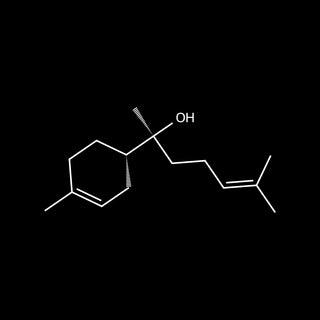
Levomenol
PubChem, Levomenol
Labelling
- Forms in the EU cosmetic inventory
- Candeia: EREMANTHUS ERYTHROPAPPUS WOOD EXTRACT · EREMANTHUS ERYTHROPAPPUS BRANCH/LEAF OIL · EREMANTHUS ERYTHROPAPPUS LEAF OIL
Performance and rules
- Available as
- essential oil
- IFRA status
- No IFRA Standard for the material itself (51st Amendment)
Candeia · See Also
Entries related to Candeia, by their place in the pyramid. “shared” marks a scent word Candeia has too.
Top notes

Artemisia
green · fresh · woody (shared) Aromatic / Top · Heart / Natural

Heart notes

1,1,2,3,3-Pentamethylindan
musk like · floral (shared) · woody (shared) Woods / Same cluster / Synthetic
Immortelle
aromatic · honey · herbal Aromatic / Natural
African Marigold
herbal · fruity · warm Aromatic / Natural
Artichoke
green · earthy · fresh Green / Natural
Bisabolol
floral (shared) · peppery · clean Florals / Heart · Base
Levomenol
floral (shared) · fruity · lemon Fruity / Heart · Base


Candeia · Sources
- International Plant Names Index (IPNI) Eremanthus erythropappus (DC.) MacLeish
- SciELO Technical feasibility of Eremanthus erythropappus (dc.) macleish coppice: critical factor for sustainable management
- Frontiers Identification of the Bisabolol Synthase in the Endangered Candeia Tree (Eremanthus erythropappus (DC) McLeisch)
- PubChem Bisabolol
- IFRA Standards, 51st Amendment
Cite as PREMIEREPEAU Glossary, “Candeia”, https://premierepeau.com/

