


Chavicol
Keywords: medicinal · phenolic · tarry
Chavicol is a phenylpropanoid, a phenol carrying a prop-2-enyl group, with a powerful, dry, tarry-medicinal and phenolic odour.
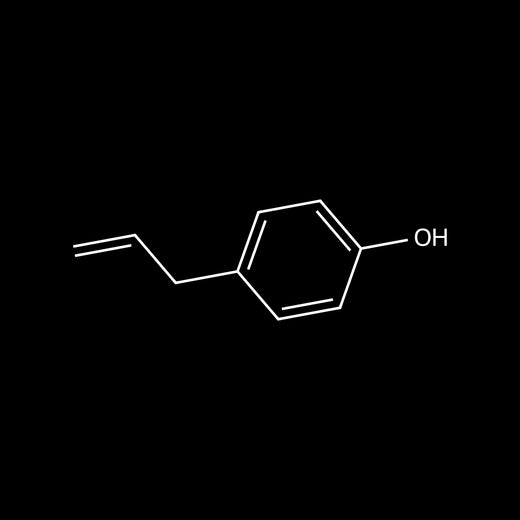
Chavicol · Facets
Entries of the glossary that carry each facet, of 3,979:
- medicinal 83
- phenolic 94
- tarry 15
- smoky 166
- spicy 473
- herbal 755
Chavicol · Scent
It has a powerful, dry, tarry-medicinal and phenolic odour, very penetrating and persistent.
Chavicol · In Perfumery
It is used as a fragrance ingredient, with a medicinal, phenolic and tarry odour.
Pyramid
Chavicol: Top · Heart. Entries of the glossary stored at each place of the pyramid, of 4,000 (35 store no place):
- Top 718
- Top · Heart 501
- Heart 1,646
- Heart · Base 512
- Base 588
Chavicol · In Depth
Identity
Chavicol has the CAS number 501-92-8, the formula C₉H₁₀O and a molecular weight of 134.17 g/mol. Its IUPAC name is 4-prop-2-enylphenol.
It is a phenylpropanoid, a phenol substituted by a prop-2-enyl group at position 4, and it is also called p-allylphenol.
Odour
It smells medicinal and phenolic, with tarry, smoky, herbal and spicy facets. Its odour is powerful, dry and tarry-medicinal, very penetrating and persistent. At 0.1 % in dipropylene glycol it smells phenolic, medicinal and herbal.
Occurrence in nature
It has been found in Achillea crithmifolia, Agastache rugosa, Alnus pendula, Alpinia conchigera, Alpinia galanga, Cinnamomum sieboldii, Clausena anisata, Cyperus conglomeratus, Daucus carota, Illicium difengpi, Magnolia garrettii and Magnolia obovata.
Use in perfumery
It is used as a fragrance ingredient.
Use in flavours
It is used as a flavouring agent in food. The Joint FAO/WHO Expert Committee on Food Additives found no safety concern at current levels of intake when it is used as a flavouring agent.
Properties
It boils at 234 to 236 °C at 760 mmHg and melts at 15 to 16 °C. Its flash point is 102.22 °C, its density is 1.017 to 1.023 and its refractive index is 1.542 to 1.548.
It is insoluble in water and soluble in ethanol. Its logP is 2.91.
Safety and IFRA
No IFRA Standard covers this material itself, as of the 51st Amendment. Its EC number is 207-929-2. Its hazard categories include Skin Irrit. 2, Eye Irrit. 2 and STOT SE 3, with the signal word Warning.
Chavicol · Technical Sheet
Molecular weight
134.17 g/mol Heavier than 121 of the 410 other entries at the same place of the pyramid that store a weight; 11 weigh the same
2,572 entries store a molecular weight. By place in the pyramid: Top 547, Top · Heart 411, Heart 888, Heart · Base 454, Base 272.
Identity
- Type
- Ingredient
- Category
- Aroma chemicals
- Also called
- 4-(prop-2-en-1-Yl)phenol, p-Chavicol, Alpha -propylene, p-Allyl-Phenol, 4-Allyl-Phenol
Classification
- Olfactive family
- Aromatic · 495 entries of the glossary in this family
- Subfamily
- Classic aromatics · 157 entries in this subfamily
- Cluster
- Camphoraceous aromatics · 116 entries in this cluster
- Chemical class
- Alcohol
Chemical data
- Formula
- C9H10O
- CAS
- 501-92-8
- PubChem CID
- 68148, compound record on PubChem
- InChIKey
- RGIBXDHONMXTLI-UHFFFAOYSA-N
- Appearance
- Colourless liquid
Physical properties
- Boiling point
- 234 to 236 °C at 760 mmHg
- Melting point
- 15 to 16 °C at 760 mmHg
- Flash point
- 102.22 °C (216 °F)
- Density
- 1.017-1.023
- Refractive index
- 1.542-1.548
- Vapour pressure
- 0.028 mmHg at 25 °C (estimated)
- Log P
- 2.91
Performance and rules
- Pyramid
- Top-Heart Note
- IFRA status
- No IFRA Standard for the material itself (51st Amendment)
Chavicol · See Also
Entries related to Chavicol, by their place in the pyramid. « shared » marks a scent word Chavicol has too.
Top notes


Heart notes
-
Anise Myrtle
licorice · aniseed · fresh Aromatic / Natural
Chavicol · Sources
- PubChem Chavicol
- ChEBI Chavicol: chemical classification record
- Pyrfume Arctander, Perfume and Flavor Chemicals: odour descriptions (Pyrfume archive)
- Pyrfume Good Scents odour data (Pyrfume archive)
- Pyrfume Leffingwell odour data (Pyrfume archive)
- European Chemicals Agency Chavicol: substance record
- The Good Scents Company Information System Chavicol: data sheet
- Wikidata (LOTUS natural products data) Chavicol: organisms it is reported in, with the papers
- IFRA Standards, 51st Amendment
Cite as PREMIEREPEAU Glossary, “Chavicol”, https://premierepeau.com/pages/glossary-terms/chavicol Updated 2026-11-20
