


Dihydromyrcene
Keywords: floral · herbal · terpenic
Dihydromyrcene is a clear colourless liquid that smells floral and herbal, with terpenic, rose and citrus tones.
- Olfactive family
- Florals · 783 entries of the glossary in this family Subfamily: Classic florals · 312 entries in this subfamily
- Pyramid
- Top-Heart Note
- Strength
- Medium Step 3 of 5 · shared by 1,462 of 2,149 graded entries Graded entries at each step, from 1 to 5: 4, 118, 1,462, 501, 40. 24 more sit between two steps.
- Also called
- 3,7-Dimethylocta-1,6-diene, 3,7-Dimethyl-1,6-octadiene
Dihydromyrcene · Facets
Entries of the glossary that carry each facet, of 3,979:
- floral 1,547
- herbal 757
- terpenic 29
- rose 214
- citrus 488
Dihydromyrcene · Scent
Dihydromyrcene smells floral and herbal, with terpenic, rose and citrus tones.
Dihydromyrcene · In Perfumery
Dihydromyrcene is a fragrance ingredient with a floral and herbal character.
Pyramid
Dihydromyrcene: Top · Heart. Entries of the glossary stored at each place of the pyramid, of 4,000 (35 store no place):
- Top 718
- Top · Heart 496
- Heart 1,644
- Heart · Base 513
- Base 594
Dihydromyrcene · Did You Know?
It is also used for metal degreasing.
Dihydromyrcene · In Depth
Identity
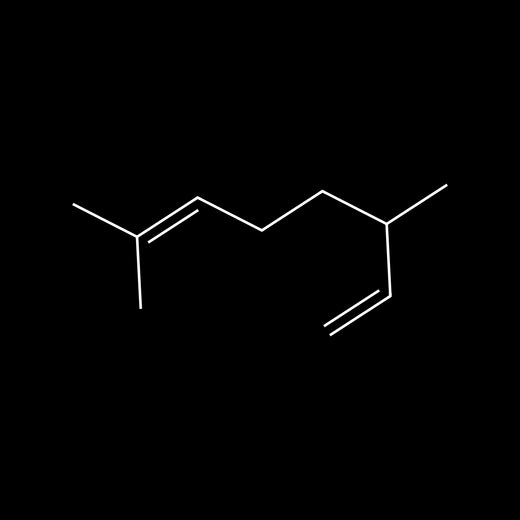
Dihydromyrcene belongs to the monoterpene hydrocarbons. Its CAS number is 2436-90-0, its molecular formula is C₁₀H₁₈ and its molecular weight is 138.25. Its IUPAC name is 3,7-dimethylocta-1,6-diene.
Odour
Dihydromyrcene smells floral and herbal, with terpenic, rose and citrus tones. Neat, it smells of citronellol with herbal, citrus and terpenic facets. Its odour strength is medium, and it is best smelled in a 10 % solution or less. Its odour lasts 4 hours at 100 %, where it smells floral and rose.
Occurrence in nature
Dihydromyrcene occurs in Corymbia citriodora, Murraya paniculata and Perilla frutescens.
Use in perfumery
It is used as a fragrance ingredient, and its function in cosmetics is perfuming.
Properties
It has an estimated boiling point of 167 to 169 °C at 760 mmHg and a flash point of 35.56 °C. Its vapour pressure is 2 mmHg at 20 °C and its estimated logP is 4.756. It is insoluble in water, with an estimated solubility of 1.669 mg/L at 25 °C.
Safety and IFRA
No IFRA Standard covers this material itself, as of the 51st Amendment. Its INCI name is DIHYDROMYRCENE and its EC number is 219-433-3. It is registered under REACH. Hazard reports class it as a category 3 flammable liquid, an aspiration hazard of category 1, a skin irritant of category 2 and a skin sensitiser of category 1.
Dihydromyrcene · Technical Sheet
Molecular weight
138.25 g/mol Heavier than 221 of the 405 other entries at the same place of the pyramid that store a weight.
2,572 entries store a molecular weight. By place in the pyramid: Top 547, Top · Heart 406, Heart 886, Heart · Base 455, Base 278.
Identity
- Type
- Ingredient
- Category
- Aroma chemicals
Classification
- Cluster
- Classic florals · 243 entries in this cluster
- Chemical class
- Hydrocarbon
Chemical data
- Formula
- C10H18
- CAS
- 2436-90-0
- PubChem CID
- 17090, compound record on PubChem
- InChIKey
- FUDNBFMOXDUIIE-UHFFFAOYSA-N
- Wikidata
- Dihydromyrcene: Q27283156, item on Wikidata
- Appearance
- Clear colourless liquid
Physical properties
- Boiling point
- 167 to 169 °C at 760 mmHg (estimated)
- Flash point
- 35.56 °C (96 °F)
- Vapour pressure
- 2 mmHg at 20 °C
- Log P
- 4.756 (estimated)
- Tenacity
- 4 hour(s) at 100 %
Performance and rules
- IFRA status
- No IFRA Standard for the material itself (51st Amendment)
Dihydromyrcene · See Also
Entries related to Dihydromyrcene, by their place in the pyramid. “shared” marks a scent word Dihydromyrcene has too.
Top notes

Dihydromyrcenol
fresh · citrus (shared) · aromatic Citrus / Synthetic / 156.26 g/mol
Melonal
fresh · fruity · sweet Green / Synthetic / 140.22 g/mol


Dihydromyrcene · Sources
- PubChem Dihydromyrcene
- Pyrfume Good Scents odour data (Pyrfume archive)
- The Good Scents Company Information System Dihydromyrcene: data sheet
- Wikidata (LOTUS natural products data) Dihydromyrcene: organisms it is reported in, with the papers
- European Commission, CosIng Dihydromyrcene: cosmetic ingredient record
- IFRA Standards, 51st Amendment
- European Chemicals Agency Dihydromyrcene: substance record
Cite as PREMIEREPEAU Glossary, “Dihydromyrcene”, https://premierepeau.com/
