


Dimethyladipate
Keywords: fruity · sweet · winey
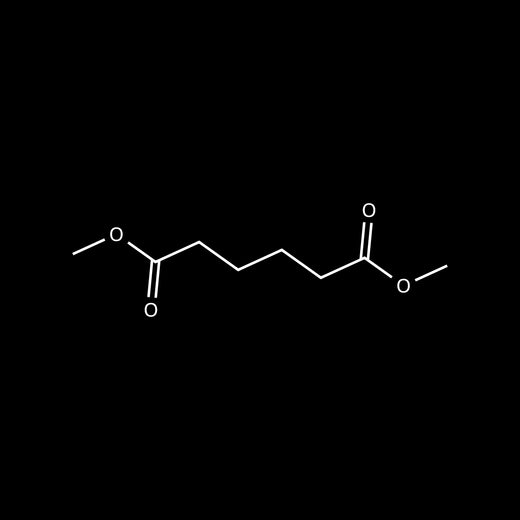
Dimethyladipate is a fatty acid methyl ester, a colourless liquid with a mild nutty odour.
- Olfactive family
- Fruity · 713 entries of the glossary in this family Subfamily: Classic fruits · 433 entries in this subfamily Cluster: Mixed fruit notes · 353 entries in this cluster
- Material
- Natural & Synthetic
- Pyramid
- Heart Note
- Strength
- Low Step 2 of 5 · shared by 118 of 2,149 graded entries Graded entries at each step, from 1 to 5: 4, 118, 1,462, 501, 40. 24 more sit between two steps.
- Also called
- Adipic acid dimethyl ester
Dimethyladipate · Facets
Entries of the glossary that carry each facet, of 3,979:
- fruity 1,299
- sweet 1,987
- winey 129
- nutty 259
Dimethyladipate · Scent
It has a mild nutty odour with fruity, sweet and winey facets.
Dimethyladipate · In Perfumery
It is a fragrance ingredient with a mild, nutty odour of low strength.
Pyramid
Dimethyladipate: Heart. Entries of the glossary stored at each place of the pyramid, of 4,000 (35 store no place):
- Top 718
- Top · Heart 496
- Heart 1,644
- Heart · Base 513
- Base 594
Dimethyladipate · Extraction & Chemistry
It is made by esterification of adipic acid with methanol in the presence of an acid catalyst.
- Appearance
- Colourless, clear liquid
Dimethyladipate · In Depth
Identity
Dimethyladipate has the CAS number 627-93-0, the formula C₈H₁₄O₄ and a molecular weight of 174.19. Its IUPAC name is dimethyl hexanedioate. It is a fatty acid methyl ester.
Odour
Dimethyladipate has a mild nutty odour with fruity, sweet and winey facets. Its odour strength is low. It also has a faint alcoholic aroma.
Occurrence in nature
It has been found in Astragalus membranaceus, Astragalus mongholicus and Astragalus trimestris.
Production
It is made by esterification of adipic acid with methanol in the presence of an acid catalyst.
Use in perfumery
It is a fragrance ingredient.
Use in flavours
It is a flavouring agent whose taste is bitter, oily and nut-skin-like. No safety concern arises at current levels of intake when it is used as a flavouring agent.
Properties
It is a colourless, clear liquid. It boils at 109 to 110 °C at 14 mmHg, melts at 9 to 11 °C and has a flash point of 107 °C. Its logP is 1.03, and it dissolves in water at 6000 mg/L at 25 °C. It is soluble in alcohol, ether and acetic acid. It is used as a plasticiser for cellulose-type resins, as a finish remover and as an alternative solvent in remover formulas.
Safety and IFRA
No IFRA Standard covers this material itself in the 51st Amendment. Its INCI name is DIMETHYL ADIPATE, its functions are skin conditioning – emollient, plasticiser and solvent, and its EC number is 211-020-6. It is registered under REACH. Of 1062 company notifications, 682 (64.2%) found that it does not meet GHS hazard criteria.
Dimethyladipate · Technical Sheet
Molecular weight
174.19 g/mol Heavier than 526 of the 885 other entries at the same place of the pyramid that store a weight; 2 weigh the same
2,572 entries store a molecular weight. By place in the pyramid: Top 547, Top · Heart 406, Heart 886, Heart · Base 455, Base 278.
Identity
- Type
- Ingredient
- Category
- Aroma chemicals
Classification
- Chemical class
- Ester
Chemical data
- Formula
- C8H14O4
- CAS
- 627-93-0
- PubChem CID
- 12329, compound record on PubChem
- InChIKey
- UDSFAEKRVUSQDD-UHFFFAOYSA-N
Physical properties
- Boiling point
- 109 to 110 °C at 14 mmHg
- Melting point
- 9 to 11 °C at 760 mmHg
- Flash point
- 107.22 °C (225 °F)
- Vapour pressure
- 0.073 mmHg at 25 °C (estimated)
- Log P
- 1.03
Performance and rules
- Available as
- synthetic
- IFRA status
- No IFRA Standard for the material itself (51st Amendment)
Dimethyladipate · See Also
Entries related to Dimethyladipate, by their place in the pyramid. « shared » marks a scent word Dimethyladipate has too.
Heart notes

Diethyl Succinate
fruity (shared) · ethereal · winey (shared) Fruity / Same cluster / 174.19 g/mol
Ethyl acetoacetate ethyleneglycol ketal
fruity (shared) · apple · sweet (shared) Fruity / Same cluster / 174.19 g/mol


Dimethyladipate · Sources
- PubChem Dimethyladipate
- ChEBI Dimethyladipate: chemical classification record
- The Good Scents Company Information System Dimethyladipate: data sheet
- Pyrfume Good Scents odour data (Pyrfume archive)
- Pyrfume Leffingwell odour data (Pyrfume archive)
- Wikidata (LOTUS natural products data) Dimethyladipate: organisms it is reported in, with the papers
- IFRA Standards, 51st Amendment
- European Commission, CosIng Dimethyladipate: cosmetic ingredient record
- European Chemicals Agency Dimethyladipate: substance record
Cite as PREMIEREPEAU Glossary, “Dimethyladipate”, https://premierepeau.com/
