


Erythorbic Acid
Keywords: vanilla · woody
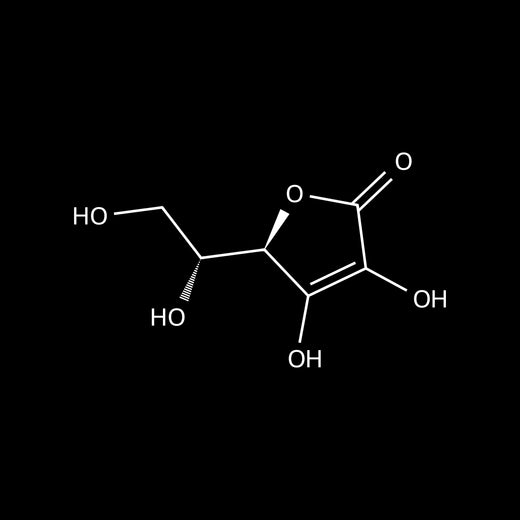
Erythorbic Acid is an isomer of ascorbic acid, a white to slightly yellow crystalline solid. It is odourless.
- Olfactive family
- Gourmand · 495 entries of the glossary in this family Subfamily: Vanilla family · 64 entries in this subfamily Cluster: Vanilla-like gourmands · 57 entries in this cluster
- Material
- Natural & Synthetic
- Pyramid
- Heart Note
Erythorbic Acid · Facets
Entries of the glossary that carry each facet, of 3,979:
- vanilla 79
- woody 790
Erythorbic Acid · Scent
It has no odour of its own at full strength.
Erythorbic Acid · In Perfumery
Erythorbic acid is odourless, so it adds no scent of its own.
Pyramid
Erythorbic Acid: Heart. Entries of the glossary stored at each place of the pyramid, of 4,000 (35 store no place):
- Top 718
- Top · Heart 496
- Heart 1,644
- Heart · Base 513
- Base 594
Erythorbic Acid · Extraction & Chemistry
Erythorbic acid is synthesised by the reaction between methyl 2-keto-D-gluconate and sodium methoxide. It can also be synthesised from sucrose and produced from Penicillium spp.
- Appearance
- White to slightly yellow crystalline solid
Erythorbic Acid · In Depth
Identity
Erythorbic Acid has the CAS number 89-65-6 and the IUPAC name (2R)-2-[(1R)-1,2-dihydroxyethyl]-3,4-dihydroxy-2H-furan-5-one. Its molecular formula is C₆H₈O₆ and its molecular weight is 176.12 g/mol.
It belongs to the ascorbic acid class and is an isomer of ascorbic acid.
Odour
Erythorbic Acid is odourless, although vanilla and woody are also named for it. At 100 % it has no odour.
Occurrence in nature
It occurs in Flammulina velutipes, Grifola frondosa and Hypsizygus marmoreus.
Production
Erythorbic acid is synthesised by the reaction between methyl 2-keto-D-gluconate and sodium methoxide. It can also be synthesised from sucrose and produced from Penicillium spp.
Use in flavours
Erythorbic acid is added to food as an antimicrobial agent, antioxidant, colour or colouring adjunct, curing or pickling agent, flavour enhancer and flavouring agent or adjuvant. It is used as an antioxidant in the brewing industry and as a reducing agent in photography.
Properties
It forms shiny granular crystals from water or dioxane, and darkens gradually on exposure to light.
It melts at about 164 °C to 172 °C with decomposition. It dissolves to the extent of 40 g in 100 mL of water at 25 °C and is soluble in alcohol and pyridine.
Its estimated logP is −2.779.
Safety and IFRA
The 51st Amendment is in force, and no IFRA Standard covers this material itself.
Its INCI name is ERYTHORBIC ACID, and its function in cosmetics is antioxidant. Its EC number is 201-928-0 and it is registered under REACH.
Erythorbic Acid · Technical Sheet
Molecular weight
176.12 g/mol Heavier than 538 of the 885 other entries at the same place of the pyramid that store a weight
2,572 entries store a molecular weight. By place in the pyramid: Top 547, Top · Heart 406, Heart 886, Heart · Base 455, Base 278.
Identity
- Type
- Ingredient
- Category
- Aroma chemicals
Classification
- Chemical class
- Carboxylic acid
Chemical data
- Formula
- C6H8O6
- CAS
- 89-65-6
- PubChem CID
- 54675810, compound record on PubChem
- InChIKey
- CIWBSHSKHKDKBQ-DUZGATOHSA-N
Physical properties
- Boiling point
- 552 to 553 °C at 760 mmHg (estimated)
- Melting point
- 164 to 171 °C at 760 mmHg
- Flash point
- > 110 °C (> 230 °F)
- Log P
- −2.779 (estimated)
Performance and rules
- Available as
- synthetic
- IFRA status
- No IFRA Standard for the material itself (51st Amendment)
Erythorbic Acid · See Also
Entries related to Erythorbic Acid, by their place in the pyramid.
Heart notes

DL-Tartaric acid
caramellic · mild Gourmand / 150.09 g/mol

Erythorbic Acid · Sources
- PubChem Erythorbic Acid
- The Good Scents Company Information System Erythorbic Acid: data sheet
- ChEBI Erythorbic Acid: chemical classification record
- Pyrfume Good Scents odour data (Pyrfume archive)
- Pyrfume Leffingwell odour data (Pyrfume archive)
- Wikidata (LOTUS natural products data) Erythorbic Acid: organisms it is reported in, with the papers
- IFRA Standards, 51st Amendment
- European Commission, CosIng Erythorbic Acid: cosmetic ingredient record
- European Chemicals Agency Erythorbic Acid: substance record
Cite as PREMIEREPEAU Glossary, “Erythorbic Acid”, https://premierepeau.com/
