


Farnesal
Keywords: oily · woody · citrus
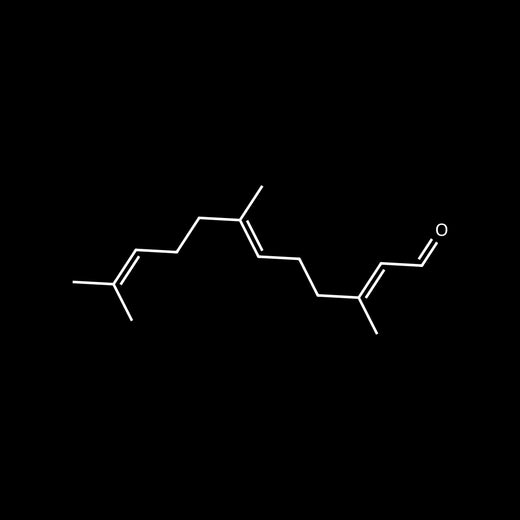
Farnesal is a farnesane sesquiterpenoid and enal with the formula C₁₅H₂₄O that smells oily, woody and citrus.
- Olfactive family
- Woods · 364 entries of the glossary in this family Subfamily: Classic woods · 131 entries in this subfamily Cluster: Earthy woods · 237 entries in this cluster
- IFRA status
- Restricted
- Pyramid
- Heart-to-Base
- Also called
- 2,6,10-Trimethyl-2,6,10-dodecatrien-12-al
Farnesal · Facets
Entries of the glossary that carry each facet, of 3,979:
- oily 238
- woody 791
- citrus 488
- sweet 1,987
- floral 1,547
- minty 108
Farnesal · Scent
It smells oily and woody, with citrus, sweet, floral and minty facets.
Farnesal · In Perfumery
It is a fragrance ingredient with an oily, woody and citrus odour.
Pyramid
Farnesal: Heart · Base. Entries of the glossary stored at each place of the pyramid, of 4,000 (35 store no place):
- Top 718
- Top · Heart 496
- Heart 1,644
- Heart · Base 513
- Base 594
Farnesal · In Depth
Identity
Farnesal has the CAS number 19317-11-4 and the molecular formula C₁₅H₂₄O. Its molecular weight is 220.35 g/mol and its IUPAC name is 3,7,11-trimethyldodeca-2,6,10-trienal. It belongs to the farnesane sesquiterpenoid and enal classes.
Odour
Farnesal smells oily and woody, with citrus, sweet, floral and minty facets. At 100 % its odour is floral and minty.
Occurrence in nature
It occurs in Abies firma, Artemisia annua, Nicotiana alata and Suidasia medanensis.
Use in perfumery
It is a fragrance ingredient with a perfuming function in cosmetics.
Use in flavours
It is used as a flavouring agent with a mint and cool flavour profile. The Joint FAO/WHO Expert Committee on Food Additives found no safety concern at current levels of intake when it is used as a flavouring agent.
Properties
It boils at 198 to 201 °C at 8 mmHg. It is insoluble in water, soluble in ethanol and 50 % soluble in heptane and triacetin. Its density is 0.890 to 0.900 and its refractive index is 1.494 to 1.504. Its flash point is above 100 °C and its estimated logP is 5.013.
Safety and IFRA
Under the 51st Amendment in force, an IFRA Standard named Farnesal exists and the material is restricted under it. Its INCI name is FARNESAL, its function is perfuming and its EC number is 242-957-9. It causes skin irritation and may cause an allergic skin reaction.
Farnesal · Technical Sheet
Molecular weight
220.35 g/mol Heavier than 308 of the 454 other entries at the same place of the pyramid that store a weight; 13 weigh the same
2,572 entries store a molecular weight. By place in the pyramid: Top 547, Top · Heart 406, Heart 886, Heart · Base 455, Base 278.
Identity
- Type
- Ingredient
- Category
- Aroma chemicals
Chemical data
- Formula
- C15H24O
- CAS
- 19317-11-4
- PubChem CID
- 68150, compound record on PubChem
- InChIKey
- YHRUHBBTQZKMEX-UHFFFAOYSA-N
- Wikidata
- Q27109827, item on Wikidata
- Appearance
- Clear yellow liquid
Physical properties
- Boiling point
- 126 to 129 °C at 3.5 mmHg
- Flash point
- > 100 °C (> 212 °F)
- Density
- 0.890-0.900
- Refractive index
- 1.494-1.504
- Vapour pressure
- 0.000187 mmHg at 25 °C (estimated)
- Log P
- 5.013 (estimated)
Performance and rules
- IFRA status
- Restricted — IFRA Standard « Farnesal » (Amendment 49)
Farnesal · See Also
Entries related to Farnesal, by their place in the pyramid. « shared » marks a scent word Farnesal has too.
Heart notes

Dihydro-beta-ionol
floral (shared) · woody (shared) · sweet (shared) Woods / Heart · Base / Same cluster / 196.33 g/mol
1-Tridecanol
woody (shared) · fruity · waxy Woods / Heart · Base / Same cluster / Natural & Synthetic / 200.36 g/mol


Farnesal · Sources
- PubChem Farnesal
- Pyrfume Arctander, Perfume and Flavor Chemicals: odour descriptions (Pyrfume archive)
- Pyrfume Good Scents odour data (Pyrfume archive)
- Pyrfume Leffingwell odour data (Pyrfume archive)
- ChEBI Farnesal: chemical classification record
- The Good Scents Company Information System Farnesal: data sheet
- Wikidata (LOTUS natural products data) Farnesal: organisms it is reported in, with the papers
- European Commission, CosIng Farnesal: cosmetic ingredient record
- IFRA Standards, 51st Amendment
- European Chemicals Agency Farnesal: substance record
Cite as PREMIEREPEAU Glossary, “Farnesal”, https://premierepeau.com/pages/glossary-terms/farnesal Updated 2026-11-18
