


Glyceryl Acetate
Keywords: musty · sour
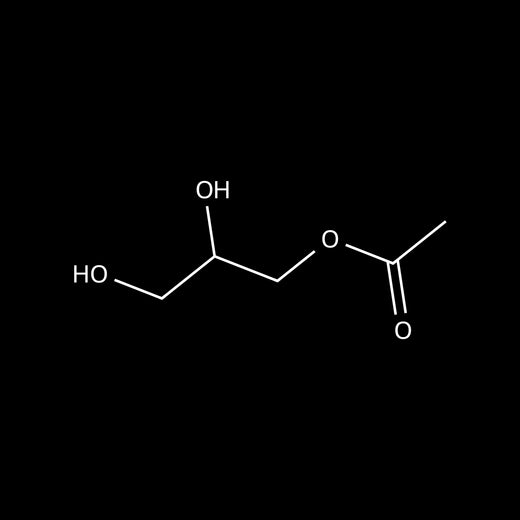
Glyceryl Acetate is 2,3-dihydroxypropyl acetate, a thick, very hygroscopic liquid with a faint musty and sour odour.
- Olfactive family
- Earthy · 87 entries of the glossary in this family Subfamily: Earthy woods · 117 entries in this subfamily
- Material
- Natural & Synthetic
- Pyramid
- Top-Heart Note
Glyceryl Acetate · Facets
Entries of the glossary that carry each facet, of 3,979:
- musty 129
- sour 45
Glyceryl Acetate · Scent
It has a faint, musty and sour odour that changes with the age and quality of the material.
Glyceryl Acetate · In Perfumery
It contributes only a faint musty and sour note.
Pyramid
Glyceryl Acetate: Top · Heart. Entries of the glossary stored at each place of the pyramid, of 4,000 (35 store no place):
- Top 718
- Top · Heart 496
- Heart 1,644
- Heart · Base 513
- Base 594
Glyceryl Acetate · Extraction & Chemistry
It is obtained, together with the di- and triacetates, by heating glycerol with glacial acetic acid. It can also be made by heating glycerol with strong acetic acid, distilling off the weak acetic acid formed, heating again with strong acetic acid and distilling, with rectification as the method of purification.
- Appearance
- Colourless, thick liquid
Glyceryl Acetate · In Depth
Identity
Glyceryl Acetate is 2,3-dihydroxypropyl acetate, with the CAS number 106-61-6, the formula C₅H₁₀O₄ and a molecular weight of 134.13 g/mol.
Odour
Glyceryl Acetate smells faintly musty and sour.
The odour varies with the age and quality of the material, and the commercial grade almost always has a sour note.
Occurrence in nature
It occurs in Clathria pyramida and Penicillium commune.
Production
It is obtained, together with the di- and triacetates, by heating glycerol with glacial acetic acid. It can also be made by heating glycerol with strong acetic acid, distilling off the weak acetic acid formed, heating again with strong acetic acid and distilling, with rectification as the method of purification.
Use in flavours
It serves as a carrier solvent for food additives and is itself used as a food additive.
Properties
It boils at 129 to 131 °C at 3 mmHg and has a density of 1.206 at 20 °C. Its vapour pressure is 3 mmHg at 130 °C. It is soluble in water and alcohol, slightly soluble in ether and insoluble in benzene. The material is very hygroscopic.
It is used as a solvent for basic dyes, in tanning leather and in making smokeless powder and dynamite.
Safety and IFRA
No IFRA Standard covers this material itself. Its EC number is 203-415-7. It carries the hazard statement H302, harmful if swallowed. Its acceptable daily intake is a group value shared with glycerol, glyceryl diacetate and glyceryl triacetate.
Glyceryl Acetate · Technical Sheet
Molecular weight
134.13 g/mol Heavier than 118 of the 405 other entries at the same place of the pyramid that store a weight; 1 weigh the same.
2,572 entries store a molecular weight. By place in the pyramid: Top 547, Top · Heart 406, Heart 886, Heart · Base 455, Base 278.
Identity
- Type
- Ingredient
- Category
- Aroma chemicals
Classification
- Cluster
- Earthy woods · 236 entries in this cluster
- Chemical class
- Ester
Chemical data
- Formula
- C5H10O4
- CAS
- 106-61-6
- PubChem CID
- 33510, compound record on PubChem
- InChIKey
- KMZHZAAOEWVPSE-UHFFFAOYSA-N
- Wikidata
- Glyceryl Acetate: Q27252646, item on Wikidata
Physical properties
- Boiling point
- 129–131 °C at 3 MM HG
- Melting point
- FP: −78 °C
- Density
- 1.206 at 20 °C/4 °C
- Vapour pressure
- 0.00392
Performance and rules
- Available as
- synthetic
- IFRA status
- No IFRA Standard for the material itself (51st Amendment)
Glyceryl Acetate · See Also
Entries related to Glyceryl Acetate, by their place in the pyramid.
Heart notes

Diethyl Malonate
fruity · apple · green Fruity / Natural & Synthetic / 160.17 g/mol

Glyceryl Acetate · Sources
- PubChem Glyceryl Acetate
- Pyrfume Arctander, Perfume and Flavor Chemicals: odour descriptions (Pyrfume archive)
- Wikidata (LOTUS natural products data) Glyceryl Acetate: organisms it is reported in, with the papers
- IFRA Standards, 51st Amendment
- European Chemicals Agency Glyceryl Acetate: substance record
Cite as PREMIEREPEAU Glossary, “Glyceryl Acetate”, https://premierepeau.com/
