


Hexachloroethane
Keywords: camphoraceous · medicinal
Hexachloroethane is ethane in which all the hydrogens are replaced by chloro groups. It has a mild camphor-like, medicinal odour.
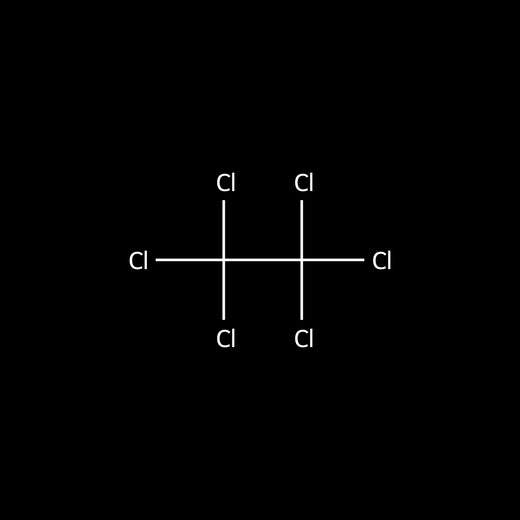
- Olfactive family
- Aromatic · 509 entries of the glossary in this family Subfamily: Classic aromatics · 164 entries in this subfamily Cluster: Camphoraceous aromatics · 114 entries in this cluster
- Material
- Synthetic
- Pyramid
- Heart · Base · Volatility: Heart · Base
Hexachloroethane · Facets
Entries of the glossary that carry each facet, of 3,979:
- camphoraceous 140
- medicinal 82
Hexachloroethane · Scent
It has a camphoraceous, medicinal odour.
Hexachloroethane · In Perfumery
It brings a mild camphor-like odour of moderate tenacity, less medicinal than camphor.
Pyramid
Hexachloroethane: Heart · Base. Entries of the glossary stored at each place of the pyramid, of 4,000 (36 store no place):
- Top 718
- Top · Heart 497
- Heart 1,641
- Heart · Base 514
- Base 594
Hexachloroethane · Extraction & Chemistry
It is formed as a by-product of the chlorination of ethylene and propylene with excess chlorine in the vapour phase at 550 to 650 °C without a catalyst. In the presence of catalysts, trichloroethylene is readily chlorinated to hexachloroethane. It also arises as a by-product of trichloroethylene and perchloroethylene production, and of perchloroethylene and carbon tetrachloride production. It is contained in pyrotechnics, where it inhibits the explosiveness of methane and the combustion of ammonium perchlorate, and smoke containing it is used to extinguish fires. It is also used in organic synthesis, as a retarding agent in fermentation, as a camphor substitute in nitrocellulose, as a solvent and in explosives.
- Appearance
- Colourless crystals
Hexachloroethane · In Depth
Identity
Hexachloroethane has the CAS number 67-72-1, the molecular formula C₂Cl₆ and a molecular weight of 236.7 g/mol. Its systematic name is 1,1,1,2,2,2-hexachloroethane. It is a chloroethane and a chlorocarbon, with all the hydrogens of ethane replaced by chloro groups.
Odour
It has a camphoraceous, medicinal odour. Its odour is a mild camphor-like one of moderate tenacity, and not as medicinal as that of camphor.
Occurrence in nature
It is found in Aegle marmelos.
Production
It is formed as a by-product of the chlorination of ethylene and propylene with excess chlorine in the vapour phase at 550 to 650 °C without a catalyst. In the presence of catalysts, trichloroethylene is readily chlorinated to hexachloroethane. It also arises as a by-product of trichloroethylene and perchloroethylene production, and of perchloroethylene and carbon tetrachloride production. It is contained in pyrotechnics, where it inhibits the explosiveness of methane and the combustion of ammonium perchlorate, and smoke containing it is used to extinguish fires.
It is also used in organic synthesis, as a retarding agent in fermentation, as a camphor substitute in nitrocellulose, as a solvent and in explosives.
Properties
It forms colourless crystals that sublime at 185 °C. The crystals are rhombic below 46 °C, triclinic from 46 to 71 °C and cubic above 71 °C. Its density is 2.091 g per cubic centimetre at 20 °C, so it is denser than water. It is soluble in alcohol, benzene, chloroform, ether and oils. Its solubility in water is 50 mg/L at 20 °C.
Safety and IFRA
No IFRA Standard covers this material itself, as of the 51st Amendment. It acts as a carcinogenic agent and as a refrigerant. It may cause cancer and is very toxic to aquatic life with long lasting effects. Its INCI name is Hexachloroethane, its EC number is 200-666-4 and it is registered under REACH.
Hexachloroethane · Technical Sheet
Molecular weight
236.7 g/mol Heavier than 431 of the 451 other entries at the same place of the pyramid that store a weight.
2,515 entries store a molecular weight. By place in the pyramid: Top 537, Top · Heart 403, Heart 861, Heart · Base 452, Base 262.
Identity
- Type
- Ingredient
- Category
- Aroma chemicals
Chemical data
- Formula
- C2Cl6
- CAS
- 67-72-1
- PubChem CID
- 6214, compound record on PubChem
- InChIKey
- VHHHONWQHHHLTI-UHFFFAOYSA-N
- Wikidata · Wikipedia
- Hexachloroethane: Q415988, item on Wikidata · Wikipedia, English article
Labelling
- EU cosmetics annexes
- CosIng, Annex II, entry 197 · prohibited in cosmetic products
“Hexachloroethane”
Physical properties
- Boiling point
- Sublimes at 185 °C
- Melting point
- Sublimes
- Density
- 2.091 g/cm³ at 20 °C
Performance and rules
- Available as
- synthetic
- IFRA status
- No IFRA Standard for the material itself (51st Amendment)
Hexachloroethane · See Also


Hexachloroethane · Sources
- PubChem Hexachloroethane
- ChEBI Hexachloroethane: chemical classification record
- Pyrfume Arctander, Perfume and Flavor Chemicals: odour descriptions (Pyrfume archive)
- Wikidata (LOTUS natural products data) Hexachloroethane: organisms it is reported in, with the papers
- IFRA Standards, 51st Amendment
- European Commission, CosIng Hexachloroethane: cosmetic ingredient record
- European Chemicals Agency Hexachloroethane: substance record
Cite as PREMIEREPEAU Glossary, “Hexachloroethane”, https://premierepeau.com/
