


Hexanoic Acid
Keywords: fatty · cheesy · sour
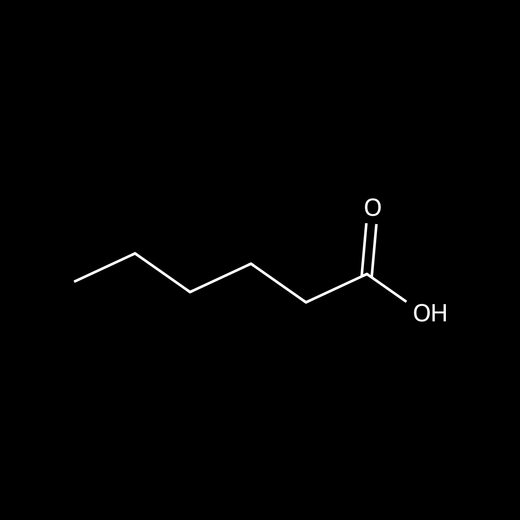
Hexanoic Acid is a straight-chain saturated fatty acid with a heavy, fatty, cheesy and sour odour, often described as sweat-like.
- Olfactive family
- Gourmand · 494 entries of the glossary in this family Subfamily: Creamy gourmands · 93 entries in this subfamily Cluster: Classic gourmands · 182 entries in this cluster
- Pyramid
- Top Note
- Strength
- Medium Step 3 of 5 · shared by 1,469 of 2,161 graded entries Graded entries at each step, from 1 to 5: 4, 117, 1,469, 507, 40. 24 more sit between two steps.
- Also called
- Caproic acid, n-Hexanoic acid, n-Caproic acid, Acid C6, Hexanoic acid (caproic acid), Ethyl 4-butanoic acid
Hexanoic Acid · Facets
Entries of the glossary that carry each facet, of 3,979:
- fatty 266
- cheesy 80
- sour 46
- acid 7
- cheese 15
- sweaty 7
Hexanoic Acid · Scent
Hexanoic Acid smells fatty, cheesy and sour, with a heavy, sweat-like edge.
Hexanoic Acid · In Perfumery
Hexanoic Acid is used as a fragrance ingredient with a heavy, fatty, cheesy and sour odour.
Pyramid
Hexanoic Acid: Top. Entries of the glossary stored at each place of the pyramid, of 4,000 (35 store no place):
- Top 718
- Top · Heart 501
- Heart 1,646
- Heart · Base 512
- Base 588
Hexanoic Acid · Did You Know?
Caproic acid serves as a lure for the green June beetle, Cotinus nitida.
Hexanoic Acid · In Depth
Identity
Hexanoic Acid carries the CAS number 142-62-1, the molecular formula C₆H₁₂O₂ and a molecular weight of 116.16. It is a straight-chain saturated fatty acid and a medium-chain fatty acid, also called caproic acid.
Odour
It smells fatty, cheesy and sour, with a sweaty edge. The odour is heavy, acrid-acid and fatty-rancid, often described as sweat-like. Its characteristic odour is also described as goat-like, and as that of Limburger cheese. At 10 % in propylene glycol it smells sour, fatty, sweaty and cheesy. Its odour strength is medium, and smelling it in a 10 % solution or less is recommended. Its substantivity exceeds 336 hours at 100 %.
Occurrence in nature
It occurs in Actaea simplex, Annona muricata, Arabidopsis thaliana, Artemisia xerophytica, Caenorhabditis elegans, Canarium album, Capsicum annuum var. annuum, Carica papaya, Chrozophora obliqua, Chrozophora plicata, Chrozophora tinctoria and Chrozophora verbascifolia. It acts as a plant metabolite and a human metabolite.
Use in perfumery
It is used as a fragrance ingredient.
Use in flavours
It is used as a flavouring agent, and to make esters for artificial flavours. Its flavour profile is cheese, oil, pungent and sour, and its taste is cheesy, fruity, phenolic, fatty and goaty.
Properties
Its boiling point is 205.8 °C and its melting point is -3.4 °C. Its flash point is 102 °C in an open cup and its logP is 1.92. It has an estimated vapour pressure of 0.158 mmHg at 25 °C. It dissolves in water to 10.3 mg/mL and is readily soluble in ethanol and ether.
Safety and IFRA
No IFRA Standard covers this material itself, as of the 51st Amendment. Its INCI name is CAPROIC ACID and its functions are cleansing, surfactant, emulsifying, fragrance and perfuming. Its EC number is 205-550-7 and it is registered under REACH. Its hazard statements include H314, causes severe skin burns and eye damage, H318, causes serious eye damage, and H311, toxic in contact with skin.
Hexanoic Acid · Technical Sheet
Molecular weight
116.16 g/mol Heavier than 324 of the 546 other entries at the same place of the pyramid that store a weight; 16 weigh the same
2,572 entries store a molecular weight. By place in the pyramid: Top 547, Top · Heart 411, Heart 888, Heart · Base 454, Base 272.
Identity
- Type
- Ingredient
- Category
- Aroma chemicals
Classification
- Chemical class
- Carboxylic acid
Chemical data
- Formula
- C6H12O2
- CAS
- 142-62-1
- PubChem CID
- 8892, compound record on PubChem
- InChIKey
- FUZZWVXGSFPDMH-UHFFFAOYSA-N
- Appearance
- Colourless to very pale yellow, oily liquid
Physical properties
- Boiling point
- 202 to 203 °C at 760 mmHg
- Melting point
- -4 to -3 °C at 760 mmHg
- Flash point
- 104.44 °C (220 °F)
- Vapour pressure
- 0.158 mmHg at 25 °C (estimated)
- Log P
- 1.92
- Tenacity
- > 336 hour(s) at 100 %
Performance and rules
- Odour threshold
- 600 ppt to 2.6 ppb in air (3 studies) · Abraham et al. 2012
- IFRA status
- No IFRA Standard for the material itself (51st Amendment)
Hexanoic Acid · See Also
Entries related to Hexanoic Acid, by their place in the pyramid. « shared » marks a scent word Hexanoic Acid has too.
Top notes

(2E)-2-Hexenoic acid
fruity · fatty (shared) · sweet Gourmand / Same cluster / 114.14 g/mol
3-Methylpentanoic acid
cheesy (shared) · green · acidic Gourmand / Same cluster / 116.16 g/mol
Isocaproic acid
pungent · sour (shared) · cheesy (shared) Gourmand / Same cluster / 116.16 g/mol
Methyl hexanoate
ethereal · pineapple · apricot Fruity / Top · Heart / 130.18 g/mol
2-Methylbutanoic Acid
cheesy (shared) · fruity · pungent Fruity / 102.13 g/mol


Heart notes

Butyl hexanoate
fruity · pineapple · berry Fruity / 172.26 g/mol
Hexyl Hexanoate
fruity · green · vegetable Fruity / Heart · Base / 200.32 g/mol
Isoamyl hexanoate
pineapple · apple · banana Fruity / 186.29 g/mol
Isobutyl hexanoate
pineapple · fruity · sweet Fruity / 172.26 g/mol
Propyl hexanoate
pineapple · fruity · green Fruity / 158.24 g/mol
Phenethyl hexanoate
banana · green · rose Fruity / Heart · Base / 220.31 g/mol
Benzyl hexanoate
apricot · floral · fruity Fruity / Heart · Base / 206.28 g/mol


Hexanoic Acid · Sources
- PubChem Hexanoic Acid
- ChEBI Hexanoic Acid: chemical classification record
- Pyrfume Arctander, Perfume and Flavor Chemicals: odour descriptions (Pyrfume archive)
- The Good Scents Company Information System Hexanoic Acid: data sheet
- European Commission, CosIng Hexanoic Acid: cosmetic ingredient record
- Pyrfume Good Scents odour data (Pyrfume archive)
- Pyrfume Leffingwell odour data (Pyrfume archive)
- Wikidata (LOTUS natural products data) Hexanoic Acid: organisms it is reported in, with the papers
- IFRA Standards, 51st Amendment
- European Chemicals Agency Hexanoic Acid: substance record
Cite as PREMIEREPEAU Glossary, “Hexanoic Acid”, https://premierepeau.com/pages/glossary-terms/hexanoic-acid Updated 2026-11-18
