


Hinokitiol
Keywords: phenolic · woody · mossy
Hinokitiol is a monoterpenoid and cyclic ketone that smells phenolic, woody and mossy. It forms colourless to pale yellow crystals.
- Olfactive family
- Woods · 363 entries of the glossary in this family Subfamily: Classic woods · 130 entries in this subfamily Cluster: Earthy woods · 236 entries in this cluster
- Pyramid
- Heart Note
- Strength
- Medium Step 3 of 5 · shared by 1,462 of 2,149 graded entries Graded entries at each step, from 1 to 5: 4, 118, 1,462, 501, 40. 24 more sit between two steps.
Hinokitiol · Facets
Entries of the glossary that carry each facet, of 3,979:
- phenolic 94
- woody 790
- mossy 22
Hinokitiol · Scent
It smells phenolic and woody, with a mossy facet.
Hinokitiol · In Perfumery
It is a fragrance ingredient with a phenolic, woody and mossy odour of medium strength.
Pyramid
Hinokitiol: Heart. Entries of the glossary stored at each place of the pyramid, of 4,000 (35 store no place):
- Top 718
- Top · Heart 496
- Heart 1,644
- Heart · Base 513
- Base 594
Hinokitiol · In Depth
Identity
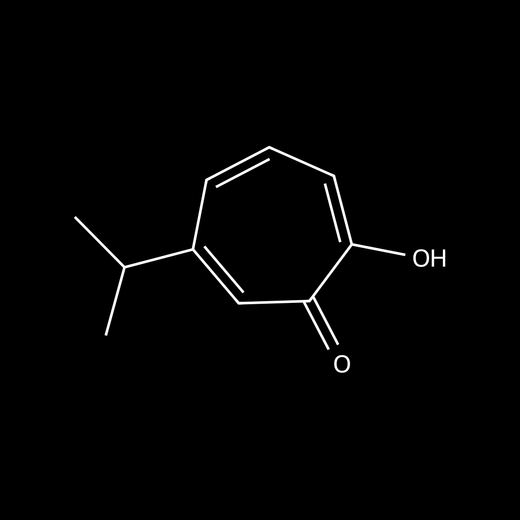
Hinokitiol has the CAS number 499-44-5 and the molecular formula C₁₀H₁₂O₂. Its molecular weight is 164.2 g/mol and its IUPAC name is 2-hydroxy-6-propan-2-ylcyclohepta-2,4,6-trien-1-one. It is a monoterpenoid, an enol and a cyclic ketone, a cyclohepta-2,4,6-trien-1-one carrying a hydroxy group at position 2 and an isopropyl group at position 4. It acts as an antibacterial, antifungal and antineoplastic agent and as an antiplasmodial drug, and it is a plant metabolite.
Odour
It smells phenolic and woody, with a mossy facet. Its odour lasts 48 hours at 100 %.
Occurrence in nature
It is isolated from Thuja plicata and Chamaecyparis obtusa. It has also been found in Calocedrus formosana, Chamaecyparis formosensis, Cupressus macrocarpa, Cupressus sargentii, Juniperus communis, Thuja occidentalis and Ganoderma applanatum.
Use in perfumery
It is a fragrance ingredient with a phenolic, woody and mossy odour.
Properties
It boils at 303 to 304 °C, or at 140 °C at 10 mmHg. It melts at 52 to 52.5 °C. Its solubility in water is 1200 mg/L at 25 °C, and it is soluble in alcohol. Its logP is 1.82 and its flash point is above 100 °C.
Safety and IFRA
No IFRA Standard covers this material itself, as of the 51st Amendment. Its INCI name is HINOKITIOL and its cosmetic functions are antistatic and hair conditioning. Its EC number is 207-880-7. All classifications mark it as harmful if swallowed, in acute oral toxicity category 4.
Hinokitiol · Technical Sheet
Molecular weight
164.20 g/mol Heavier than 307 of the 885 other entries at the same place of the pyramid that store a weight; 18 weigh the same
2,572 entries store a molecular weight. By place in the pyramid: Top 547, Top · Heart 406, Heart 886, Heart · Base 455, Base 278.
Identity
- Type
- Ingredient
- Category
- Aroma chemicals
Classification
- Chemical class
- Alcohol
Chemical data
- Formula
- C10H12O2
- CAS
- 499-44-5
- PubChem CID
- 3611, compound record on PubChem
- InChIKey
- FUWUEFKEXZQKKA-UHFFFAOYSA-N
- Appearance
- Colourless to pale yellow crystals
Physical properties
- Boiling point
- 303 to 304 °C at 760 mmHg
- Melting point
- 48 to 53 °C at 760 mmHg
- Flash point
- > 100 °C (> 212 °F)
- Vapour pressure
- 0.000089 mmHg at 25 °C (estimated)
- Log P
- 1.137 (estimated)
- Tenacity
- 48 hour(s) at 100 %
Performance and rules
- IFRA status
- No IFRA Standard for the material itself (51st Amendment)
Hinokitiol · See Also
Entries related to Hinokitiol, by their place in the pyramid. « shared » marks a scent word Hinokitiol has too.
Heart notes

Hinoki Wood
woody (shared) · warm · earthy Woods / Natural
False Cypress
woody (shared) · fresh · earthy Woods / Natural


Base notes

Hiba
woody (shared) · rich · balsamic Woods / Same cluster / Natural

Hinokitiol · Sources
- PubChem Hinokitiol
- ChEBI Hinokitiol: chemical classification record
- Pyrfume Good Scents odour data (Pyrfume archive)
- Pyrfume Leffingwell odour data (Pyrfume archive)
- The Good Scents Company Information System Hinokitiol: data sheet
- Wikidata (LOTUS natural products data) Hinokitiol: organisms it is reported in, with the papers
- IFRA Standards, 51st Amendment
- European Commission, CosIng Hinokitiol: cosmetic ingredient record
Cite as PREMIEREPEAU Glossary, “Hinokitiol”, https://premierepeau.com/
