


Isophytol
Keywords: leafy · tea · sweet
Isophytol is an oily liquid with a delicate, dry-leaf, tea-like and slightly caramellic-sweet odour. It is a fragrance ingredient and is used as a diluent in fine fragrances.
- Olfactive family
- Gourmand · 494 entries of the glossary in this family Subfamily: Caramel notes · 81 entries in this subfamily Cluster: Caramel-like gourmands · 80 entries in this cluster
- Material
- Natural & Synthetic
- Pyramid
- Base Note
- Strength
- Low Step 2 of 5 · shared by 117 of 2,161 graded entries Graded entries at each step, from 1 to 5: 4, 117, 1,469, 507, 40. 24 more sit between two steps.
- Also called
- Isophytol [mi]
Isophytol · Facets
Entries of the glossary that carry each facet, of 3,979:
- leafy 84
- tea 26
- sweet 1,990
- floral 1,551
- caramellic 111
- banana 79
Isophytol · Scent
Leafy and tea-like, with a sweet, caramelic and floral character. The odour is delicate, dry-leaf and slightly caramellic-sweet.
Isophytol · In Perfumery
It serves as a diluent in higher price fragrances and as a fragrance ingredient.
Pyramid
Isophytol: Base. Entries of the glossary stored at each place of the pyramid, of 4,000 (35 store no place):
- Top 718
- Top · Heart 501
- Heart 1,646
- Heart · Base 512
- Base 588
Isophytol · Extraction & Chemistry
Isophytol is formed by transition-metal-catalysed addition of malonic ester to myrcene and subsequent acidification. It can also be synthesised from linalool or citral, from acetylene, and from pseudoionone and propargyl alcohol.
- Appearance
- Colourless clear viscous liquid (estimated)
Isophytol · Did You Know?
Isophytol is a decomposition product of chlorophyll, and the industrial synthesis of phytol starts from it.
Isophytol · In Depth
Identity
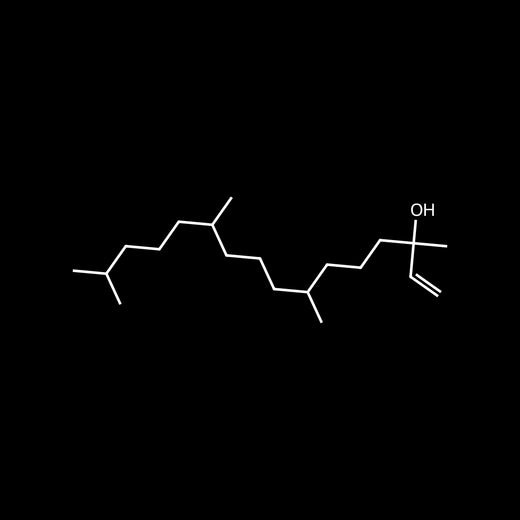
Isophytol has the CAS number 505-32-8 and the molecular formula C₂₀H₄₀O. Its molecular weight is 296.5 g/mol and its IUPAC name is 3,7,11,15-tetramethylhexadec-1-en-3-ol.
Odour
Leafy and tea-like, with a sweet, caramelic and floral character. It is virtually odourless and tasteless when absolutely pure, but normally carries a delicate, dry-leaf, tea-like and slightly caramellic-sweet odour. At 100 % it is mild, floral, herbal and green. Its odour strength is low and its substantivity is 68 hours at 100 %.
Occurrence in nature
It has been found in Allium ampeloprasum, Artemisia, Evernia prunastri, Hamamelis virginiana and Hordeum vulgare.
Production
Isophytol is formed by transition-metal-catalysed addition of malonic ester to myrcene and subsequent acidification. It can also be synthesised from linalool or citral, from acetylene, and from pseudoionone and propargyl alcohol.
Use in perfumery
It is used as a diluent in higher price fragrances. Cosmetic rules class it as a perfuming ingredient.
Use in flavours
It is used as a flavouring agent in Europe. Its flavour type is described as oily and citrus.
Properties
It is a colourless, clear, viscous liquid (estimated). It boils at 303 to 309 °C at 760 mmHg. Its density is 0.8519 at 20 °C/4 °C and its refractive index is 1.4571 at 20 °C. Its flash point is 135 °C. It is very soluble in benzene, ether and ethanol. Its logP is estimated at 8.067.
Safety and IFRA
No IFRA Standard covers this material itself. Its INCI name is TETRAMETHYL-1-HEXADECEN-3-OL, with the function perfuming. Its EC number is 208-008-8 and it is registered under REACH. It causes skin irritation and is very toxic to aquatic life with long lasting effects.
Isophytol · Technical Sheet
Molecular weight
296.5 g/mol Heavier than 232 of the 271 other entries at the same place of the pyramid that store a weight; 2 weigh the same
2,572 entries store a molecular weight. By place in the pyramid: Top 547, Top · Heart 411, Heart 888, Heart · Base 454, Base 272.
Identity
- Type
- Ingredient
- Category
- Aroma chemicals
Classification
- Chemical class
- Alcohol
Chemical data
- Formula
- C20H40O
- CAS
- 505-32-8
- PubChem CID
- 10453, compound record on PubChem
- InChIKey
- KEVYVLWNCKMXJX-UHFFFAOYSA-N
Physical properties
- Boiling point
- 303 to 309 °C at 760 mmHg
- Flash point
- 135 °C (275 °F)
- Density
- 0.8519 at 20 °C/4 °C
- Refractive index
- 1.4571 at 20 °C
- Vapour pressure
- 0.000014 mmHg at 25 °C (estimated)
- Log P
- 8.067 (estimated)
- Tenacity
- 68 hour(s) at 100 %
Performance and rules
- Available as
- synthetic
- IFRA status
- No IFRA Standard for the material itself (51st Amendment)
Isophytol · See Also
Entries related to Isophytol, by their place in the pyramid. « shared » marks a scent word Isophytol has too.
Top notes

Maleic Acid
caramellic (shared) · winey Gourmand / Same cluster / Natural & Synthetic / 116.07 g/mol
Propargyl alcohol
geranium · gassy · green Florals / Natural & Synthetic / 56.06 g/mol


Heart notes

Benzyl Acetate
floral (shared) · jasmine · fruity Florals / Natural & Synthetic / 150.17 g/mol
Jasmine
floral (shared) Florals / Natural
Jasmine Orchid
floral (shared) · sweet (shared) · rich Florals / Fantasy/Concept
Pseudoionone
floral (shared) · sweet (shared) · berry Florals / 192.3 g/mol


Base notes

Oleyl Alcohol
fatty · animal Animalic / 268.5 g/mol
Stearyl Alcohol
oily · fatty · bland Green / Natural & Synthetic / 270.5 g/mol


Isophytol · Sources
- PubChem Isophytol
- Pyrfume Arctander, Perfume and Flavor Chemicals: odour descriptions (Pyrfume archive)
- Pyrfume Good Scents odour data (Pyrfume archive)
- Pyrfume Leffingwell odour data (Pyrfume archive)
- The Good Scents Company Information System Isophytol: data sheet
- Wikidata (LOTUS natural products data) Isophytol: organisms it is reported in, with the papers
- European Commission, CosIng Isophytol: cosmetic ingredient record
- IFRA Standards, 51st Amendment
- European Chemicals Agency Isophytol: substance record
Cite as PREMIEREPEAU Glossary, “Isophytol”, https://premierepeau.com/pages/glossary-terms/isophytol Updated 2026-11-20
