


Linalool oxide pyranoid
Keywords: floral · creamy · earthy
Linalool oxide pyranoid is an oxane and secondary alcohol with a floral, honeyed odour.
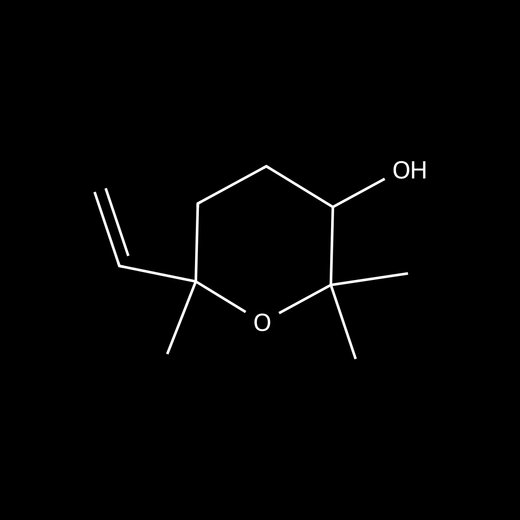
Linalool oxide pyranoid · Facets
Entries of the glossary that carry each facet, of 3,979:
- floral 1,547
- creamy 404
- earthy 660
- fresh 1,390
- honey 97
Linalool oxide pyranoid · Scent
It has a floral, honeyed odour with creamy, earthy and fresh facets.
Linalool oxide pyranoid · In Perfumery
It is a fragrance ingredient with a floral, honeyed character.
Pyramid
Linalool oxide pyranoid: Heart. Entries of the glossary stored at each place of the pyramid, of 4,000 (35 store no place):
- Top 718
- Top · Heart 496
- Heart 1,644
- Heart · Base 513
- Base 594
Linalool oxide pyranoid · In Depth
Identity
Its systematic name is 6-ethenyl-2,2,6-trimethyloxan-3-ol, its CAS number is 14049-11-7, its formula is C₁₀H₁₈O₂ and its molecular weight is 170.25. It is an oxane substituted by methyl groups at positions 2,2 and 6, a hydroxy group at position 3 and an ethenyl group at position 6. It is also named tetrahydro-2,2,6-trimethyl-6-vinyl-2H-pyran-3-ol.
Odour
It smells floral and honeyed, with creamy, earthy and fresh facets.
Occurrence in nature
It occurs in Aloe africana, Chamaecyparis obtusa, Citrus australasica, Citrus australis, Citrus garrawayae, Citrus garrawayi, Citrus glauca, Citrus gracilis, Citrus inodora, Tanacetum boreale and Tanacetum vulgare. It is also a pheromone and a plant metabolite.
Use in perfumery
It is used as a fragrance ingredient.
Use in flavours
It is used as a flavouring agent with a flower flavour profile. The Joint FAO/WHO Expert Committee on Food Additives found no safety concern at current levels of intake when it is used as a flavouring agent.
Properties
It boils at 223 to 224 °C at 760 mmHg and its flash point is 76.11 °C. Its density is 0.991 to 0.996 at 20 °C and its refractive index is 1.472 to 1.482. It is practically insoluble in water and soluble in ethanol, with an estimated logP of 1.729.
Safety and IFRA
No IFRA Standard covers this material itself, in the 51st Amendment in force. Its EC number is 237-889-1.
Linalool oxide pyranoid · Technical Sheet
Molecular weight
170.25 g/mol Heavier than 412 of the 862 other entries at the same place of the pyramid that store a weight; 25 weigh the same.
2,517 entries store a molecular weight. By place in the pyramid: Top 536, Top · Heart 403, Heart 863, Heart · Base 452, Base 263.
Identity
- Type
- Ingredient
- Category
- Aroma chemicals
- Also called
- Linalool pyran oxide, Linalool oxide I (pyranoid), Linalool oxide II (pyranoid), (Z)-Linalool oxide (pyranoid)
Classification
- Olfactive family
- Gourmand · 495 entries of the glossary in this family
- Subfamily
- Honeyed notes · 23 entries in this subfamily
- Cluster
- Honeyed gourmands · 22 entries in this cluster
Chemical data
- Formula
- C10H18O2
- CAS
- 14049-11-7
- PubChem CID
- 26396, compound record on PubChem
- InChIKey
- BCTBAGTXFYWYMW-UHFFFAOYSA-N
- Wikidata
- Linalool oxide pyranoid: Q82854534, item on Wikidata
Physical properties
- Appearance
- Colourless to pale yellow liquid
- Boiling point
- 223 to 224 °C at 760 mmHg
- Flash point
- 76.11 °C (169 °F)
- Density
- 0.991–0.996 (20 °C)
- Refractive index
- 1.472–1.482
- Vapour pressure
- 0.019 mmHg at 25 °C (estimated)
- Log P
- 1.729 (estimated)
Performance and rules
- Pyramid
- Heart Note
- IFRA status
- No IFRA Standard for the material itself (51st Amendment)
Linalool oxide pyranoid · See Also
Entries related to Linalool oxide pyranoid, by their place in the pyramid. “shared” marks a scent word Linalool oxide pyranoid has too.
Heart notes

Linalool
floral (shared) · fresh (shared) · woody Florals / Natural & Synthetic / 154.25 g/mol
Linalool formate
citrus · green · herbal Aromatic / 182.26 g/mol


Linalool oxide pyranoid · Sources
- PubChem Linalool oxide pyranoid
- ChEBI Linalool oxide pyranoid: chemical classification record
- Pyrfume Good Scents odour data (Pyrfume archive)
- Pyrfume Leffingwell odour data (Pyrfume archive)
- The Good Scents Company Information System Linalool oxide pyranoid: data sheet
- European Chemicals Agency Linalool oxide pyranoid: substance record
- Wikidata (LOTUS natural products data) Linalool oxide pyranoid: organisms it is reported in, with the papers
- IFRA Standards, 51st Amendment
Cite as PREMIEREPEAU Glossary, “Linalool oxide pyranoid”, https://premierepeau.com/
