


Melilot or Sweet Clover
Keywords: green · sweet · floral
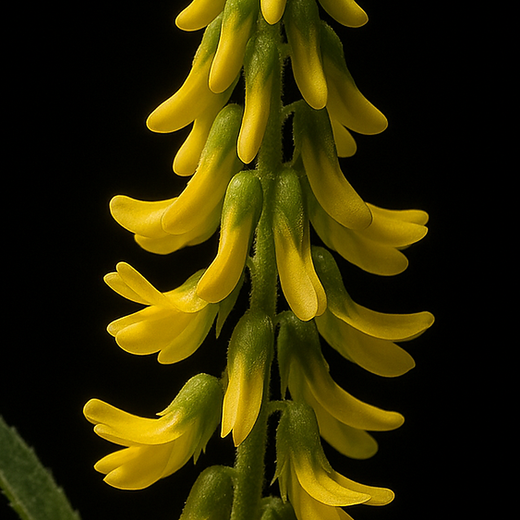
Melilot or Sweet Clover: Melilot, or sweet clover, is a genus of legumes in the family Fabaceae. Its absolute is described as having an odour of tobacco, coumarin and hay.
- Olfactive family
- Aromatic · 510 entries of the glossary in this family Subfamily: Green notes · 93 entries in this subfamily Cluster: Green leafy notes · 420 entries in this cluster
- Material
- Natural Flowers (absolute); flowering top (hydroalcoholic extract)
- Pyramid
- Heart · Volatility: Heart Note
- Strength
- Medium Step 3 of 5 · shared by 1,473 of 2,156 graded entries Graded entries at each step, from 1 to 5: 4, 119, 1,473, 498, 39. 23 more sit between two steps.
- Also called
- sweet clover, sweet yellow clover, yellow melilot, ribbed melilot, common melilot
Family, subfamily and cluster: PREMIEREPEAU house classification, version 2026‑11.
Melilot or Sweet Clover · Facets
Entries of the glossary that carry each facet, of 3,979:
- green 1,442
- sweet 1,988
- warm 1,108
- fresh 1,387
Melilot or Sweet Clover · Scent
The absolute is described as tobacco, coumarin and hay. Another absolute opens with praline, herbaceous and coumarin notes, has a heart of fresh almond and herbaceous notes, and a base of dried herbs, coumarin and white flowers.
Evolution over time
Melilot or Sweet Clover: scent over time.
- Immediately
Praline, herbaceous and coumarin notes.
Scent words: herbal - After a few hours
Fresh almond and herbaceous notes.
Scent words: fresh · herbal - After a few days
Dried herbs, coumarin and white flowers.
The absolute as a whole is described as tobacco, coumarin and hay.
Melilot or Sweet Clover · In Perfumery
Coumarin, which gives melilot its sweet smell, has been an integral part of the fougère genre of perfume since 1882. A melilot absolute pairs very well with an absolute of orange blossom, vanilla, peppermint oil, extra ylang-ylang, and mate extracts. It is considered interesting for its long-lasting effect.
Pyramid
Melilot or Sweet Clover: Heart. Entries of the glossary stored at each place of the pyramid, of 4,006 (42 store no place):
- Top 718
- Top · Heart 497
- Heart 1,641
- Heart · Base 514
- Base 594
Role in the formula
Melilot or Sweet Clover: roles in the formula. Entries of the glossary that share each role, of 4,006:
- Diffusion enhancer 248
- Modifier 1,167
- Blender 1,040
- Volume builder 780
- Freshness 720
Melilot or Sweet Clover · Terroir & Origins
- Producing countries
- Bulgaria, France
No origin card: Bulgaria.
French Melilot or Sweet Clover
France
Facet scores, out of 100
- Herbal 97
- Fresh 77 (also a facet of the entry)
- Green 71 (also a facet of the entry)
- Woody 54
- Aromatic 48
- Earthy 20
The French absolute is obtained by solvent extraction and has top notes of praline, herbaceous and coumarin. Its heart notes are fresh almond and herbaceous, and its base notes are dried herbs, coumarin and white flowers.
A French organic extract of the plant is made from supplies bought from a local herbalist, a farmers’ cooperative and other farmers directly.
- Species
- Melilotus officinalis
- Harvest
- July to September
- Extraction
- Solvent extraction (absolute)
Melilot or Sweet Clover · Extraction & Chemistry
The absolute is obtained by extraction with volatile solvents, followed by a purification in alcohol. A hydroalcoholic extract of melilot is also made, from the flowering top.
Available as
Melilot or Sweet Clover: available as.
- essential oil
- absolute
- hydroalcoholic extract
- Appearance
- Dark brown semi-solid
Melilot or Sweet Clover · Did You Know?
Dicoumarol, a toxic anticoagulant, may be found in decaying Melilotus and was the cause of the so-called “sweet-clover disease”, identified in cattle in the 1920s.
Melilot or Sweet Clover · In Depth
The plant
Melilotus officinalis is a species of legume native to Eurasia and introduced in North America, Africa, and Australia. It can be an annual or biennial plant, 120–180 centimetres high at maturity. Its yellow flowers bloom in spring and summer.
The genus currently has 23 accepted species and two natural hybrids. The scientific and English names both derive from the Greek melílōtos, from méli (honey) and lōtos (lotus).
Chemistry
The plants have a sweet smell, which is due to the presence of coumarin in the tissues. Coumarin is a colorless crystalline solid with a sweet odor resembling the scent of vanilla and a bitter taste. It is an aromatic organic compound with the formula C₉H₆O₂.
The European Pharmacopoeia mentions a minimum content of 0.3% of coumarin, which relates to the dried plant material.
Harvest
Sweet clover grown in France is harvested from July to September.
Other uses of the plant
Sweetclover can be used as pasture or livestock feed when properly cured. It is a major source of nectar for domestic honey bees. Some species are used as a green manure to increase the soil nitrogen and organic matter content.
Genus and coumarin
The genus is closely related to Trifolium, the clovers. Several species are common grassland plants and weeds of cultivated ground, and some species are now found worldwide as naturalised plants. Yellow sweetclover is distinguished from white sweetclover by yellow rather than white flowers. Yellow sweetclover has a tendency to bloom about 2–4 weeks earlier than white sweetclover. Melilotus albus, the white melilot, is an annual or biennial legume that can reach 2.5 m in height.
White and yellow sweetclover are considered valuable honey plants. Sweet clover is a major source of nectar for domestic honey bees as hives near sweetclover can yield up to 200 pounds of honey in a year.
Coumarin is a colorless crystalline solid that belongs to the benzopyrone chemical class and is considered a lactone. Coumarin is responsible for the sweet smell of hay. Coumarin has a bitter taste and possibly acts as a means for the plant to discourage consumption by animals. When clover is cut, a glycosylated cinnamic acid is brought into contact with a glucosidase. The sugar is then removed and the hydroxycinnamic acid esterifies to form coumarin.
Some mould fungi, including Penicillium, Aspergillus, Fusarium and Mucor, can convert coumarin into dicoumarol, a toxic anticoagulant. Hay containing the plant must be properly dried and cured, especially in wet environments. A few cultivars have been developed with low coumarin content and are safer for forage and silage.
Vogel of Munich first isolated coumarin from tonka beans in 1820 and at first took it for benzoic acid. Also in 1820, Nicholas Jean Baptiste Gaston Guibourt of France independently isolated coumarin, but he realized that it was not benzoic acid. In 1835, the French pharmacist Guillemette proved that Vogel and Guibourt had isolated the same substance. Coumarin was first synthesized in 1868 by the English chemist William Henry Perkin.
A cow had died of internal bleeding after eating moldy sweet clover. An outbreak of such deaths had begun in the 1920s. In 1921, Frank Schofield, a Canadian veterinary pathologist, determined that the cattle were ingesting moldy silage made from sweet clover, and that this was functioning as a potent anticoagulant.
In 1940, synthesizing dicoumarol proved that it was identical to the naturally occurring agent, an anticoagulant originally discovered in spoiled sweet clover. Warfarin is a derivative of dicoumarol, an anticoagulant originally discovered in spoiled sweet clover.
White melilot has a characteristic sweet odor, intensified by drying, which is derived from coumarin. Melilotus alba is the source of the coumarin that gives new mown hay its sweet smell.
Fougère perfumes have sweet top-notes with the scent of lavender flowers. As the more volatile components evaporate, oakmoss and coumarin, similar to the scent of new-mown hay, become noticeable. Coumarin is subject to restrictions on its use in perfumery, as some people may become sensitized to it, although the evidence that coumarin can cause an allergic reaction in humans is disputed.
Explore all seven extraits in the Discovery Set.
Related: Heliotrope · Cherry Leaf · Fenugreek · Liatrix · Genet · Lydia Broom
Melilot or Sweet Clover · Technical Sheet
Identity
- Botanical
- Melilotus officinalis
- Taxonomy
- Fabales order › Fabaceae family › Melilotus genus · GBIF
- Botanical records
- Melilotus officinalis: POWO, Melilotus officinalis · IPNI, Melilotus officinalis · GBIF, Melilotus officinalis · Wikidata, Melilotus officinalis · Wikipedia, Melilotus officinalis
- IPNI
- Melilotus officinalis (L.) Lam., Fl. Franç. (Lamarck) 2: 594 (1779) — Jean-Baptiste Pierre Antoine de Monet de Lamarck (1744–1829) · ≡ Trifolium officinale L. (1753)
- Type
- Ingredient
- Category
- Greens, herbs and fougeres
- Note
- N/A – limited commercial extraction data
In Nature
- Growth form
- Herb · POWO
- Native range
- Middle Europe · Southwestern Europe · Southeastern Europe · Eastern Europe · Siberia · Middle Asia · Caucasus · Western Asia · 2 more regions · POWO
- Introduced to
- 112 regions · Northern America 64 · Temperate Asia 13 · Europe 10 · Africa 8 · Australasia 8 · Southern America 7 · Tropical Asia 1 · Antarctic 1
- Flowering
- peak in June–July · north of the equator · iNaturalist
- Recorded altitude
- 100–1,650 m · median 500 m · 10,430 records with an altitude · GBIF
- Wild or cultivated
- 3,297 native · 2,902 introduced · 381 cultivated among 154,532 records (the rest carry no such mark) · GBIF
- Recorded in
- 111 of 512 squares of the world grid; a brighter dot holds more records · GBIF
- Also from this botanical family
- Fabaceae: Acacia · Albizia · Amburana Bark · Amburana Wood · Ashoka Flower · Astragalus · 50 more entries
In Print
- In English books
- most mentioned in the 1910s · Google Books Ngram
Classification
- Chemical class
- Complex natural (essential oil)
Chemical data
- Formula
- Complex natural mixture (key constituents: coumarin C₉H₆O₂)
- Most reported compounds
- Coumarin (4 papers; one: Phytother Res 2002, Coumarin) · Robinin (2 papers; one: Encyclopedic Dictionary of Genetics, Genomics and Proteomics 2004, Robinin) · Soyasaponin I (2 papers; one: Chem Pharm Bull (Tokyo) 1998, Soyasaponin I) · LOTUS
- Structure
- Coumarin:
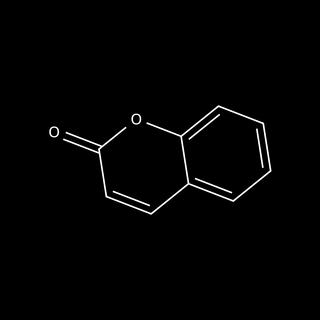
Coumarin
PubChem, Coumarin - CAS
- 84082-81-5
- EC
- 282-028-5
- INCI names (CosIng)
- MELILOTUS OFFICINALIS HERB OIL (PERFUMING)MELILOTUS OFFICINALIS EXTRACT (ASTRINGENT, FRAGRANCE, SOOTHING)MELILOTUS OFFICINALIS FLOWER EXTRACT (ASTRINGENT, SKIN CONDITIONING – EMOLLIENT, SKIN CONDITIONING)MELILOTUS OFFICINALIS HERB EXTRACT (PERFUMING)MELILOTUS OFFICINALIS LEAF EXTRACT (SKIN CONDITIONING)MELILOTUS OFFICINALIS LEAF/STEM EXTRACT (SKIN CONDITIONING – MISCELLANEOUS)MELILOTUS OFFICINALIS FLOWER WATER (SKIN CONDITIONING)
Labelling
- EU allergens reported
- Coumarin
Physical properties
- Flash point
- > 100 °C
Performance and rules
- IFRA status
- No IFRA Standard for the material itself (51st Amendment)
Melilot or Sweet Clover · See Also
Entries related to Melilot or Sweet Clover, by their place in the pyramid. “shared” marks a scent word Melilot or Sweet Clover has too.
Top notes

Shishito Pepper
green (shared) · spicy · vegetal Aromatic / Same cluster / Natural & Synthetic
Mimosa Leaves
green (shared) · fresh (shared) · floral (shared) Aromatic / Top · Heart / Same cluster / Natural
Black Pepper
spicy · warm (shared) · aromatic Aromatic / Natural
Sainfoins
forage legume · herbaceous plant Green / Top · Heart / Fantasy/Concept


Heart notes

Strawberry Leaf
fruity · green (shared) · fresh (shared) Aromatic / Same cluster / Natural
Acronychia pedunculata
green (shared) · fresh (shared) · aromatic Aromatic / Same cluster / Natural
Hay Absolute
green (shared) · sweet (shared) · herbal Aromatic / Heart · Base / Same subfamily / Natural
Immortelle
aromatic · honey · herbal Aromatic / Natural
Tea
green (shared) · aromatic · dry Aromatic / Heart · Base / Natural
Deer Tongue Grass
green (shared) · aromatic · sweet (shared) Aromatic / Natural
Woodruff or Galium Odoratum
sweet (shared) · herbal · hay Aromatic / Natural
Clover
floral (shared) · green (shared) · sweet (shared) Florals / Natural
Honeybush or Cyclopia
sweet (shared) · floral (shared) · warm (shared) Florals / Natural
Spanish Broom
floral (shared) · sweet (shared) · green (shared) Florals / Natural


Base notes

Flouve
sweet (shared) · herbaceous · hay-like Aromatic / Same cluster / Natural
Tobacco
warm (shared) · sweet (shared) · leathery Aromatic / Natural
Tonka Bean
Gourmand / Natural

Melilot or Sweet Clover · Sources
- International Plant Names Index (IPNI) Melilotus officinalis Pall.
- Plants (2025) In Vivo Investigation of Cardioprotective Effects of Melilotus officinalis and Melilotus albus Aerial Parts Extracts for Potential Therapeutic Application
- Justus Liebigs Annalen der Chemie (1863) Ueber das Cumarin aus dem Steinklee (Melilotus officinalis)
- IFRA Standards, 51st Amendment
- Wikipedia Melilotus
- Wikipedia Melilotus officinalis
- Wikipedia Coumarin
- University of Bristol Coumarin
- Wikipedia Melilotus albus
- Wikipedia Fougère
- Wikipedia Warfarin
- Wikipedia Dicoumarol
Cite as PREMIEREPEAU Glossary, “Melilot or Sweet Clover”, https://premierepeau.com/
