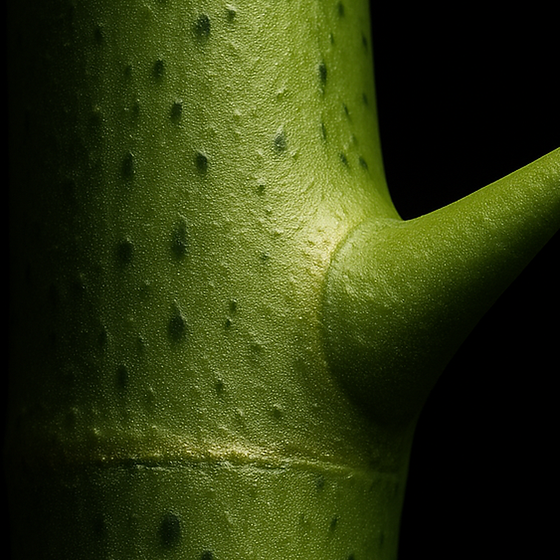
Parkinsonia contains about 12 species that are native to semi desert regions of Africa and the Americas. The genus name honors the English apothecary and botanist John Parkinson (1567-1650). Its members are large shrubs or small trees, 5-12 m tall, deciduous in the dry season, with sparse, open, thorny crowns and green bark. The leaves are borne only for a relatively short time after rains, and much of the photosynthesis is carried out by the green twigs and branches. The flowers have five yellow or white petals, and the fruit is a pod containing several seeds.
Species and range
Blue palo verde, Parkinsonia florida, is native to the Sonoran Deserts in the Southwestern United States and Northwestern Mexico. Foothill palo verde, Parkinsonia microphylla, is also called yellow paloverde or little-leaved palo verde. It is native to southeastern California and southern Arizona, and to Sinaloa, Sonora and Baja California in northwest Mexico. Mexican palo verde, Parkinsonia aculeata, is native to the southwestern United States and northern Mexico south to the Galapagos Islands and northern Argentina. The blue palo verde is the state tree of Arizona.
Biology and ecology
Blue palo verde is drought-deciduous, shedding its foliage for most of the year and leafing out after rainfall. Its gray-green branches and twigs carry out photosynthesis whether or not leaves are present. Its bright yellow, pea-like flowers cover the tree in late spring. They attract pollinators such as bees, beetles and flies. The seed pods are a food source for small rodents and birds.
A major pollinator of Parkinsonia species in the southwestern United States and western Mexico is Centris pallida, a solitary bee known as the digger or pallid bee. The nectar and pollen give its bee bread a strong orange color. Foothill palo verde photosynthesizes in its bark, which allows it to survive leafless in hotter periods. It is also a honey plant. Palo verde trees are the primary nurse plants for the saguaro.
Human uses
The Quechan, Mojave and Akimel O'odham used the beans of blue palo verde as food and its wood for carving ladles. The Akimel and Tohono O'odham ate the beans when soft and immature and cooked whole, and also ground the ripe seeds into flour to eat as atole or gruel. The flowers of blue palo verde are sweet and edible either fresh or cooked. Palo verde beans can be dried and used for cattle feed.
The Seri people of northwestern Mexico grind up the seeds of foothill palo verde for flour, boil the green pods with meat, and eat the sweet green seeds. In Mexico, the leaves of Parkinsonia aculeata are steeped and made into medicine for fever and epilepsy.
Blue palo verde is cultivated as an ornamental plant and tree by specialty plant nurseries. It offers an unusual green-blue silhouette in gardens, and delicately patterned light shade over patios.
—
Related: Alder · Alpha Humulene · Amaranth · Amberever · Amburana Bark · Antillone · Apple Tree