


Propyl phenylacetate
Keywords: honey · apricot · rose
Propyl phenylacetate is an ester with a honey-like odour that is fresh and light, with a fruity apricot-rose character.
Propyl phenylacetate · Facets
Entries of the glossary that carry each facet, of 3,979:
- honey 97
- apricot 53
- rose 214
- sweet 1,987
- floral 1,547
- fruity 1,299
Propyl phenylacetate · Scent
It smells of honey, apricot and rose, fresh and light, with sweet, floral and fruity notes.
Propyl phenylacetate · In Perfumery
Propyl phenylacetate is a perfuming ingredient with a fresh, light, honey-like odour and a fruity apricot-rose character.
Pyramid
Propyl phenylacetate: Heart. Entries of the glossary stored at each place of the pyramid, of 4,000 (35 store no place):
- Top 718
- Top · Heart 496
- Heart 1,644
- Heart · Base 513
- Base 594
Propyl phenylacetate · In Depth
Identity
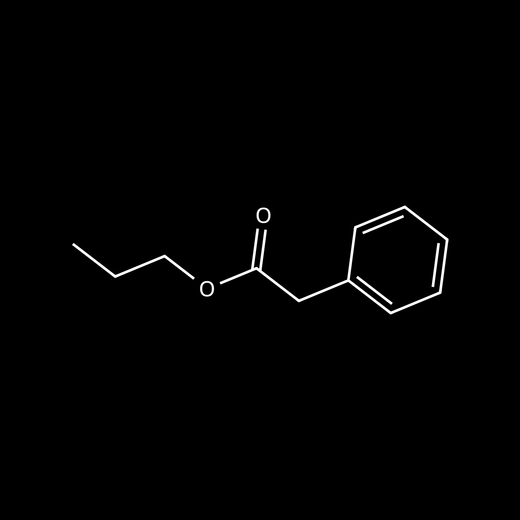
Propyl phenylacetate has the CAS number 4606-15-9 and the formula C₁₁H₁₄O₂, with a molecular weight of 178.23 g/mol. Its systematic name is propyl 2-phenylacetate.
Odour
It smells of honey, apricot and rose, with sweet, floral and fruity notes. The honey-like odour is fresh and light, with a fruity apricot-rose character and moderate tenacity.
Occurrence in nature
It is found in Chrysanthemum morifolium.
Use in perfumery
Its cosmetic function is perfuming.
Use in flavours
It is used as a flavouring agent with a floral flavour profile. The Joint FAO/WHO Expert Committee on Food Additives found no safety concern at current levels of intake when it is used as a flavouring agent.
Properties
It boils at 253 °C at 760 mmHg and has a flash point above 100 °C. Its density is 0.985 to 0.995 at 15.5 °C and its refractive index is 1.489 to 1.497. It is insoluble in water, soluble in oils and miscible with ethanol at room temperature. It has an estimated logP of 2.93.
Safety and IFRA
No IFRA Standard covers this material itself in the 51st Amendment. Its INCI name is Propyl Phenylacetate and its EC number is 225-012-5. It does not meet GHS hazard criteria in any of the 91 reports.
Propyl phenylacetate · Technical Sheet
Molecular weight
178.23 g/mol Heavier than 542 of the 862 other entries at the same place of the pyramid that store a weight; 18 weigh the same.
2,517 entries store a molecular weight. By place in the pyramid: Top 536, Top · Heart 403, Heart 863, Heart · Base 452, Base 263.
Identity
- Type
- Ingredient
- Category
- Aroma chemicals
- Also called
- Propyl benzeneacetate, n-PROPYL PHENYLACETATE, Phenyl propyl acetate
Classification
- Olfactive family
- Florals · 783 entries of the glossary in this family
- Subfamily
- Classic florals · 312 entries in this subfamily
- Cluster
- Rose-like florals · 146 entries in this cluster
- Chemical class
- Ester
Chemical data
- Formula
- C11H14O2
- CAS
- 4606-15-9
- PubChem CID
- 221641, compound record on PubChem
- InChIKey
- GXXFZZLGPFNITM-UHFFFAOYSA-N
- Wikidata
- Propyl phenylacetate: Q27261676, item on Wikidata
Physical properties
- Appearance
- Colourless clear liquid
- Boiling point
- 253 °C at 760 mmHg
- Flash point
- > 100 °C (> 212 °F)
- Density
- 0.985–0.995 (15.5 °C)
- Refractive index
- 1.489–1.497
- Vapour pressure
- 0.031 mmHg at 25 °C (estimated)
- Log P
- 2.93 (estimated)
Performance and rules
- Pyramid
- Heart Note
- IFRA status
- No IFRA Standard for the material itself (51st Amendment)
Propyl phenylacetate · See Also
Entries related to Propyl phenylacetate, by their place in the pyramid. “shared” marks a scent word Propyl phenylacetate has too.
Heart notes

Ethyl phenylacetate
honey (shared) · apricot (shared) · sweet (shared) Fruity / Synthetic / 164.2 g/mol
Isobutyl phenylacetate
honey (shared) · waxy · rose (shared) Gourmand / 192.25 g/mol


Base notes

Anisyl phenylacetate
honey (shared) · balsamic · fruity (shared) Florals / Same cluster / 256.3 g/mol

Propyl phenylacetate · Sources
- PubChem Propyl phenylacetate
- Pyrfume Arctander, Perfume and Flavor Chemicals: odour descriptions (Pyrfume archive)
- Pyrfume Good Scents odour data (Pyrfume archive)
- Pyrfume Leffingwell odour data (Pyrfume archive)
- European Commission, CosIng Propyl phenylacetate: cosmetic ingredient record
- Wikidata (LOTUS natural products data) Propyl phenylacetate: organisms it is reported in, with the papers
- The Good Scents Company Information System Propyl phenylacetate: data sheet
- IFRA Standards, 51st Amendment
Cite as PREMIEREPEAU Glossary, “Propyl phenylacetate”, https://premierepeau.com/
