


Thioglycolic Acid
Keywords: sour · sulfurous
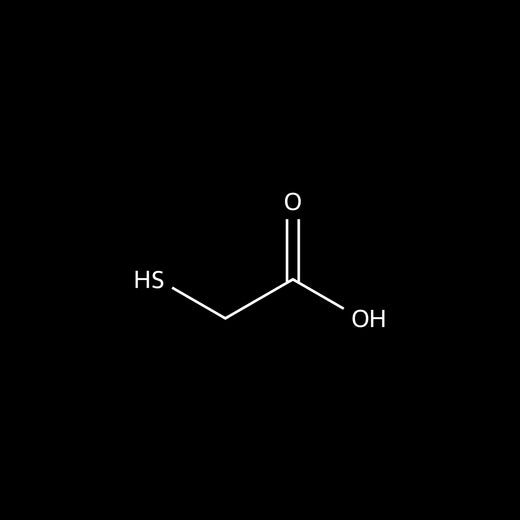
Thioglycolic Acid is a sulfur-containing carboxylic acid. It smells sour and sulfurous.
Thioglycolic Acid · Facets
Entries of the glossary that carry each facet, of 3,979:
- sour 45
- sulfurous 146
Thioglycolic Acid · Scent
Its odour is mildly sour when pure, with a heavy, slightly nauseating pungency.
Thioglycolic Acid · In Perfumery
Its character is sour and sulfurous, with poor tenacity.
Pyramid
Thioglycolic Acid: Top. Entries of the glossary stored at each place of the pyramid, of 4,006 (42 store no place):
- Top 718
- Top · Heart 497
- Heart 1,641
- Heart · Base 514
- Base 594
Thioglycolic Acid · Extraction & Chemistry
It is prepared by the action of sodium sulfhydrate on sodium chloroacetate, or by electrolysis of dithioglycollic acid, which comes from sodium sulfide and sodium chloroacetate. It is used to make drugs, permanent wave solutions and other chemicals, with concentrations up to 11 % in hair products and 5 % in depilatories. It also serves as a carbonyl condensation catalyst, as a sensitive reagent for iron, molybdenum, silver and tin, and as a raw material for fine and specialty chemicals in the pharmaceutical and agricultural sectors.
- Appearance
- Colourless, viscous liquid
Thioglycolic Acid · In Depth
Identity
Thioglycolic Acid has the systematic name 2-sulfanylacetic acid, is also called mercaptoacetic acid, and has the CAS number 68-11-1.
Odour
It smells sour and sulfurous. The odour of the absolutely pure acid is mildly sour, with a heavy or slightly nauseating pungency and poor tenacity. The odour is strong and disagreeable, characteristic of mercaptans and of sulfhydryl groups, and olfactory fatigue may occur after short exposures.
Production
It is prepared by the action of sodium sulfhydrate on sodium chloroacetate, or by electrolysis of dithioglycollic acid, which comes from sodium sulfide and sodium chloroacetate. It is used to make drugs, permanent wave solutions and other chemicals, with concentrations up to 11 % in hair products and 5 % in depilatories. It also serves as a carbonyl condensation catalyst, as a sensitive reagent for iron, molybdenum, silver and tin, and as a raw material for fine and specialty chemicals in the pharmaceutical and agricultural sectors.
Properties
It boils at 120 °C at 20 mmHg and melts at −16.5 °C. Its flash point is 126 °C in an open cup and 130 °C in a closed cup. Its density is 1.325 g/cm3, and it is corrosive to metals and tissue.
Safety and IFRA
No IFRA Standard covers this material itself, as of the 51st Amendment. Its INCI name is THIOGLYCOLIC ACID and its cosmetic functions are antioxidant, depilatory, hair waving or straightening, and reducing. It is entered in Annex III, entry 2a, of the EU Cosmetics Regulation, which lists restricted substances. Its EC number is 200-677-4 and it is registered under REACH. Its hazard statements are H301, toxic if swallowed, H311, toxic in contact with skin, H314, causes severe skin burns and eye damage, and H331, toxic if inhaled.
Thioglycolic Acid · Technical Sheet
Molecular weight
92.12 g/mol Heavier than 134 of the 536 other entries at the same place of the pyramid that store a weight.
2,515 entries store a molecular weight. By place in the pyramid: Top 537, Top · Heart 403, Heart 861, Heart · Base 452, Base 262.
Identity
- Source
- Synthetic molecule
- Material
- Synthetic
- Type
- Ingredient
- Category
- Aroma chemicals
Classification
- Chemical class
- Carboxylic acid
Chemical data
- Formula
- C2H4O2S
- CAS
- 68-11-1
- PubChem CID
- 1133, compound record on PubChem
- InChIKey
- CWERGRDVMFNCDR-UHFFFAOYSA-N
- Wikidata · Wikipedia
- Thioglycolic Acid: Q414738, item on Wikidata · Wikipedia, English article
Labelling
- EU cosmetics annexes
- THIOGLYCOLIC ACID · CosIng, Annex III, entry 2a, THIOGLYCOLIC ACID · restricted Product type, body parts:
“(a) Hair products (b) Depilatories (c) Hair rinse-off products (d) Products intended for eyelash waving”
Maximum concentration:“(a) (i) 8% (ii) 11% (b) 5% (c) 2% (d) 11% The abovementioned percentages are calculated as thioglycollic acid”
Wording of conditions:“Conditions of use: (a) (b) (c) (d) Avoid contact with eyes Rinse eyes immediately if product comes into contact with them. (a) (c) (d) Wear suitable gloves Warnings to be printed on the label: (a)(i) (b) (c) Contains thioglycolate Follow the instructions Keep out of reach of children (a)(ii) (d) For professional use only Contains thioglycolate Follow the instructions’”
Other:“(a) (i) General use ready for use pH 7 to 9.5 (ii) Professional use ready for use pH 7 to 9.5 (b) ready for use pH 7 to 12.7 (c) ready for use pH 7 to 9.5 (d) ready for use pH 7 to 9,5”
Physical properties
- Boiling point
- 120 °C at 20 mmHg
- Melting point
- −16.5 °C
- Flash point
- 126 °C o.c
Performance and rules
- Pyramid
- Top Note
- Available as
- synthetic
- IFRA status
- No IFRA Standard for the material itself (51st Amendment)
Thioglycolic Acid · See Also
Entries related to Thioglycolic Acid, by their place in the pyramid. “shared” marks a scent word Thioglycolic Acid has too.
Top notes

Thiazole
nutty · meaty · fishy Green / 85.13 g/mol
Methional
meaty · potato · tomato Green / Synthetic / 104.17 g/mol
Thiolactic acid
meaty · sulfurous (shared) · brothy Green / 106.15 g/mol


Thioglycolic Acid · Sources
- PubChem Thioglycolic Acid
- ChEBI Thioglycolic Acid: chemical classification record
- Pyrfume Arctander, Perfume and Flavor Chemicals: odour descriptions (Pyrfume archive)
- Pyrfume Leffingwell odour data (Pyrfume archive)
- European Chemicals Agency Thioglycolic Acid: substance record
- IFRA Standards, 51st Amendment
- European Commission, CosIng Thioglycolic Acid: cosmetic ingredient record
Cite as PREMIEREPEAU Glossary, “Thioglycolic Acid”, https://premierepeau.com/

