


Tiglic acid
Keywords: spicy · sweet · herbal
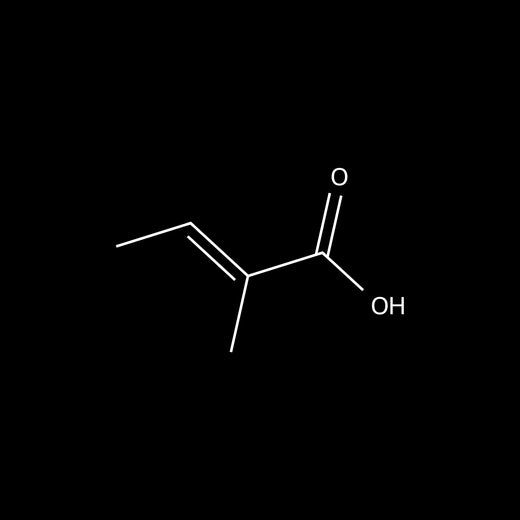
Tiglic acid is a 2-methylbut-2-enoic acid with its double bond in trans-configuration, and it has a sweet, warm, spicy aroma.
- Olfactive family
- Spicy · 155 entries of the glossary in this family Subfamily: Warm spices · 144 entries in this subfamily Cluster: Classic spices · 85 entries in this cluster
- Material
- Natural & Synthetic
- Pyramid
- Top Note
- Strength
- Medium Step 3 of 5 · shared by 1,462 of 2,149 graded entries Graded entries at each step, from 1 to 5: 4, 118, 1,462, 501, 40. 24 more sit between two steps.
- Also called
- (E)-2-Methylbut-2-enoic acid, trans-2-Methyl-2-butenoic acid, (E)-2-Methyl-2-butenoic acid, 2-methyl-2E-butenoic acid, 2-Methyl-2-butenoic acid, 2-Methylbut-2-enoic acid
Tiglic acid · Facets
Entries of the glossary that carry each facet, of 3,979:
- spicy 473
- sweet 1,987
- herbal 757
- rooty 16
- sour 45
- ripe 21
Tiglic acid · Scent
It has a spicy-rooty, sweet-sour herbaceous odour of moderate tenacity, warm and sweet in character.
Tiglic acid · In Perfumery
It is used as a fragrance ingredient, bringing a spicy-rooty, sweet-sour herbaceous note of moderate tenacity.
Pyramid
Tiglic acid: Top. Entries of the glossary stored at each place of the pyramid, of 4,000 (35 store no place):
- Top 718
- Top · Heart 496
- Heart 1,644
- Heart · Base 513
- Base 594
Tiglic acid · Extraction & Chemistry
It is obtained from croton oil. It can be synthesised from 2-hydroxy-2-methylbutyronitrile.
- Appearance
- White crystalline solid, appearing as lustrous flakes
Tiglic acid · In Depth
Identity
Tiglic acid, systematic name (E)-2-methylbut-2-enoic acid, has the CAS number 80-59-1. Its molecular formula is C₅H₈O₂ and its molecular weight is 100.12 g/mol. It is a plant metabolite.
Odour
It smells spicy and sweet, with warm, rooty and herbal facets and a sour edge. Its tenacity is moderate. The odour can also be fruity. Its odour strength is medium, and its substantivity is 16 hours at 100 %.
Occurrence in nature
It occurs in Aloe africana, Azadirachta indica, Daucus carota, Eryngium foetidum, Fragaria, Nicotiana tabacum and Pelargonium graveolens. It also occurs in English chamomile oil.
Production
It is obtained from croton oil. It can be synthesised from 2-hydroxy-2-methylbutyronitrile.
Use in perfumery
It is used as a fragrance ingredient, and its esters are used in fragrance work. The free acid is also used as an emulsion breaker.
Use in flavours
It is a flavouring agent and a flavour enhancer, and its esters are used in flavourings. Its flavour profile is savoury. An expert committee of the FAO and WHO found no safety concern at current levels of intake when it is used as a flavouring agent.
Properties
It boils at 198.5 °C at 760 mmHg and melts at 62.5 to 64 °C. Its density is 0.972 and its flash point is 101.67 °C. It is sparingly soluble in cold water, freely soluble in hot water, and soluble in alcohol and ether. Its pKa is 4.96 at 18 °C.
Safety and IFRA
No IFRA Standard covers this material itself in the 51st Amendment. Its INCI name is TIGLIC ACID, its function is perfuming and its EC number is 201-295-0. It causes skin irritation and serious eye irritation.
Tiglic acid · Technical Sheet
Molecular weight
100.12 g/mol Heavier than 165 of the 546 other entries at the same place of the pyramid that store a weight; 12 weigh the same
2,572 entries store a molecular weight. By place in the pyramid: Top 547, Top · Heart 406, Heart 886, Heart · Base 455, Base 278.
Identity
- Type
- Ingredient
- Category
- Aroma chemicals
Classification
- Chemical class
- Carboxylic acid
Chemical data
- Formula
- C5H8O2
- CAS
- 80-59-1
- PubChem CID
- 125468, compound record on PubChem
- InChIKey
- UIERETOOQGIECD-ONEGZZNKSA-N
Physical properties
- Boiling point
- 198 to 199 °C at 760 mmHg
- Melting point
- 54 to 57 °C at 760 mmHg
- Flash point
- 101.67 °C (215 °F)
- Density
- 0.972
- Refractive index
- 1.4342 at 81 °C/D
- Vapour pressure
- 0.152 mmHg at 25 °C (estimated)
- Log P
- 1.076 (estimated)
- Tenacity
- 16 hour(s) at 100 %
Performance and rules
- Available as
- synthetic
- IFRA status
- No IFRA Standard for the material itself (51st Amendment)
Tiglic acid · See Also
Entries related to Tiglic acid, by their place in the pyramid. « shared » marks a scent word Tiglic acid has too.
Top notes

(2E)-2-Hexenoic acid
fruity · fatty · sweet (shared) Gourmand / 114.14 g/mol

Heart notes

Chamomile
floral · sweet (shared) · aromatic Florals / Natural

Tiglic acid · Sources
- PubChem Tiglic acid
- ChEBI Tiglic acid: chemical classification record
- Pyrfume Arctander, Perfume and Flavor Chemicals: odour descriptions (Pyrfume archive)
- Pyrfume Good Scents odour data (Pyrfume archive)
- Pyrfume Leffingwell odour data (Pyrfume archive)
- The Good Scents Company Information System Tiglic acid: data sheet
- Wikidata (LOTUS natural products data) Tiglic acid: organisms it is reported in, with the papers
- IFRA Standards, 51st Amendment
- European Commission, CosIng Tiglic acid: cosmetic ingredient record
- European Chemicals Agency Tiglic acid: substance record
Cite as PREMIEREPEAU Glossary, “Tiglic acid”, https://premierepeau.com/
