


Tridecanoic acid
Keywords: waxy · woody · fatty
Tridecanoic acid is a straight-chain saturated fatty acid with a very faint waxy-woody odour. It is a white to off-white solid.
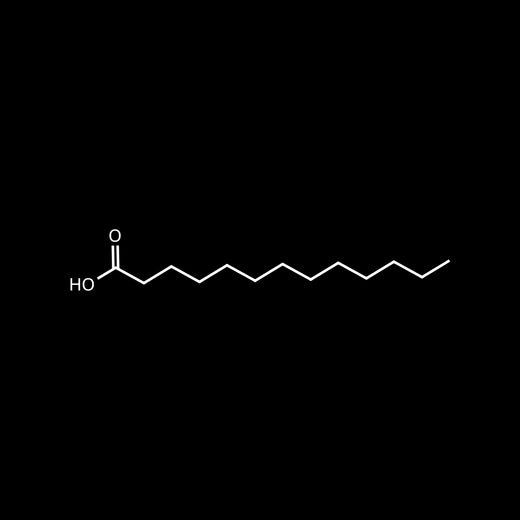
Tridecanoic acid · Facets
Entries of the glossary that carry each facet, of 3,979:
- waxy 212
- woody 790
- fatty 268
Tridecanoic acid · Scent
It smells waxy and woody, with a fatty edge, and its odour is very faint.
Tridecanoic acid · In Perfumery
It offers a very faint waxy-woody odour, and a highly purified material may be virtually odourless.
Pyramid
Tridecanoic acid: Heart · Base. Entries of the glossary stored at each place of the pyramid, of 4,000 (35 store no place):
- Top 718
- Top · Heart 496
- Heart 1,644
- Heart · Base 513
- Base 594
Tridecanoic acid · In Depth
Identity
Its IUPAC name is tridecanoic acid and its CAS number is 638-53-9. Its molecular formula is C₁₃H₂₆O₂ and its molecular weight is 214.34 g/mol. It is a straight-chain saturated fatty acid with thirteen carbons, and it also acts as a plant metabolite. It is produced within the human body as a metabolite.
Odour
It smells waxy and woody, with a fatty edge. Its odour is very faint and waxy-woody, and a highly purified material may be virtually odourless.
Occurrence in nature
It is found in Agelas, Arnica montana, Bellis perennis, Caenorhabditis elegans, Carica papaya, Cucumis melo and Dictamnus albus, among other organisms.
Use in flavours
It is used as a flavouring agent. The Joint FAO/WHO Expert Committee on Food Additives found no safety concern at current levels of intake when it is used as a flavouring agent.
Properties
It boils at 312.4 °C and melts at 44.5 °C. Its flash point is 112.78 °C. It has an estimated logP of 5.282 and an estimated vapour pressure of 0.000299 mmHg at 25 °C. Its solubility in water is 33 mg/L at 20 °C.
Safety and IFRA
No IFRA Standard covers this material itself, as of the 51st Amendment. Its EC number is 211-341-1. It causes skin irritation and serious eye irritation, and it may cause respiratory irritation.
Tridecanoic acid · Technical Sheet
Molecular weight
214.34 g/mol Heavier than 259 of the 454 other entries at the same place of the pyramid that store a weight; 13 weigh the same
2,572 entries store a molecular weight. By place in the pyramid: Top 547, Top · Heart 406, Heart 886, Heart · Base 455, Base 278.
Identity
- Type
- Ingredient
- Category
- Aroma chemicals
Classification
- Olfactive family
- Woods · 363 entries of the glossary in this family
- Subfamily
- Classic woods · 130 entries in this subfamily
- Cluster
- Earthy woods · 236 entries in this cluster
- Chemical class
- Carboxylic acid
Chemical data
- Formula
- C13H26O2
- CAS
- 638-53-9
- PubChem CID
- 12530, compound record on PubChem
- InChIKey
- SZHOJFHSIKHZHA-UHFFFAOYSA-N
- Appearance
- White to off-white solid
Physical properties
- Boiling point
- 312 to 313 °C at 760 mmHg
- Melting point
- 41 to 43 °C at 760 mmHg
- Flash point
- 112.78 °C (235 °F)
- Vapour pressure
- 0.000299 mmHg at 25 °C (estimated)
- Log P
- 5.282 (estimated)
Performance and rules
- Pyramid
- Heart-to-Base
- IFRA status
- No IFRA Standard for the material itself (51st Amendment)
Tridecanoic acid · See Also
Entries related to Tridecanoic acid, by their place in the pyramid. « shared » marks a scent word Tridecanoic acid has too.
Top notes

Tridecanal
citrus · waxy (shared) · aldehydic Citrus / 198.34 g/mol

Heart notes

1-Tridecanol
woody (shared) · fruity · waxy (shared) Woods / Heart · Base / Same cluster / Natural & Synthetic / 200.36 g/mol
Aloe Vera
succulent plant · leaf gel Aromatic / Natural
Lauric Acid
fatty (shared) · waxy (shared) · fresh Green / Heart · Base / 200.32 g/mol


Tridecanoic acid · Sources
- PubChem Tridecanoic acid
- ChEBI Tridecanoic acid: chemical classification record
- Pyrfume Arctander, Perfume and Flavor Chemicals: odour descriptions (Pyrfume archive)
- Pyrfume Good Scents odour data (Pyrfume archive)
- Pyrfume Leffingwell odour data (Pyrfume archive)
- Wikidata (LOTUS natural products data) Tridecanoic acid: organisms it is reported in, with the papers
- The Good Scents Company Information System Tridecanoic acid: data sheet
- IFRA Standards, 51st Amendment
- European Chemicals Agency Tridecanoic acid: substance record
Cite as PREMIEREPEAU Glossary, “Tridecanoic acid”, https://premierepeau.com/pages/glossary-terms/tridecanoic-acid Updated 2026-11-20
