


Wild Garlic Leaf
Keywords: sulfurous · garlic-like
Wild garlic leaf is the leaf of Allium ursinum, a bulbous perennial flowering plant of the amaryllis family known as ramsons and bear’s garlic. It is native to Europe and Asia, where it grows in moist woodland.

- Olfactive family
- Aromatic · 510 entries of the glossary in this family Subfamily: Green notes · 93 entries in this subfamily Cluster: Green leafy notes · 420 entries in this cluster
- Material
- Natural Leaves
- Pyramid
- Heart · Volatility: Heart Note
- Strength
- Medium Step 3 of 5 · shared by 1,473 of 2,156 graded entries Graded entries at each step, from 1 to 5: 4, 119, 1,473, 498, 39. 23 more sit between two steps.
- Producing countries
- Asia, Europe
- Also called
- ramsons, bear’s garlic, wild garlic, broad-leaved garlic, wood garlic, bear leek, buckrams, onion grass
Family, subfamily and cluster: PREMIEREPEAU house classification, version 2026‑11.
Wild Garlic Leaf · Facets
Entries of the glossary that carry each facet, of 3,979:
- green 1,442
- earthy 660
- warm 1,108
- fresh 1,387
- sulfurous 146
- garlic-like 1
- pungent 90
Wild Garlic Leaf · Scent
Diallyl disulfide, one of the most abundant volatiles of the plant, has a strong garlic smell.
Evolution over time
Wild Garlic Leaf: scent over time.
- Immediately
Sharp sulfurous green blast, pungent and vegetal
Scent words: green - After a few hours
Green chlorophyll dominates, sulfur softens
Scent words: green - After a few days
Faint green-earthy trace, sulfur dissipated
Scent words: green · earthy
- Tenacity
- 6–12 hours
Wild Garlic Leaf · In Perfumery
Plant sulfur compounds, their extracts and their odours have a wide application in folk medicine, in food flavouring and preservation, and in the fragrance industry. Diallyl disulfide, a principal component of the distilled oil of garlic, is used as a food flavouring when highly diluted.
Pyramid
Wild Garlic Leaf: Heart. Entries of the glossary stored at each place of the pyramid, of 4,006 (42 store no place):
- Top 718
- Top · Heart 497
- Heart 1,641
- Heart · Base 514
- Base 594
Role in the formula
Wild Garlic Leaf: roles in the formula. Entries of the glossary that share each role, of 4,006:
- Modifier 1,167
- Signature note 897
- Lifting agent 567
- Blender 1,040
- Freshness 720
- Flavouring fewer than 40 entries
Wild Garlic Leaf · Extraction & Chemistry
Steam distillation of ramson leaves converts the alliin totally to diallyl sulfides. The essential oil yield of ramsons was established at 0.37 %.
Available as
Wild Garlic Leaf: available as.
- synthetic accord
- fantasy note
- essential oil
- Appearance
- Pale green to yellowish liquid
Wild Garlic Leaf · Did You Know?
Dairy farmers in Devon have occasionally had their herds’ milk rejected because cows that grazed on the plant gave it a garlic flavour. Alliinase is part of the plant’s defence against herbivores: it is normally sequestered within a plant cell and is released to produce pungent chemicals when a feeding animal damages the plant.
Wild Garlic Leaf · In Depth
The plant
Allium ursinum is a wild relative of onion and garlic, all belonging to the genus Allium. It grows in deciduous woodlands with moist soils, preferring slightly acidic conditions. It is considered to be an ancient woodland indicator species. It flowers in the British Isles from April to June, starting before deciduous trees leaf in the spring. The leaves are bright green and elliptical, up to 25 cm long by 7 cm wide.
Chemistry of the smell
The most familiar or important chemical constituents reported from ramsons are the sulfur compounds. The main cysteine sulfoxides are alliin and isoalliin. When the bulb of the ramson is crushed, minced or otherwise processed, alliin is released and interacts with the enzyme alliinase in adjacent vacuoles.
Allicin forms through hydrolysis and condensation of the reactive intermediate allylsulfenic acid. Allicin is unstable and, depending on environmental and processing conditions, undergoes further reactions to form other derivatives. Allicin decomposed completely at 20 °C after 20 hours, giving diallyl disulfide, diallyl trisulfide, diallyl sulfide and sulfur dioxide.
The most abundant volatile compounds of A. ursinum included diallyl disulfide and diallyl trisulfide. The main constituents of the essential oil of A. ursinum leaves, as detected by GC-MS, were disulfides (44 %), trisulfides (41 %) and tetrasulfides (5 %). In the mix of volatiles generated from S-methyl cysteine sulfoxide, dimethyl disulfide, dimethyl trisulfide and dimethyl thiosulfonate were the compounds of greater concentration.
Edible use and look-alikes
All parts of A. ursinum are edible. The leaves can be used as a salad or boiled as a vegetable. Several poisonous plants can be mistaken for A. ursinum, including lily of the valley, Colchicum autumnale and Arum maculatum.
Unfolded Arum maculatum leaves have irregular edges and many deep veins, while the leaves of ramsons are convex with a single main vein. Grinding the leaves between the fingers and checking for a garlic-like smell can help in identifying them, but if the smell remains on the hands, one can mistake a subsequent poisonous plant for a safe one.
Explore all seven extraits in the Discovery Set.
Related: Garlic
Wild Garlic Leaf · History
Ramsons comes from the Old English word hramsa, meaning garlic. There is evidence it has been used in British cuisine since the Celtic Britons over 1,500 years ago. Early healers among the Celts, Gaels, Teutonic tribes and ancient Romans knew the wild herb and called it herba salutaris, meaning ‘healing herb’.
The Latin specific name ursinum means ‘bear’ and refers to the supposed fondness of the brown bear for the bulbs. A high concentration of A. ursinum pollen was found in the settlement layer of the Swiss Neolithic settlement of Thayngen-Weier, interpreted by some as evidence for use of the plant as fodder.
Wild Garlic Leaf · Technical Sheet
Identity
- Botanical
- Allium ursinum
- Taxonomy
- Asparagales order › Amaryllidaceae family › Allium genus · GBIF
- Botanical records
- Allium ursinum: POWO, Allium ursinum · IPNI, Allium ursinum · GBIF, Allium ursinum · Wikidata, Allium ursinum · Wikipedia, Allium ursinum
- IPNI
- Allium ursinum L., Sp. Pl. 1: 300 (1753) — Carl Linnaeus (1707–1778)
- Type
- Ingredient
- Category
- Greens, herbs and fougeres
- Note
- Wild garlic leaf (Allium ursinum) essential oil. Key sulfur compounds: diallyl disulfide (CAS 2179-57-9), allicin. Steam-distilled. Yield: ~0.01–0.05%. Density: ~0.90–0.95 g/mL. Refractive index: ~1.470–1.490. Flash point: > 60 °C. Rarely used in fine perfumery; mostly culinary and aromatherapy.
In Nature
- Growth form
- Herb · POWO
- Native range
- Northern Europe · Middle Europe · Southwestern Europe · Southeastern Europe · Eastern Europe · Caucasus · POWO
- Flowering
- peak in April–May · north of the equator · iNaturalist
- Recorded altitude
- 0–700 m · median 250 m · 71,905 records with an altitude · GBIF
- Wild or cultivated
- 60,631 native · 232 introduced · 161 cultivated among 408,714 records (the rest carry no such mark) · GBIF
- Recorded in
- 21 of 512 squares of the world grid; a brighter dot holds more records · GBIF
- Also from this botanical family
- Amaryllidaceae: Azteca Lily · Jonquille · Narcissus · Narcissus Absolute · Sea Daffodil · Snowdrops
In Print
- Timeline
- first described 1753 · earliest aroma paper in Europe PMC, 2008
- In English books
- most mentioned in the 1880s · Google Books Ngram
Classification
- Chemical class
- Sulfur compounds (disulfides, trisulfides, tetrasulfides)
Chemical data
- Formula
- Complex natural mixture (key constituents: diallyl disulfide C₆H₁₀S₂; diallyl trisulfide)
- Most reported compounds
- Alliin (5 papers; one: J Nat Prod 2006, Alliin) · Methiin (3 papers; one: J Nat Prod 2006, Methiin) · Diallyl Disulfide (2 papers; one: J Nat Prod 2006, Diallyl Disulfide) · Dipropyl disulfide (2 papers; one: J Nat Prod 2006, Dipropyl disulfide) · Allicin (2 papers; one: J Nat Prod 2006, Allicin) · LOTUS
- Structure
- Diallyl Disulfide, Diallyl Trisulfide:
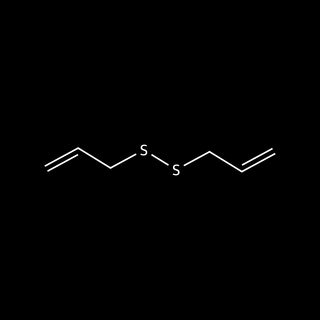
Diallyl Disulfide
PubChem, Diallyl Disulfide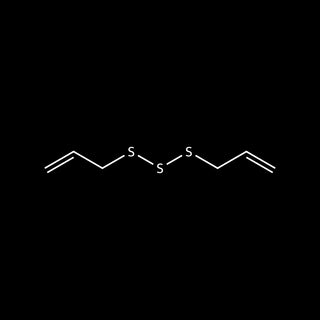
Diallyl Trisulfide
PubChem, Diallyl Trisulfide - INCI names (CosIng)
- ALLIUM URSINUM EXTRACT (SKIN CONDITIONING)
- Composition
- Complex natural mixture (key: diallyl disulfide C₆H₁₀S₂, allicin C₆H₁₀OS₂)
Performance and rules
- IFRA status
- No IFRA Standard for the material itself (51st Amendment)
Wild Garlic Leaf · See Also
Entries related to Wild Garlic Leaf, by their place in the pyramid. “shared” marks a scent word Wild Garlic Leaf has too.
Top notes

Shishito Pepper
green (shared) · spicy · vegetal Aromatic / Same cluster / Natural & Synthetic
Basil
aromatic · green (shared) · herbal Aromatic / Top · Heart / Same subfamily / Natural
Black Pepper
spicy · warm (shared) · aromatic Aromatic / Natural


Heart notes

Celery
fresh (shared) · green (shared) · earthy (shared) Aromatic / Same cluster / Natural
Snake Plant
fresh (shared) · green (shared) · earthy (shared) Aromatic / Same cluster / Fantasy/Concept
White Meranti
fresh (shared) · sappy Woods / Same cluster / Natural
Diallyl Trisulfide
garlic · onion · roasted Green / Same cluster
Sage
aromatic · herbal · amber Aromatic / Natural
Chive
green (shared) · herbal · onion-like Aromatic / Natural


Wild Garlic Leaf · Sources
Read the science
- Food Res Int (2015) New volatile sulfur-containing compounds from wild garlic (Allium ursinum L., Liliaceae)
- International Plant Names Index (IPNI) Allium ursinum L.
- International Journal of Molecular Sciences (2012) Chemical composition and in vitro antifungal activity screening of the Allium ursinum L. (Liliaceae)
- Biochemical Systematics and Ecology (1995) Qualitative and quantitative comparison of volatile sulphides and flavour precursors in different organs of some wild and cultivated garlics
- PubChem Diallyl Disulfide
- IFRA Standards, 51st Amendment
- Wikipedia Allium ursinum
- Wikipedia Diallyl disulfide
- Wikipedia Alliinase
Cite as PREMIEREPEAU Glossary, “Wild Garlic Leaf”, https://premierepeau.com/
