Hyssop: The Herb of the Psalms, and Why the Garden Plant Is Another

Hyssop is a scented shrub of the mint family, named Hyssopus officinalis by Linnaeus in 1753 and Dracocephalum officinale by Kew since 2022, native from Europe and the Mediterranean to Iran. It flavours food and absinthe, and its oil, rich in pinocamphone, is reserved to pharmacists in France. The Bible's hyssop was probably a wild oregano of the Levant.
What is hyssop?
Hyssop is a small, scented shrub of the mint family with spikes of blue-violet flowers, known to gardeners as Hyssopus officinalis and to Kew, since 2022, as Dracocephalum officinale. It flavours food and liqueurs such as absinthe, and its oil is used by perfumers. The hyssop of the Bible, the Hebrew ezov, was probably another plant: several reference works point to a wild oregano.
"Purge me with hyssop, and I shall be clean: wash me, and I shall be whiter than snow." Psalm 51 made the plant a word for cleansing, and the garden herb took the credit. The Catholic Encyclopedia of 1910 already doubted it: the identification was "now commonly rejected for this reason, among others, that the Hyssopus officinalis appears to have been unknown in ancient Syria and Egypt."
So there are two hyssops: the one in the verses, and the one in the seed catalogue. The first belongs to philology, the second to botany and to the still.
Hyssop, the plant
Britannica describes an "evergreen garden herb of the mint family (Lamiaceae), grown for its aromatic leaves and flowers," about half a metre high, with "a sweet scent and a warm bitter taste." Linnaeus named it Hyssopus officinalis in his Species Plantarum, published on 1 May 1753.
The name has moved since. In 2022 two botanists placed the plant in the genus of the dragonheads, and Kew now accepts it as Dracocephalum officinale, "First published in Cladistics 38: 447 (2022)," with the old name as its synonym. Not everyone has followed: GBIF, the global biodiversity database, still accepts Hyssopus officinalis, and French law still uses it.
| Source | Name it uses |
|---|---|
| Linnaeus, Species Plantarum, 1753 | Hyssopus officinalis |
| Kew, Plants of the World Online, since 2022 | Dracocephalum officinale |
| GBIF backbone taxonomy | Hyssopus officinalis, accepted |
| French public health code, article D4211-13 | Hyssopus officinalis L. |
Kew gives its native range as "Europe, Medit. to Iran." The list runs from Spain, Morocco and Algeria to Türkiye, the Caucasus and Iran. It holds no country of the Levant.
Hyssop in the Bible
The King James Bible names hyssop at the great moments of purification. At the first Passover: "And ye shall take a bunch of hyssop, and dip it in the blood that is in the bason, and strike the lintel and the two side posts." For the cleansing of a leper, the priest takes "two birds alive and clean, and cedar wood, and scarlet, and hyssop." For the water of purification, "a clean person shall take hyssop, and dip it in the water, and sprinkle it upon the tent."
| Passage | What the hyssop does |
|---|---|
| Exodus 12:22 | Dipped in the blood of the Passover lamb, struck on the doorposts |
| Leviticus 14:4 | With cedar wood and scarlet, in the cleansing of a leper |
| Numbers 19:6 | Cast with cedar wood and scarlet into the burning of the red heifer |
| Numbers 19:18 | Dipped in water and sprinkled on the tent, the vessels and the people |
| 1 Kings 4:33 | The small end of Solomon's learning: "the hyssop that springeth out of the wall" |
| Psalm 51:7 | "Purge me with hyssop, and I shall be clean" |
| John 19:29 | A sponge of vinegar "put it upon hyssop" and raised to Jesus's mouth |
| Hebrews 9:19 | With scarlet wool, to sprinkle "both the book, and all the people" |
In every case the plant is a tool. A Bible dictionary of 1899 makes the point: "It was not used internally, but for sprinkling."
What was the hyssop of the Bible?
Probably a wild marjoram. The 1899 Dictionary of the Bible edited by James Hastings puts the botanical case plainly: "The genus Hyssopus is of modern creation, and none of the species grow wild in Sinai, Pal., or Syria. There are, however, several species of marjoram which grow wild, and are known under the Arab. name sa'tar, which according to high rabbinical authority was the hyssop." The Catholic Encyclopedia of 1910 names the same candidate: "The plant, which at the present day, is considered as more probably the hyssop of the Mosaic ritual, is the Origanum maru." It gives three reasons: ancient tradition, an Egyptian name, "supho," allied to the Hebrew, and its habit, for it "grows on the walls of all the terraces throughout Palestine and Syria."
A paper of 2019 on the medicinal plants of the Bible reaches the same plant under its current name. Of all the plants once listed, it keeps five that the Bible itself names as medicine, among them "Hyssop (Origanum syriacum)."
| Source | The plant it names for the ezov |
|---|---|
| Hastings, Dictionary of the Bible, 1899 | A wild marjoram, probably Origanum maru |
| Catholic Encyclopedia, entry "Hyssop", 1910 | Origanum maru |
| Catholic Encyclopedia, entry "Plants in the Bible" | Hyssopus officinalis, the older view |
| Dafni and Böck, 2019 | Origanum syriacum |
| Britannica, 2026 | Not Hyssopus officinalis; perhaps a caper or a savory |
The one verse that troubles the oregano is in John. The 1910 entry calls it "The chief difficulty," since the herb might seem too short to raise a sponge, and some proposed the caper instead. Its answer: Origanum maru, "some 40 or 50 centimetres in length," could have been used "either alone, or together with a reed." Matthew's account of the same scene says simply that a man "put it on a reed." Britannica keeps the question open: the ezov "is not Hyssopus officinalis, which is alien to Palestine; it may have been a species of caper or savory." The oregano of the Levant has its own entry in our glossary, Syrian oregano.
What does hyssop smell like?
Fresh, herbal and camphor-sharp, then sweeter. Our glossary entry for hyssop follows the oil over time: immediately "Fresh, herbaceous and camphoraceous, with a somewhat sharp edge"; after a few hours "Sweet, herbal and spicy, with a warm-aromatic undertone"; after a few days "Woody and pine-like, with an animalic base note." It records a tenacity of 92 hours, and lists its odour type as "herbal," with "sage, clary sage, camphoraceous, green, pine, terpenic and woody."
Its main molecule is pinocamphone, which the trade's databases describe as camphoreous, fresh, herbal and spicy. In a perfume, our glossary notes, the oil brings "warm and spicy-herbaceous notes" to "citrus-type colognes, fougères, ambres and light-aldehydic fragrances." A manual of 1893 describes the plant's flowering tops for the distiller in four words: "yellowish, agreeable odor."
What is in hyssop oil?
It depends on where the plant grew. A review of 2022 gathers the analyses, and no two agree: "The chemical composition can be related to many factors, such as the origin, geography, climate and technological influence, stages of development, parts used, and harvesting time, as well as the presence of chemotypes." The leaves hold 0.3 to 1.0% of oil, and a field yields 10 to 20 kg of it per hectare.
| Origin of the oil | Leading molecules |
|---|---|
| Poland | Isopinocamphone 22.53 to 28.74%, pinocamphone 11.41 to 17.99%, beta-pinene 6.69 to 12.01% |
| Near Urbino, Italy, two localities | Pinocamphone 34% and 18.5%, isopinocamphone 3.2% and 29% |
| Spain | 1,8-cineole 52.89%, beta-pinene 16.82% |
| Banon, in the French Alps | Linalool 49.6%, 1,8-cineole 13.3% |
| Iran | Myrtenyl acetate 74.08%, camphor 6.76% |
The pinocamphones, the two ketones that lead most of these oils, are what makes the oil a matter for rules.
Is hyssop toxic?
The concern is the essential oil, not the herb in a dish. A case report of 1999 described three people, two adults and a child, who had seizures after taking several plant oils, and listed the essential oils of eleven plants as "powerful convulsants (eucalyptus, fennel, hyssop, pennyroyal, rosemary, sage, savin, tansy, thuja, turpentine, and wormwood) due to their content of highly reactive monoterpene ketones." A systematic review of 2019 says the same: "Internal use of EOs like sage, hyssop, rosemary, camphor, pennyroyal, eucalyptus, cedar, thuja, and fennel can cause epileptic seizures."
The 2022 review reports the animal data. In rats, 80 mg/kg of hyssop oil produced abnormal brain-wave spikes, and 1.25 g/kg seizures and a "lethal convulsive status"; "Similar results were obtained with half these doses of pinocamphone." It adds two limits: "No clinical trials have been conducted on hyssop essential oil adverse effects in humans," and the herb "is believed to be relatively safe at levels commonly used in foods."
France draws a legal line. Its public health code reserves a short list of essential oils to pharmacists, and hyssop is on it, beside wormwood, garden sage, tansy, sassafras, savin and rue.
Hyssop in absinthe and the kitchen
Britannica lists its modern uses: "flavouring meats, fish, vegetables, salads, sweets, and such liqueurs as absinthe," and adds that "Honey made from hyssop pollen is considered especially fine." A distiller's manual of 1893 gives the dose for absinthe in a recipe headed "Absinthe (Fine)": 250 grams of greater wormwood, 50 of lesser wormwood, 100 of hyssop, 100 of balm mint, 500 of green anise, 100 of Chinese anise, 200 of fennel and 100 of coriander, macerated in five and a half litres of alcohol at 85 degrees.
The same manual gives an "Essence of Hyssop" of 2.5 kilograms of dried flowering tops in ten and a half litres of alcohol and five of water, and a tincture of 250 grams of tops in a litre of alcohol, macerated for 14 days. The resins of the same biblical world, used beside hyssop in the temple's rites, are told in frankincense and myrrh.
Frequently Asked Questions
Why did God use hyssop in the Bible?
The texts show the use rather than the reason: a bunch of hyssop was dipped in blood or water and sprinkled, at the first Passover, for the cleansing of lepers and for the water of purification, and it was burned with the red heifer. A Bible dictionary of 1899 notes that it was not used internally, but for sprinkling.
What is hyssop used for?
It flavours meats, fish, vegetables, salads, sweets and liqueurs such as absinthe, by Britannica's account, and its oil is used by perfumers. A distiller's manual of 1893 puts 100 grams of hyssop in a recipe for fine absinthe. A tea of the leaves sweetened with honey is a traditional remedy for the nose, throat and lungs.
What is hyssop called today?
Its common name is still hyssop. The botanical name Hyssopus officinalis, given by Linnaeus in 1753, is still accepted by GBIF and used by French law, while Kew has accepted Dracocephalum officinale since 2022. The hyssop of the Bible is read by a 2019 paper as Origanum syriacum, a wild oregano.
Is hyssop toxic to humans?
The concern in the record is the essential oil. A 1999 case report and a 2019 review list hyssop oil among oils that can cause seizures, because of ketones such as pinocamphone, and France reserves the oil to pharmacists. A 2022 review notes that no clinical trials exist and that the herb is believed relatively safe in food.
Is hyssop native to the Holy Land?
Not by Kew's record: its native range runs from Europe and the Mediterranean to Iran, with Morocco, Algeria and Türkiye on the list and no country of the Levant. A Bible dictionary of 1899 said no species of the genus grew wild in Sinai, Palestine or Syria, and Britannica calls the plant alien to Palestine.
Is hyssop the same as Syrian oregano?
No. Garden hyssop and Syrian oregano are different plants of the same family. Syrian oregano, Origanum syriacum, is the plant a 2019 paper gives for the hyssop of the Bible, and the 1899 Dictionary of the Bible links the wild marjorams called sa'tar in Arabic to the biblical hyssop.
What does hyssop smell like?
Our glossary follows the oil from fresh, herbaceous and camphoraceous, with a sharp edge, to sweet, herbal and spicy after a few hours, then woody and pine-like after a few days, with a tenacity of 92 hours. Britannica gives the plant a sweet scent and a warm bitter taste.
Was hyssop used in absinthe?
Yes, in some recipes. A distiller's manual of 1893 gives a fine absinthe of 250 grams of greater wormwood, 50 of lesser wormwood and 100 of hyssop, with balm mint, anise, fennel and coriander, macerated in alcohol at 85 degrees. Britannica still lists absinthe among the liqueurs that hyssop flavours.
Sources
- The Bible, King James Version: Exodus 12:22, Leviticus 14:4, Numbers 19:6 and 19:18, 1 Kings 4:33, Psalm 51:7, Matthew 27:48, John 19:29, Hebrews 9:19. Read through bible-api.com.
- G. E. Post, "Hyssop", in James Hastings (editor), A Dictionary of the Bible, volume 2, Edinburgh, 1899. Read in full text at the Internet Archive.
- F. Gigot, "Hyssop", and "Plants in the Bible", The Catholic Encyclopedia, New York, from 1910. Read at New Advent.
- A. Dafni and B. Böck, "Medicinal plants of the Bible: revisited", Journal of Ethnobiology and Ethnomedicine, 2019. DOI 10.1186/s13002-019-0338-8.
- IPNI, Hyssopus officinalis L. Kew, Plants of the World Online, Dracocephalum officinale (L.) Y.P.Chen and B.T.Drew. GBIF backbone taxonomy. Read on 20 November 2026.
- J. Sharifi-Rad and others, "Hyssopus Essential Oil: An Update of Its Phytochemistry, Biological Activities, and Safety Profile", Oxidative Medicine and Cellular Longevity, 2022. DOI 10.1155/2022/8442734.
- P. R. Burkhard and others, "Plant-induced seizures: reappearance of an old problem", Journal of Neurology 246, 667 to 670, 1999. T. A. Bahr and others, "The Effects of Various Essential Oils on Epilepsy and Acute Seizure: A Systematic Review", Evidence-Based Complementary and Alternative Medicine, 2019.
- Code de la santé publique, article D4211-13, in force since 8 August 2007. Read at Légifrance.
- J. de Brevans, The Manufacture of Liquors and Preserves, 1893. Read in full text at the Internet Archive. Britannica, "Hyssop". Read on 20 November 2026.
- PREMIEREPEAU glossary, entry hyssop. Odour descriptors of pinocamphone from the Leffingwell and Good Scents data, through Pyrfume.
Doppel Dancers
Extrait de parfum at 20%. 8 notes, including pink pepper and skin.
Read also
3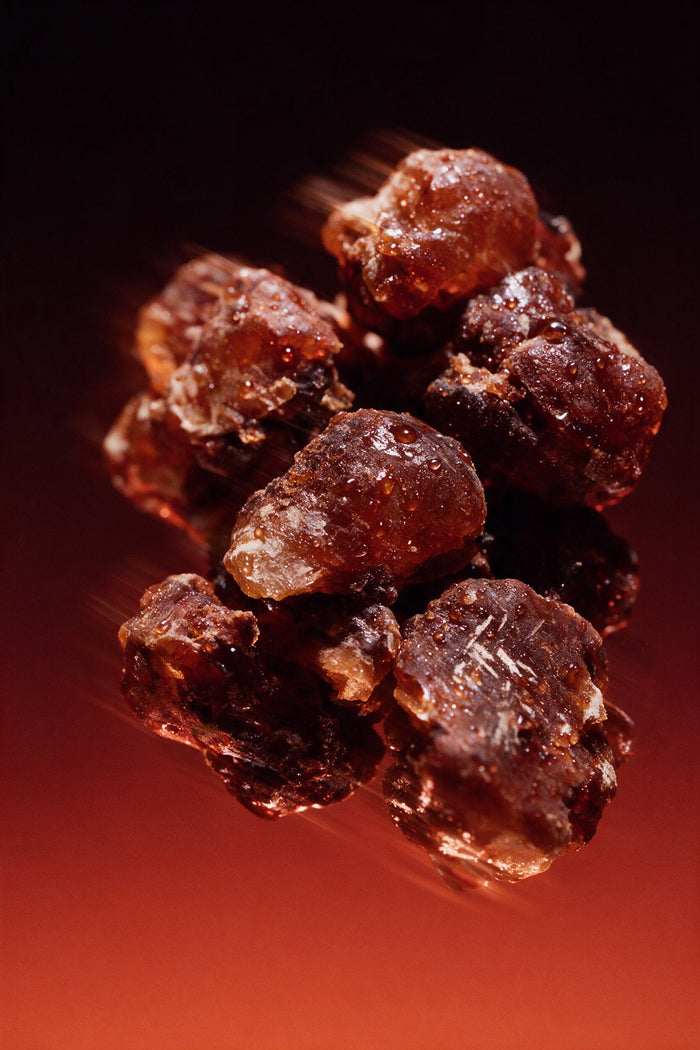
Myrrh Myrrh: The Bitter Resin of the Pharaohs, and What It Smells Like
Myrrh is named for what it tastes like. The word comes from the Semitic root m-r-r, meaning bitter. Arabic murr, Hebrew mor, Akkadian murru. It entered English through the Greek myrrha, which borrowed it from the same...
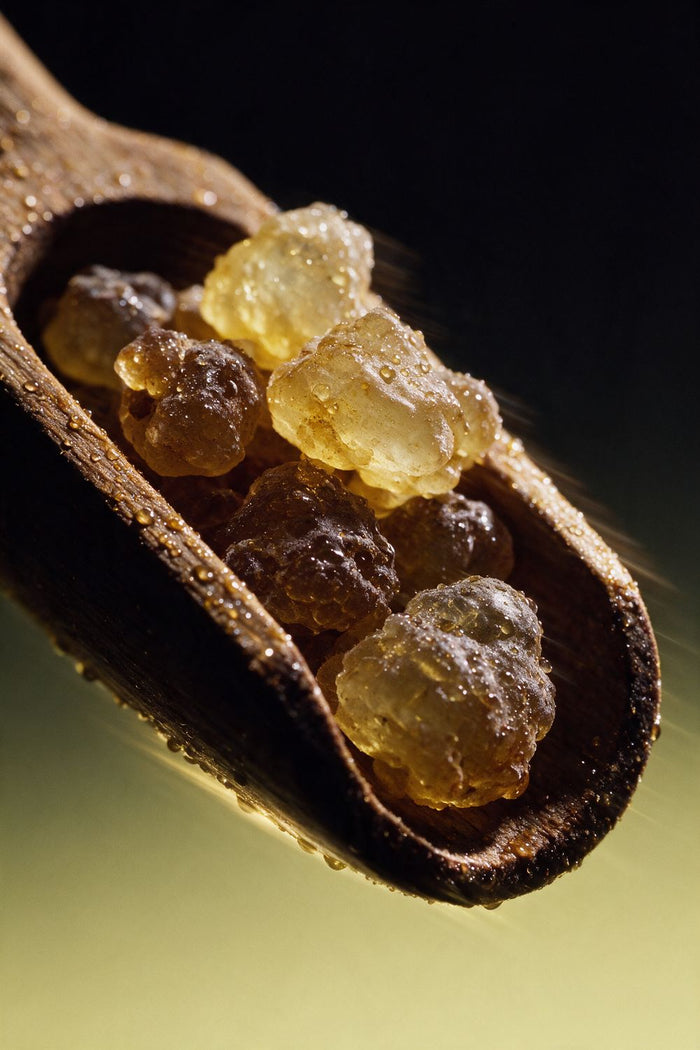
Incense Frankincense: 5,000 Years of Sacred Commerce
Before silk, before spices, before tea, before opium, there was resin.
Bakhoor Bakhoor: The Ancient Scenting Ritual The West Forgot
The sources call it smouldering, and the oldest English eyewitness saw its smoke wafted to the face and beard. What bakhoor is made of, how it was used in Cairo and in Qatar, what the studies of its smoke report, and ...
Next
Perfumery Journal
Myrrh Myrrh: The Bitter Resin of the Pharaohs, and What It Smells Like
20.11.25