Potpourri: The Rotten Pot That Began as a Stew
Potpourri is a mixture of dried flowers, herbs and spices kept in a jar or bowl to scent a room. The word is French for rotten pot and first named a Spanish stew: an English dictionary of 1611 defines it so, and the scented sense is dated to 1749. Orris root is the best known fixative, added to slow the loss of scent.
What is potpourri?
Potpourri is a mixture of dried flowers, herbs and spices, usually kept in a jar or bowl to scent a room. The word is French for "rotten pot." It first named a Spanish stew, and the scented sense is dated to 1749. A second sense is a medley of any kind.
Search the word and the same two lines come back. Potpourri means "rotten pot," and the jar was called that because the flowers were left to rot. The first line is true. The second is a story told after the fact. In the oldest English record the pot holds meat, not petals, and the first scented use found in this research is an insult, written by a woman who thought a heap of mixed flowers smelled bad. What the jar really held changed with every century, and what a bag of it holds today is stranger than the label suggests.
Potpourri meaning: the rotten pot
Merriam-Webster gives two senses. The first is "a mixture of flowers, herbs, and spices that is usually kept in a jar and used for scent." The second is "a miscellaneous collection," a medley, as in a potpourri of hit songs. It traces the word to French pot pourri, literally "rotten pot," and adds that the French was a translation of the Spanish olla podrida, which "likewise means 'rotten pot.'" Then it admits a gap: "We don't know why both the Spanish and the French gave their stews such unappetizing names." One guess it records is that the slow cooking of the dish over a fire may have played a part.
So the rot is in a cooking pot. Neither language says anything yet about flowers.
1611: the pot was a stew
Randle Cotgrave's French and English dictionary of 1611 has both halves of the word. Under the second, it reads "Pourri" as "Rotten, putrified; corrupted; tainted." Under the first it gives "A pot porride; a Spanish dish of many severall meates boyled or stewed together." There is no flower, no jar and no scent in the entry. Merriam-Webster says the word referred "solely to stew" for its first hundred and some-odd years.
1749: the first scented use was an insult
Merriam-Webster dates the scented sense to 1749, "in the meaning defined at sense 1." The letter that fits the date is from Lady Luxborough to William Shenstone, written at Barrells on 29 November 1749 and printed in 1775. She is describing a fashion of the day, couplets written about people by the dozen, and she calls the heap "an offensive medley" that "might be called a pot-pourri; which is a potful of all kinds of flowers which are severally perfumes, and commonly when mixt and rotten, smell very ill."
Each flower has a fine smell alone, and together, rotten, they smell bad. That is a joke about verses. It is not a recipe, and it does not say how the pot was made. The dictionary's date is the earliest this research found, not a proof that nothing older exists.
| Year | What the word names | Source |
|---|---|---|
| 1611 | A Spanish stew of many meats | Cotgrave's dictionary |
| 1749 | A pot of mixed flowers that "smell very ill," used as an insult | Lady Luxborough's letter to Shenstone, printed 1775 |
| 1857 | Dried flowers mixed with spices, sold by perfumers, put in a vase | Piesse, The Art of Perfumery |
| 1895 | A home jar of petals, salt and brandy | McDonald, Sweet-scented Flowers and Fragrant Leaves |
Did the jar rot? A story that grew around the name
Many pages join the two ideas. An herbalist's article reprinted by Millcreek Herbs says of the moist jar: "In olden times, it was made by letting fresh, fragrant plant parts rot into an aromatic cake, thus the origin of the name pot pourri which means 'rotten pot.'" An author's page says: "Potpourri translates as rotten pot and later became known by the more attractive name of sweet jar." It adds that the flowers "were layered in a jar with coarse sea salt and often began to ferment." Wikipedia, in its history section, writes that "Often the mixture would ferment or even mold as the summer went by."
Only the first of these states a cause in so many words, "thus the origin of the name." The record points the other way. In 1611 the word was a stew's name, borrowed from a Spanish stew, and no one knows why it was called rotten. The jar took the word more than a hundred years later. Neither Piesse nor McDonald explains why the jar took it.
1857: the perfumers' recipe and the salt that was only filler
In 1857 George William Septimus Piesse, a perfumer, wrote that "the modern perfumer calls pot-pourri" a mixture of dried flowers and spices "used for scenting apartments, and generally placed in some ornamental Vase." He read it back into the past. Passages in Pliny, he thought, show that dried flowers were used for perfume in Roman times and that they were "as now, mixed with spices." That is a belief of 1857, not proof of a Roman jar.
His own recipe is a trade recipe, and its comment is blunt. After listing a pound of table salt he wrote: "We need scarcely observe that the salt is only used to increase the bulk and weight of the product". The aim, he says, was to sell it cheap. The salt, in this mix, was not a preservative. It was weight.
The next entry in his book is a second mix, which he calls "Olla-Podrida," the name of the stew again. It was "generally made, or 'knocked up,' with the refuse and spent materials derived from other processes in the manufacture of perfumery," such as spent vanilla, grain musk and orris left from making tinctures. In his chapter on the tonka bean he adds that the beans, after a month steeped in spirit, "are still useful when dried and ground in those compounds known as POT-POURRI, Olla Podrida." Our glossary records that the seeds of tonka have a strong fragrance because of their high content of coumarin. It follows, as an inference, that some of the trade's old mixes could carry coumarin. Piesse does not say so.
How to make potpourri
Three sources of three eras describe a method. They agree on more than they differ.
The modern dry method, from the Nebraska Extension in Lancaster County (2021), has five parts: "aromatic plant materials, thoroughly dried; decorative plant materials, thoroughly dried; other aromatic ingredients, such as whole spices, chips of pleasant-smelling wood and citrus peel; essential oils; and fixative." Its first rule is that "Whatever you use absolutely must be thoroughly dried so that your mixture doesn't mold." Whole cloves or stick cinnamon go in with the dried petals. The mix goes into "tightly sealed glass containers," and "Potpourri needs to age for at least a month before it's ready for use." Herbalist Merry Harrison gives a ratio: "Use about one tablespoon of fixative to five cups of potpourri mix."
The moist jar is the older home method. The herbalist describes it today as fresh scented herbs mixed with brandy, in a jar with a lid, and calls it a "moist pot potpourri" or "sweet jar." Donald McDonald printed two recipes for it in 1895.
| Source | Method | Salt | Fixative and resin | Spices |
|---|---|---|---|---|
| Piesse, 1857 (trade, dry) | Dry flowers and spices, "not ground" | Table salt, 1 lb, as filler | Coarse crushed orris, 1 lb | Cloves, cinnamon, allspice, 2 oz each, with 1 lb each of lavender and rose leaves |
| McDonald, 1895 (first jar) | Moist, covered stone pot, stirred daily, 2 to 3 months | Bay salt, 1 lb | Orris root 1 oz, gum benzoin 1 oz | Cinnamon 1 oz, cloves half an ounce, nutmegs 1 oz |
| McDonald, 1895 (second jar) | Moist, with brandy, stirred now and then, covers raised only when the scent is wanted | Common salt three quarters of a pound, bay salt half a pound | Orris root 2 oz, gum benzoin a quarter of a pound | Allspice and cloves half a pound each, brown sugar half a pound |
McDonald says the second mixture "is said to retain its fragrance for fifty years." The hedge is his own, and the claim is not tested here. His first jar adds "one grain musk," lemon rind, bay leaves, lavender water and Eau de Cologne, and it ends as "a sweet-scented mass ready to fill any number of pretty Japanese Rose jars." These are old recipes, kept here as what was believed then.
Orris root: the fixative of the old jars
All three eras reach for the same root. Piesse's 1857 recipe lists orris, McDonald's two jars list it, and the Nebraska Extension calls it "The best known fixative," which "smells faintly of violets when fresh" and is sold "in powder or chunk form." It adds that "Chunks tend to be effective longer." The herbalist explains the idea: "Fixatives absorb the fragrance and slow the evaporation of the essential oil," because the oils "are volatile" and "dissipate quickly, leaving a pretty mix without fragrance."
Our glossary records orris root as the rhizome of the German iris and the sweet iris, and notes that "For potpourri, the root powder is used without further processing." It describes the smell as "tenaciously flowery, heavy and woody" and says "Cis-γ-irone and cis-α-irone are the compounds responsible for the violet-like scent." Over hours it reads "cool, grey, powdery-violet," and the persistence on fabric "lasts 24-48 hours." Piesse, in 1879, wrote that the dried rhizome "of Iris florentina has a very pleasant odour, which, for the want of a better comparison, is said to resemble the smell of violets," and that the powder was "very extensively used in the manufacture of sachet powders." The two botanical names differ. The records agree on the use. The long story of the root is told in orris root and its five-year wait, and the difference between the flower and the root in iris and orris.
None of the old passages says in one sentence that orris fixes a pot-pourri. That claim belongs to the modern sources. McDonald's recipes do put benzoin, a balsamic resin, next to the orris, and benzoin has its own article.
What is in bought potpourri
The flowers in a garden jar and the stuff in a bag are not the same thing. Research at the Royal Botanic Gardens, Kew, that began in 1990 identified the ingredients of 1,000 samples taken from 12 manufacturers and traders in the United Kingdom.
| Kew study of UK potpourri ingredients | Figure |
|---|---|
| Samples of single ingredients | 1,000 |
| Manufacturers and traders | 12 |
| Different ingredients | 546 |
| Species, up to | 455 |
| Genera | 289 |
| Plant families | over 100 |
| Wild Indian species with no global conservation assessment | 80% |
The authors, Frances Cook, Christine Leon and Mark Nesbitt, report that "The vast majority of ingredients imported from Asia, especially India, were byproducts from crops and wild harvested species used by the Indian herbal healthcare industry." Fruits, seeds, leaves, inflorescences and stems of cane, pith and timber carried most of the list, and only "about one-tenth of study samples" came from Africa, the Middle East, Europe, America and Australia. Two sampled trees, Pterocarpus marsupium and P. indicus, are "vulnerable globally." The paper is about the United Kingdom, and its research began in 1990.
The scent is added. A safety data sheet from a US maker for a "Potpourri" refresher oil, reviewed in 2020, describes a liquid with a flash point of 92 degrees Celsius.
| Component on the sheet | CAS | Share |
|---|---|---|
| Dipropylene glycol | 25265-71-8 | 25-50% |
| Benzyl salicylate | 118-58-1 | 10-25% |
| Phenyl ethyl alcohol | 60-12-8 | 10-25% |
| Iso E Super | 54464-57-2 | 1 to under 2.5% |
| Geraniol | 106-24-1 | 1 to under 2.5% |
| Clove leaf oil | 8000-34-8 | 0.1 to 1% |
That is one maker's blend, not every potpourri. A UK supplier's sheet for a bag of "Lavender Pot pourri," dated May 2015, reads differently. Its product use is "Air freshener pot pourri," its appearance "Dried botanicals," and the fragrance oil has "a separate material" sheet. It carries the label line EUH208, "Contains dl-Limonene (racemic), omega-Pentadecalactone. May produce an allergic reaction." The same supplier's rose and bay sheet names geraniol, alpha-hexylcinnamaldehyde and citronellol, among others, in that line. On both sheets the line appears in the label-elements section under Regulation (EC) No 1272/2008. It names an ingredient, limonene among them. It is a listing, not a verdict on the product.
Is potpourri safe? What the poison centres say
The warnings concern the liquid kind, not the dry mix. The ASPCA wrote on 17 September 2026 that "Liquid potpourri and some diffuser liquids may also contain cationic detergents, although most primarily contain fragrances, alcohol or essential oils," and that "Cats appear especially sensitive and may develop severe signs even after relatively small exposures." A veterinary toxicologist writing in dvm360 in 2009 says that cats "are particularly sensitive to the components called cationic detergents," and that if eaten, "severe burns to the mouth, esophagus, and stomach may occur." Pet Poison Helpline lists the item too: "Ingestion of liquid potpourri can cause chemical burns to lips, tongue, gums and throat of companion animals."
Three sources agree, though the vet's article cites the helpline, so they are not wholly independent. None is a regulator. All speak of some products only. The one safety data sheet of a liquid refresher lists no cationic detergent among its components, so it does not bear on this warning. None of the warnings concerns dry potpourri and pets. None of them reports a ban.
Another name for potpourri
The home jar had its own names. The herbalist calls the moist kind a "sweet jar," and McDonald's recipes end in "Rose jars." Piesse's "Olla-Podrida" was a scrap mix from the perfume workshop. As a plain medley, the dictionary lists "medley," "assortment," "variety," "jumble," "collage" and "mélange."
Frequently Asked Questions
What does potpourri mean?
In French pot pourri means rotten pot. It first named a Spanish stew: Cotgrave's dictionary of 1611 defines it as a dish of many meats boiled together. The scented sense is dated to 1749 by Merriam-Webster, and a second sense, a miscellaneous collection or medley, followed. The reason for the rotten name is not known.
Why is it called potpourri, or rotten pot?
English took the French name of a stew, itself a translation of the Spanish olla podrida, both meaning rotten pot. Merriam-Webster says nobody knows why the stews got such names and offers slow cooking as one guess. Pages that blame the rotting of the flower jar give no old source for it.
How to make potpourri?
The Nebraska Extension lists dried plant material, whole spices, essential oils and a fixative. The material must be thoroughly dried so it does not mold. The mix goes into tightly sealed glass containers and ages for at least a month. Older moist jars used salt and brandy and were stirred for two or three months.
What is the difference between dry and moist potpourri?
Dry potpourri is made of fully dried flowers and spices with a fixative. The moist kind, called a sweet jar, mixes fresh petals with salt and brandy in a lidded jar. McDonald's two recipes of 1895 are moist. In Piesse's trade recipe of 1857 the salt was filler, added to bulk the product up.
What is orris root and why is it in potpourri?
Orris root is the dried rhizome of an iris, with a smell said to resemble violets. The Nebraska Extension calls it the best known fixative, and an herbalist says fixatives absorb the fragrance and slow its evaporation. Piesse's recipe of 1857 and both of McDonald's of 1895 list it among their ingredients.
What is in store-bought potpourri?
A Kew study of 1,000 samples from 12 UK makers found 546 different ingredients, mostly byproducts of Indian crops and herbal medicine trades. The scent is added: one US maker's sheet for a refresher oil lists dipropylene glycol, benzyl salicylate and phenyl ethyl alcohol, with aldehydes, geraniol and clove leaf oil in smaller shares.
Is liquid potpourri dangerous for cats?
The ASPCA, a veterinary toxicologist and Pet Poison Helpline all say cats are especially sensitive to the cationic detergents that some liquid potpourri contains, which can burn the mouth and gullet. The ASPCA adds that most liquid products mainly hold fragrance, alcohol or essential oils. None of these sources speaks of dry potpourri.
Is potpourri unhealthy?
The warnings concern liquid products and pets. Supplier sheets for dry bags carry the allergen line EUH208, which names an ingredient such as limonene or geraniol and says it may produce an allergic reaction. That line is a listing, not a verdict. An herbalist notes that some people are allergic to iris.
Sources
- Randle Cotgrave, A Dictionarie of the French and English Tongues, London, 1611, entries Pot pourri and Pourri. Read in the scan at the Internet Archive (OCR, long s restored).
- Merriam-Webster, "potpourri", with its word history and first known use (1749). Read on 19 November 2026.
- Henrietta Knight, Lady Luxborough, Letters written by the late Right Honourable Lady Luxborough, to William Shenstone, Esq., London, 1775, letter of 29 November 1749, pp. 143-144. Read at the Internet Archive.
- G. W. Septimus Piesse, The Art of Perfumery, London, 1857 and 3rd edition 1879, entries Pot-Pourri, Olla-Podrida, Orris, Tonquin, and the history chapter. Read at the Internet Archive.
- Donald McDonald, Sweet-scented Flowers and Fragrant Leaves, London, 1895, the historical sketch, two recipes. Read at the Internet Archive.
- Frances E. M. Cook, Christine J. Leon and Mark Nesbitt, "Potpourri as a Sustainable Plant Product: Identity, Origin, and Conservation Status", Economic Botany 69(4), 330-344, 2015. DOI 10.1007/s12231-015-9325-8. Abstract read on the publisher's page.
- Mary Jane Frogge, "Potpourri: Make Your Own", Nebraska Extension in Lancaster County, 19 August 2021. Merry Harrison, "Potpourri", Catalyst Magazine, reprinted by Millcreek Herbs, 2015. Charlotte Betts, "Potpourri", author's website. Wikipedia, "Potpourri" (raw text).
- Safety data sheet "Potpourri" (article 37000), US maker, reviewed 17 November 2020. Material safety data sheets "Lavender Pot pourri" (May 2015) and "Rose & Bay" (January 2017), a UK supplier.
- ASPCA, "What Pet Parents Need To Know About Corrosive Household Products", 17 September 2026. Ahna Brutlag, "Holiday hazard 1: Liquid potpourri", dvm360, 4 December 2009. Pet Poison Helpline, "Liquid Potpourri".
- PREMIEREPEAU glossary, entries orris root, tonka bean and coumarin. PREMIEREPEAU journal, "Does perfume go bad". Google's first page for the word "potpourri" in the United States, read on 19 November 2026.

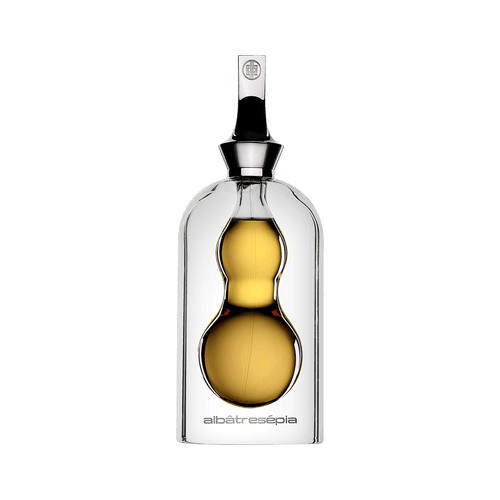
Albâtre Sépia
Extrait de parfum at 20%. 8 notes, including incense and white truffle.
Read also
3
Does Perfume Go Bad? Shelf Life, Signs and Storage
Four ranking pages say perfume lasts three to five years and none gives a source. What the EU label rule says, what air does to limonene and linalool, what a perfumer wrote in 1857, and how to keep a bottle.
The King of Nine Essences: A 17th-Century Manual for Perfuming a Room
Sultan Ibrahim Adil Shah II of Bijapur preferred to be called the King of Nine Essences.

Smelling Salts: Ammonia, a Reflex, and the Perfumers Who Sold It
Most smelling salts are no longer salts. The capsules sold to athletes hold ammonia in water and alcohol. The salt was the older form, and the people who filled the bottle were perfumers.
Next
Perfumery Journal
Orris Root: Perfumery's 5-Year Wait
02.10.25