Queen of the Night Flower: One Name for Several Plants and Their Scent
Queen of the night is a loose name. GBIF gives it to two cacti, Epiphyllum oxypetalum and Selenicereus grandiflorus, and it lists the name for a shrub too, Cestrum nocturnum. Each flower lasts one night, but the plants flower more than once. A 2025 study measured the scent of Epiphyllum oxypetalum through the night: mostly geraniol, with benzyl alcohol and methyl salicylate behind it.
What is the queen of the night flower?
The queen of the night flower is a loose name, not one species. GBIF gives it to two cacti, Epiphyllum oxypetalum and Selenicereus grandiflorus, and it lists the name for a shrub too, Cestrum nocturnum. All of them open scented flowers after dark. Each flower lasts one night, but the plants flower more than once.
Search the name and three pages tell the same story: the plant blooms once a year, for a few hours, and then it is gone. The record differs. A single flower does last one night, but the plant does not wait a year between flowers, and one of the pages is about another cactus. The scent of one of the cacti has also been measured, hour by hour.
Which plants are called queen of the night?
At least five plants answer to the words. Two are cacti of the genera Epiphyllum and Selenicereus. GBIF lists "queen of the night" and "night-blooming cereus" among the English names of both. A third plant, Cestrum nocturnum, is a shrub of the potato family. GBIF lists "queen of the night" among its English names too. A fourth is the Arizona desert cactus Peniocereus greggii, which the Desert Botanical Garden in Phoenix calls "the Arizona Queen of the Night." A fifth is the tuberose: our article on that flower records that its Hindi name, Rajnigandha, is rendered "queen of the night."
| Plant | Family | Name published | Chinese name |
|---|---|---|---|
| Epiphyllum oxypetalum | Cactaceae | Haworth, 1829, on Candolle's Cereus oxypetalus of 1828 | tan hua |
| Selenicereus grandiflorus | Cactaceae | Britton and Rose, 1909, on Linnaeus's Cactus grandiflorus of 1753 | none given |
| Cestrum nocturnum | Solanaceae | Linnaeus, 1753 | none given |
The dates come from IPNI, the index of plant names, and from Flora of China. Linnaeus gave both the Selenicereus species and the Cestrum their first names in the Species Plantarum of 1753, as IPNI records it.
Night blooming cereus: which cactus is it?
The night-blooming cereus carries the same loose name. GBIF's English names for Epiphyllum oxypetalum are "night-blooming cereus," "queen of the night," "Moonflower Cactus" and "Dutchman's Pipe Cactus." For Selenicereus grandiflorus it lists "Queen of The Night," "night-blooming cereus" and "queen-of-the-night."
GBIF's French names split the two. Epiphyllum oxypetalum is "Belle de nuit" there, and Selenicereus grandiflorus is "Fleur d'amour." A garden post under the same name is about Peniocereus greggii, and Cestrum nocturnum is a shrub, not a cactus.
Does the queen of the night bloom only once a year?
Not as the sources have it. One florist's guide to Epiphyllum oxypetalum says: "The queen of the night flower opens just once a year, after dark, and wilts before sunrise." The Desert Botanical Garden writes of its desert cactus: "The Queen of the Night usually blooms once a year." NC State's plant toolbox, on Epiphyllum, says: "They bloom at night annually, each flower lasting a few hours." The florist's line and the garden's line are nearly the same, though the first is about Epiphyllum and the second about a desert cactus. That does not prove that one copied the other, but it shows how the name carries a line from plant to plant.
Against it stand the flowering seasons the other sources give.
| Source | Plant | What it says about timing |
|---|---|---|
| Flora of China | Epiphyllum oxypetalum | "Fl. Jun-Oct." |
| NC State Extension | Epiphyllum oxypetalum | Late spring to early summer, and "houseplants tend to bloom sporadically" |
| Botanic.jp, a Japanese plant site | Epiphyllum oxypetalum | About 2 hours in the evening, from June to September |
| Garden Clinic, an Australian nursery guide | Epiphyllum oxypetalum | "Ours usually starts flowering at Christmas and can flower throughout January." |
| A florist's guide | Epiphyllum oxypetalum | A mature plant, 3 years or more, may make 4 to 6 blooms per season |
| Desert Botanical Garden | Peniocereus greggii | "One night each year" |
So the line holds for the desert cactus, by that garden's account. For Epiphyllum oxypetalum the sources show a season of weeks or months, with one flower per night. The seasons differ by country and by garden. That is an inference from the Chinese, Japanese and Australian dates above.
How long does the flower last?
One night. The 2025 study of scent in Epiphyllum oxypetalum calls the bloom "transient blooming, which lasts for only one night." Its plants were 5-year-old seedlings at a planting base at Zizhong, Sichuan. In that study "the flowers typically began opening after 8 p.m. local time and reached full bloom at ~11:00 p.m." The authors write that, unlike many plants that bloom over a long period, the flowers "rapidly bloom within a few hours."
Other sources give other lengths. NC State says each flower lasts a few hours and withers by the next morning. The Japanese plant site says about two hours of bloom in the evening. Garden Clinic says each flower lasts "one night only" and "is finished at dawn." The figures differ, and they may count different things: the first opening, the fully open flower, or the whole night. The study's hours are those of one place and one latitude, and the clock will move elsewhere.
What the plant looks like and where it grows
Flora of China describes Epiphyllum oxypetalum as an epiphytic shrub 2 to 6 m tall, with aerial roots and flat, leaflike branches 15 to 100 cm long. Its flowers are "nocturnal, fragrant, funnelform, 25-30 × 10-27 cm." The petals are white, the sepals pale green or pinkish red, and the style is white and 20 to 22 cm long. Fruit is rare. NC State gives the flower as 12 inches long and 8 inches wide.
Flora of China puts the home of the species in Mexico and Guatemala. Kew's World Checklist lists Mexico and Central America for it without marking them native, and lists Brazil, Cuba, the Dominican Republic, south-central China, Vietnam and several Pacific islands as introduced. For Selenicereus grandiflorus the same checklist lists the Bahamas, the Cayman Islands, Cuba, the Dominican Republic, Haiti, Jamaica, Mexico and Central America, again without marking them native, with Florida, Puerto Rico, Bangladesh and Myanmar as introduced. Cuba's own 2023 red list marks it native on the Cuban archipelago.
Flora of China adds the story of tan hua, the plant's Chinese name, written 昙花. It "was first introduced to China in 1645, and the naturalized plant was first recorded in Jinghong, Yunnan, in 1936." The same flora records that "the mucilaginous flower is often eaten in a vegetable soup." GBIF holds the Japanese name 月下美人 for the plant and the traditional Chinese form 曇花.
What does the queen of the night smell like?
The only measurement found is for Epiphyllum oxypetalum. In the Sichuan study, flowers were sampled at 13 stages from 7 pm to 7 am by dynamic headspace, and 49 volatile compounds were identified: 26 terpenoids, 5 fatty acid derivatives and 18 benzenoids. The authors describe the scent as one that "begins with a mild phenolic odour, transitioning to a pronounced fragrance." Starting after 8 pm, "volatile emission increased 200-fold within 6 h." Most of it came from the petals and sepals, and "pistil contributes little." The method is the one in our article on headspace, which captures the scent of a living flower without touching it.
The mixture changed through the night.
| Time (local) | What the paper records |
|---|---|
| 7 pm | Start of sampling |
| After 8 pm | Flowers begin to open and emission begins to rise |
| 9 pm | Benzenoid esters are 92.46% of the emission |
| About 11 pm | Full bloom |
| 1 am | Terpenoids are 81.33% of the emission |
| 2 am | Peak emission, 165.45 μg per flower per hour |
| 3 am | Benzenoid alcohols reach their peak |
| From 5 am | Esters are the majority again until the flower withers |
| 7 am | End of sampling |
The scent at 9 pm is not the scent at 1 am. No scent analysis of the other cactus, Selenicereus grandiflorus, is on record.
The molecules behind the scent
At the peak, 2 am, the paper gives geraniol 72.54%, benzyl alcohol 13.72% and methyl salicylate 4.55% of the emission, 90.25% together. The abstract gives the same 72.54% for geraniol "at full bloom," with 12.96% and 3.75% for the other two. The two wordings differ on the second and third compounds, and both are given. In either, geraniol leads by a wide margin. The authors call it a monoterpene "known for its sweet, rose-like aroma" that has been "extensively applied in the cosmetic and fragrance industries."
| Molecule | CAS | Odour words, Good Scents and Leffingwell | In the flower |
|---|---|---|---|
| Geraniol | 106-24-1 | sweet, floral, rose, fruity, citrus, waxy / floral, rose, sweet | 72.54% at the peak |
| Benzyl alcohol | 100-51-6 | sweet, floral, rose, fruity, phenolic, balsamic, chemical / almond, fruity, sweet | 13.72% at the peak |
| Methyl salicylate | 119-36-8 | sweet, root beer, camphoreous, phenolic, minty, wintergreen, aromatic / sweet, warm | 4.55% at the peak |
A reader may think of rose for a reason in the odour words, since two of the three molecules carry that word in the Good Scents list. The paper also says that the moth-pollinated cacti emit blends of terpenoids and benzenoids, while bat-pollinated ones give "sulphur-containing VOCs with a cabbage-like smell." The paper does not say which animal visits Epiphyllum oxypetalum.
Queen of the night or night-blooming jasmine?
They are different plants, and their scents were measured differently. Night-blooming jasmine is Cestrum nocturnum, a shrub of the potato family. A 2025 study in Scientific Reports on flowers collected in Fujian, China, found that "Benzaldehyde, phenyl acetaldehyde and benzyl acetate were identified as the main floral scent substances." Their relative peak areas at midnight were 32.40%, 26.91% and 23.07%.
The two sets of percentages cannot be set side by side. The Cestrum figures are peak areas from petals, by solid-phase microextraction, and the Epiphyllum figures are shares of the emission of a living flower. In that study the Cestrum petals opened gradually from 18:00 to 22:00, were fully open from 22:00 to 02:00, and closed from 02:00 to 06:00. Both plants work at night, which is why the names overlap.
The tuberose is a fifth plant under the words. Its night scent has a story of its own in our article on the tuberose, and the jasmine picked after dark is in our article on jasmine sambac.
Is the queen of the night used in perfume?
Not as a trade material. The European Commission's cosmetic ingredient database, CosIng, lists Epiphyllum oxypetalum flower extract and Cereus grandiflorus flower extract, each with one function, skin conditioning. No fragrance function is recorded for either. These are listings, not a verdict on safety, and no safety figure is on record for either cactus.
The authors of the 2025 study write that their work on how the plant builds geraniol "may hold potential for the development of novel perfume products." That is a hope, not a product.
Can the queen of the night be grown from a cutting?
A nursery guide says yes. Garden Clinic writes: "Propagate by cutting from the long flat arching stems." and "Allow it to dry out for a few days before planting into very well drained potting media." That is a nursery's instruction for Epiphyllum, not a standard or a paper. NC State lists the plant for hardiness zones 10a to 11b and says that it "is not frost-tolerant." A florist's guide says young cuttings often take 2 to 3 years before their first flower.
Our articles on gardenia and on jasmine in perfumery follow two other white flowers.
Frequently Asked Questions
What is night blooming cereus?
It is a loose name. GBIF lists "night-blooming cereus" among the English names of both Epiphyllum oxypetalum and Selenicereus grandiflorus, two cacti of the cactus family. A garden post under the same name is about Peniocereus greggii. Cestrum nocturnum is a shrub of the potato family that GBIF lists under "queen of the night" too.
Why does the queen of the night only bloom once a year?
Each flower lasts one night, but the plant is not limited to one night a year. Flora of China gives June to October for Epiphyllum oxypetalum, and an Australian nursery reports flowering from Christmas through January. The line "once a year" is printed on a page about a desert cactus, Peniocereus greggii, and on pages about the others.
How long does the queen of the night flower bloom?
One night. In a 2025 study in Sichuan the flowers began opening after 8 pm and reached full bloom near 11 pm. NC State says each flower lasts a few hours and withers by the next morning. A Japanese plant site says about two hours open in the evening. The figures vary with the place and with what is counted.
What does the queen of the night flower smell like?
Measured on Epiphyllum oxypetalum, the scent at its peak is 72.54% geraniol, a sweet, rose-like molecule, with benzyl alcohol and methyl salicylate behind it. The authors say it begins with a mild phenolic odour. No scent analysis of Selenicereus grandiflorus is on record.
Is the queen of the night the same as night-blooming jasmine?
No. Night-blooming jasmine is Cestrum nocturnum, a shrub of the potato family, and the queen of the night cacti are in the cactus family. Their scents differ in the papers: Cestrum is led by benzaldehyde, phenylacetaldehyde and benzyl acetate, while Epiphyllum is led by geraniol. Both open at night, which is why the names overlap.
Where does the queen of the night flower grow?
Flora of China gives Epiphyllum oxypetalum as native to Mexico and Guatemala. Kew's checklist lists Mexico and Central America for it and Brazil, Cuba, south-central China and Vietnam as introduced. For Selenicereus grandiflorus it lists the Greater Antilles, Mexico and Central America, and Florida as introduced. Both are grown as ornamentals.
What is the Chinese name of the queen of the night flower?
Flora of China names Epiphyllum oxypetalum tan hua, written 昙花. It says the plant first came to China in 1645, that a naturalised plant was recorded in Jinghong, Yunnan, in 1936, and that the mucilaginous flower is often eaten in a vegetable soup.
Is the queen of the night flower used in perfume?
Not as a trade material. CosIng lists the extracts only as skin conditioning, with no fragrance function. The authors of the 2025 study say their finding may help future perfume products, and the scent of a living flower can be captured by headspace.
Sources
- Y. Zhang and others, "Floral scent emission of Epiphyllum oxypetalum: discovery of its cytosol-localized geraniol biosynthesis", Horticulture Research, 2025. DOI 10.1093/hr/uhaf039. Read in full text at Europe PMC (PMC11997432).
- "Unraveling the mechanism of fragrance release in Cestrum nocturnum", Scientific Reports, 2025. DOI 10.1038/s41598-025-99542-3. Read in full text at Europe PMC (PMC12048523).
- Flora of China, vol. 13, p. 212, treatment of Epiphyllum oxypetalum, read at efloras.org.
- IPNI records for Epiphyllum oxypetalum, Selenicereus grandiflorus, Cactus grandiflorus L. and Cestrum nocturnum. GBIF records and English, French, Chinese and Japanese names for the first two species. Kew, World Checklist of Vascular Plants, and the Catalogue of Life, distributions.
- NC State Extension Gardener Plant Toolbox, Epiphyllum oxypetalum. Desert Botanical Garden, Phoenix, "Queen of the Night in Bloom", 5 March 2026. Garden Clinic, "Queen of the Night". A florist's guide to the queen of the night flower. Botanic.jp, Epiphyllum oxypetalum. All read on 19 November 2026.
- PubChem, Pyrfume (Good Scents and Leffingwell odour words) and the IFRA Transparency List for geraniol, benzyl alcohol and methyl salicylate. European Commission CosIng, entries for Epiphyllum oxypetalum flower extract and Cereus grandiflorus flower extract.
- Google's first page for "queen of the night flower" in the United States, read on 19 November 2026.

Rose Monotone
Extrait de parfum at 20%. 8 notes, including crystalline rose, pink pepper and cellophane.
Read also
3
Gardenia: Why Perfumers Call It The Impossible Flower
A gardenia absolute was made by enfleurage in 2015 and judged close to the fresh flower, so the flower is not beyond extraction. Its names, its range, the molecules of the accord and the growers' advice, from sources ...
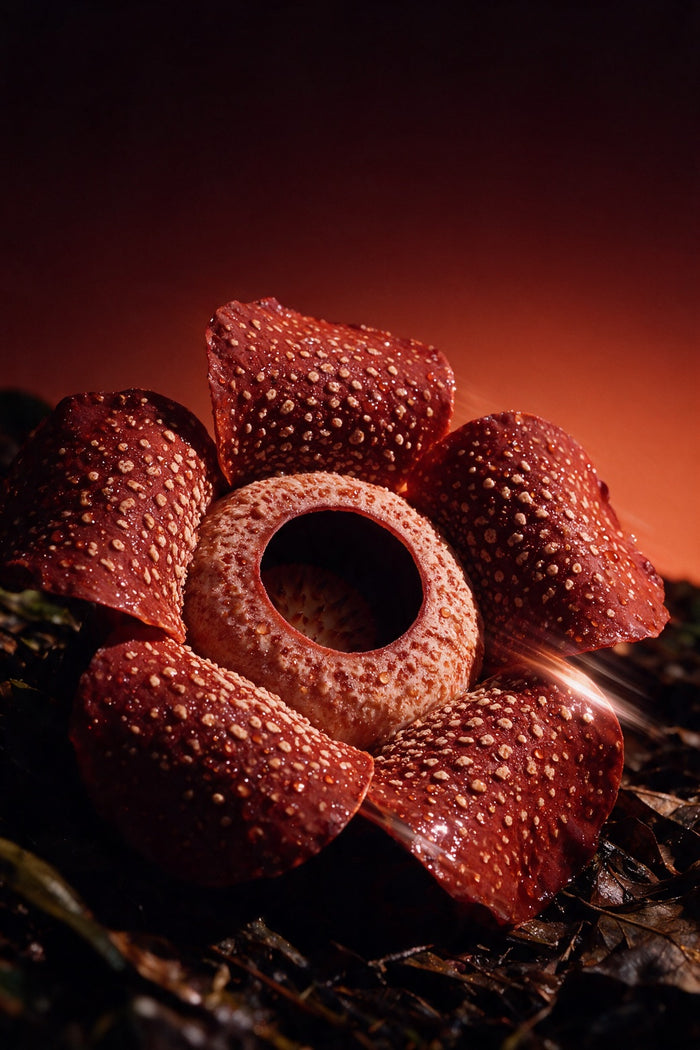
Rafflesia: The Giant Parasite and the Two Plants Called Corpse Flower
Rafflesia is a leafless parasite that shows only a bud and a flower, and its smell is that of rotting meat. The corpse flower of the botanic garden queues is another plant.

Jasmine in Perfumery: Why It Smells of Skin, Not Soap
What jasmine really smells like (heady, indolic, animal), the difference between sambac and grandiflorum, and how to wear it, with Nuit Élastique as the worked example.
Next
Perfumery Journal
Tuberose: The Night-Blooming Flower That Divides
05.11.25