


Benzyl Alcohol
Keywords: fruity · sweet · almond
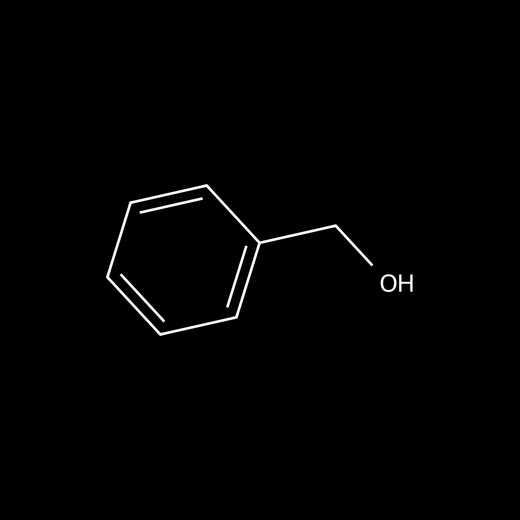
Benzyl Alcohol is an aromatic alcohol, a benzene ring bearing a single hydroxymethyl group, with a faint, sweet, fruity and floral odour.
- Olfactive family
- Fruity · 696 entries of the glossary in this family Subfamily: Classic fruits · 422 entries in this subfamily Cluster: Mixed fruit notes · 346 entries in this cluster
- IFRA status
- Restricted
- Pyramid
- Top · Volatility: Top Note
- Strength
- Medium Step 3 of 5 · shared by 1,473 of 2,156 graded entries Graded entries at each step, from 1 to 5: 4, 119, 1,473, 498, 39. 23 more sit between two steps.
- Also called
- Benzenemethanol, Phenylmethyl alcohol, (Hydroxymethyl)
benzene, Phenyl carbinol, Phenyl-methanol
Family, subfamily and cluster: PREMIEREPEAU house classification, version 2026‑11.
Benzyl Alcohol · Facets
Entries of the glossary that carry each facet, of 3,979:
- fruity 1,301
- sweet 1,988
- almond 56
- berry 97
- cherry 53
- grapefruit 27
Benzyl Alcohol · Scent
Benzyl Alcohol · In Perfumery
It is a fragrance component and a preservative, solvent and viscosity-decreasing agent in cosmetics.
Pyramid
Benzyl Alcohol: Top. Entries of the glossary stored at each place of the pyramid, of 4,006 (42 store no place):
- Top 718
- Top · Heart 497
- Heart 1,641
- Heart · Base 514
- Base 594
Benzyl Alcohol · In Depth
Identity
Benzyl Alcohol has the CAS number 100-51-6, the formula C₇H₈O and a molecular weight of 108.14 g/mol. Its systematic name is phenylmethanol.
It is an aromatic alcohol that consists of benzene bearing a single hydroxymethyl substituent.
Odour
Benzyl Alcohol has a faint, sweet, fruity odour with floral and almond touches. At 100 % it reads as floral, rose, phenolic and balsamic. Its odour is nondescript and rather sweet, and it varies considerably with the quality of the alcohol. Its odour strength is medium, and its substantivity is 35 hours at 100 %.
Occurrence in nature
It occurs in organisms including Camellia sinensis, Abies alba, Achillea abrotanoides, Acokanthera oblongifolia, Agaricus bisporus, Agaricus smithii, Alliaria petiolata, Aloe arborescens, Anthriscus sylvestris, Aronia melanocarpa, Arum maculatum and Aspalathus linearis.
Use in perfumery
It is used in cosmetics as a fragrance component, preservative, solvent and viscosity-decreasing agent.
Use in flavours
It is a flavouring agent and a carrier solvent. Its taste is chemical, fruity, cherry, almond, balsamic and bitter. The Joint FAO/WHO Expert Committee on Food Additives set an acceptable daily intake of 0 to 5 mg/kg of body weight in 1996.
Properties
It boils at 205 to 206 °C at 760 mmHg and melts at −15.2 °C. It is slightly denser than water. It dissolves in ethyl alcohol, 1:1.5 in 50 % alcohol and 1:8-9 in 30 % alcohol, and in most organic solvents, but not in paraffin oil. Its flash point is 96 °C, its logP is 1.1 and its vapour pressure is 0.094 mmHg at 25 °C.
Safety and IFRA
It is restricted under the IFRA Standard “Benzyl alcohol” (Amendment 49). Its INCI name is BENZYL ALCOHOL, its functions are preservative, solvent, viscosity controlling and perfuming, and its EC number is 202-859-9. It appears in Annex III, entry 45, of the EU Cosmetics Regulation, the annex that lists restricted substances. It is registered under REACH. It is harmful if swallowed (H302), may cause an allergic skin reaction (H317) and causes serious eye irritation (H319).
Benzyl Alcohol · Technical Sheet
Molecular weight
108.14 g/mol Heavier than 244 of the 536 other entries at the same place of the pyramid that store a weight; 7 weigh the same.
2,515 entries store a molecular weight. By place in the pyramid: Top 537, Top · Heart 403, Heart 861, Heart · Base 452, Base 262.
Identity
- Type
- Ingredient
- Category
- Aroma chemicals
Classification
- Chemical class
- Alcohol
Chemical data
- Formula
- C7H8O
- CAS
- 100-51-6
- Reported in plants
- Camellia sinensis (4 papers; one: Agricultural and Biological Chemistry 1986, Camellia sinensis) · Carica papaya (2 papers; one: J Agric Food Chem 1984, Carica papaya) · Juglans nigra (2 papers; one: Journal of essential oil research 1992, Juglans nigra) · Myrtus communis (2 papers; one: Journal of essential oil research 1992, Myrtus communis) · Paeonia lactiflora (2 papers; one: Agricultural and Biological Chemistry 1984, Paeonia lactiflora) · Vitis vinifera (2 papers; one: Front Microbiol 2017, Vitis vinifera) · LOTUS
- PubChem CID
- 244, compound record on PubChem
- InChIKey
- WVDDGKGOMKODPV-UHFFFAOYSA-N
- Wikidata · Wikipedia
- Benzyl Alcohol: Q52353, item on Wikidata · Wikipedia, English article
Labelling
- EU cosmetics annexes
- BENZYL ALCOHOL · CosIng, Annex III, entry 45, BENZYL ALCOHOL · restricted Product type, body parts:
“(a) Solvent (b) Fragrance/ aromatic compositions/ their raw materials”
Other:“For purposes other than inhibiting the development of microorganisms in the product. This purpose has to be apparent from the presentation of the product. The presence of the substance shall be indicated in the list of ingredients referred to in Article 19(1), point (g), when its concentration exceeds: — 0,001 % in leave-on products — 0,01 % in rinse-off products.”
Note:“III (45) For use as a preservative, see Annex V, No. 34”
BENZYL ALCOHOL · CosIng, Annex V, entry 34, BENZYL ALCOHOL · preservative Maximum concentration:“1.0%”
Note:“V (7) For use other than as a preservative, see Annex III, No. 45 (a) (b)”
Physical properties
- Appearance
- Clear, colourless liquid
- Boiling point
- 205 to 206 °C at 760 mmHg
- Melting point
- −15.2 °C
- Flash point
- 96 °C
- Vapour pressure
- 0.094 mmHg at 25 °C
- Log P
- 1.1
Performance and rules
- Tenacity
- 35 hours at 100 %
- IFRA status
- Restricted — IFRA Standard “Benzyl alcohol” (Amendment 49)
Benzyl Alcohol · See Also
Entries related to Benzyl Alcohol, by their place in the pyramid. “shared” marks a scent word Benzyl Alcohol has too.
Top notes

4-Hydroxybenzyl Alcohol
fruity (shared) · sweet (shared) · medicinal Fruity / Same cluster / 124.14 g/mol
Benzyl formate
fruity (shared) · floral · cherry (shared) Fruity / Top · Heart / 136.15 g/mol
2-Phenyl-2-propanol
green · floral · fatty Florals / Top · Heart / 136.19 g/mol


Heart notes

Benzyl hexanoate
apricot · floral · fruity (shared) Fruity / Heart · Base / 206.28 g/mol
Orchid Cactus
floral · fruity (shared) · sweet (shared) Florals / Accord
Benzyl Acetate
floral · jasmine · fruity (shared) Florals / Natural & Synthetic / 150.17 g/mol
Benzyl Cinnamate
balsamic · floral · sweet (shared) Resinous / Heart · Base / Synthetic / 238.28 g/mol
Phenylethyl Alcohol
floral · rosy · honeyed Florals / Synthetic / 122.16 g/mol
Dibenzyl ether
almond (shared) · sweet (shared) · earthy Gourmand / Heart · Base / Synthetic / 198.26 g/mol


Benzyl Alcohol · Sources
- PubChem Benzyl Alcohol
- ChEBI Benzyl Alcohol: chemical classification record
- Pyrfume Arctander, Perfume and Flavor Chemicals: odour descriptions (Pyrfume archive)
- The Good Scents Company Information System Benzyl Alcohol: data sheet
- Pyrfume Good Scents odour data (Pyrfume archive)
- Pyrfume Leffingwell odour data (Pyrfume archive)
- Wikidata (LOTUS natural products data) Benzyl Alcohol: organisms it is reported in, with the papers
- IFRA Standards, 51st Amendment
- European Commission, CosIng Benzyl Alcohol: cosmetic ingredient record
- European Chemicals Agency Benzyl Alcohol: substance record
Cite as PREMIEREPEAU Glossary, “Benzyl Alcohol”, https://premierepeau.com/
