


Black Walnut
Keywords: nutty · earthy · rich
Black walnut is Juglans nigra, the eastern American black walnut, a deciduous tree of the walnut family, Juglandaceae, native to central and eastern North America. Most parts of the tree, including the leaves, stems and fruit husks, have a very characteristic pungent or spicy odor.
- Olfactive family
- Gourmand · 494 entries of the glossary in this family Subfamily: Classic fruits · 435 entries in this subfamily Cluster: Nutty notes · 100 entries in this cluster
- Material
- Natural Shells and peels
- Pyramid
- Base Note
- Strength
- Medium Step 3 of 5 · shared by 1,469 of 2,161 graded entries Graded entries at each step, from 1 to 5: 4, 117, 1,469, 507, 40. 24 more sit between two steps.
- Also called
- Eastern black walnut, eastern American black walnut
Black Walnut · Facets
Entries of the glossary that carry each facet, of 3,979:
- earthy 657
- sweet 1,990
- warm 1,109
- fresh 1,392
- nutty 258
- spicy 473
- pungent 90
Black Walnut · Scent
The odor is pungent or spicy, and very characteristic of the tree. It is found in the leaves, stems and fruit husks, while the nut itself lacks it.
Evolution over time
Black Walnut: scent over time.
- Immediately
Pungent and spicy, the characteristic odor of the leaves, stems and fruit husks.
Scent words: fruity · spicy
The nut itself lacks the pungent, spicy odor.
Black Walnut · In Perfumery
In cosmetic products, Juglans nigra shell extract has three functions: astringent, fragrance and skin conditioning (emollient). As a fragrance, it enhances the smell of a product or perfumes the skin.
Pyramid
Black Walnut: Base. Entries of the glossary stored at each place of the pyramid, of 4,000 (35 store no place):
- Top 718
- Top · Heart 501
- Heart 1,646
- Heart · Base 512
- Base 588
Role in the formula
Black Walnut: roles in the formula. Entries of the glossary that share each role, of 4,000:
- Modifier 1,168
- Blender 1,041
- Fixative 341
Black Walnut · Terroir & Origins
- Producing countries
- United States
Black Walnut · Extraction & Chemistry
Solvent extraction of the shells and peels.
Available as
Black Walnut: available as.
- synthetic accord
- fantasy note
- solvent extract
- Appearance
- Dark amber to brown liquid
Black Walnut · Did You Know?
Colorless hydroxyjuglone in walnuts is rapidly oxidized to juglone once exposed to air, and walnut hulls change color from yellow to black after being freshly cut.
Black Walnut · In Depth
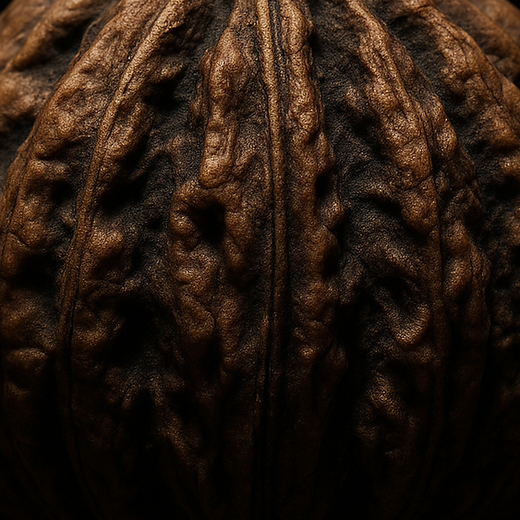
Black walnut, Juglans nigra, is a deciduous tree native to central and eastern North America, growing mostly in riparian zones. It ranges from southern Ontario west to southeast South Dakota, south to Georgia, northern Florida and southwest to central Texas. In summer and autumn a spherical fruit ripens, made of a brownish-green, semifleshy husk and a brown, corrugated nut. The relatively small seed lies inside a very hard, corrugated shell, which is enclosed by the fleshy outer husk.
Origin and Production
Black walnuts are shelled commercially in the United States. With about 65% of the annual wild harvest in the United States, Missouri is home to the world's largest processor and distributor of black walnuts.
Chemistry
Juglone is a phenolic organic compound with the molecular formula C₁₀H₆O₃. It occurs naturally in the leaves, roots, husks, fruit and bark of plants in the Juglandaceae family, particularly the black walnut. The largest sources of juglone on the tree are located in the buds, roots, and nut hulls. Juglone has been extracted from the husk of walnut fruit at concentrations of 2-4% by fresh weight. It is an allelopathic compound, a substance produced by a plant to stunt the growth of another plant.
Uses
Black walnut kernels are edible. As a food ingredient, the nut is commonly used in ice cream, bakery goods and confections. Extracts of the outer, soft part of the fruit are still used as a natural dye for handicrafts. The hard black walnut shell is used commercially in abrasive cleaning, in cosmetics, in oil well drilling and in water filtration. Black walnut is an important tree commercially, as the wood is a deep brown color and easily worked.
Black Walnut · History
Juglone was first isolated from black walnut in 1856 and was identified as the compound responsible for its allelopathic effects in 1881. The Chippewa and the Cherokee used the bark to make brown and black dyes. The Cherokee also ate the fruit of the black walnut. American pioneers let the nuts dry in the sun, then removed the husks and let the kernels dry, making them less bitter. In 1990, Missouri named the "Eastern Black Walnut" as its official tree nut.
Black Walnut · Technical Sheet
Identity
- Botanical
- Juglans nigra
- IPNI
- Juglans nigra L., Sp. Pl. 2: 997 (1753) — Carl Linnaeus (1707-1778)
- Type
- Ingredient
- Category
- Fruits, vegetables and nuts
In Nature
- Growth form
- Tree · POWO
- Native range
- Eastern Canada · North-Central U.S.A. · Northeastern U.S.A. · South-Central U.S.A. · Southeastern U.S.A. · POWO
- Introduced to
- 17 regions · Europe 11 · Temperate Asia 3 · Northern America 2 · Tropical Asia 1
- Flowering
- May · north of the equator · iNaturalist
- Recorded altitude
- 50–450 m · median 200 m · 4,056 records with an altitude · GBIF
- Wild or cultivated
- 165 native · 346 introduced · 483 cultivated among 47,341 records (the rest carry no such mark) · GBIF
- Recorded in
- 47 of 512 squares of the world grid; a brighter dot holds more records · GBIF
- Also from this genus
- Juglans: Walnut
- Also from this botanical family
- Juglandaceae: Pecan
In Print
- Timeline
- first described 1753 · earliest aroma paper in Europe PMC, 1992
- In English books
- most mentioned in the 1970s · Google Books Ngram
Classification
- Chemical class
- Natural extract
Chemical data
- Formula
- Complex natural mixture (key constituents: juglone C₁₀H₆O₃)
- CAS
- 96690-56-1
- INCI names (CosIng)
- JUGLANS NIGRA BARK EXTRACT (HAIR CONDITIONING)JUGLANS NIGRA LEAF EXTRACT (ASTRINGENT)JUGLANS NIGRA SHELL EXTRACT (ASTRINGENT, SKIN CONDITIONING - EMOLLIENT, FRAGRANCE)
Labelling
- EU allergens reported
- Limonene · Geraniol · Benzyl Alcohol · Pinene · Benzaldehyde
Physical properties
- Specific gravity
- 0.910–0.940 @ 25 °C (est)
- Note
- Juglans nigra hull/wood extract. Rich, earthy, slightly bitter-green aroma with nutty undertones.
Performance and rules
- IFRA status
- No IFRA Standard for the material itself (51st Amendment)
Black Walnut · See Also
Entries related to Black Walnut, by their place in the pyramid. « shared » marks a scent word Black Walnut has too.
Top notes

Benzaldehyde
gourmand · almond · cherry Gourmand / Same cluster / Natural & Synthetic

Heart notes

Buckwheat
earthy (shared) · green · nutty (shared) Gourmand / Same cluster / Natural
Nutty Notes
nutty (shared) · warm (shared) · creamy Fruity / Same cluster / Fantasy/Concept
Black Sesame
gourmand · nutty (shared) · roasted Gourmand / Natural & Synthetic
Coffee
gourmand · roasted · bitter Gourmand / Heart · Base / Natural-
Butterscotch
caramel · buttery · sweet (shared) Gourmand / Heart · Base / Fantasy/Concept


Base notes

Brazil Nut
nutty (shared) · creamy · rich (shared) Gourmand / Same cluster / Natural
Vanilla
gourmand · balsamic · warm (shared) Gourmand / Natural & Synthetic
Cocoa Absolute
gourmand · chocolate · sweet (shared) Gourmand / Natural-
Pecan
nutty (shared) · roasted · gourmand Gourmand / Fantasy/Concept


Black Walnut · Sources
- USDA PLANTS Database Pg juni (PDF)
- PubChem Juglone
- IFRA Standards, 51st Amendment
- COSMILE Europe JUGLANS NIGRA SHELL EXTRACT
- Wikipedia Juglans nigra
- Wikipedia Juglone
- Wikipedia Juglans
- Iowa State University Extension Black Walnut
- PubChem substance: Juglans nigra extract (96690-56-1)
Cite as PREMIEREPEAU Glossary, “Black Walnut”, https://premierepeau.com/pages/glossary-terms/black-walnut Updated 2026-11-19
