


1-Butanol
Keywords: winey · alcoholic · solvent
1-Butanol is a primary alcohol with a winey, alcoholic, fermented odour.
- Olfactive family
- Aromatic · 495 entries of the glossary in this family Subfamily: Classic aromatics · 155 entries in this subfamily Cluster: Camphoraceous aromatics · 114 entries in this cluster
- Material
- Natural & Synthetic
- Pyramid
- Top Note
- Strength
- Medium Step 3 of 5 · shared by 1,462 of 2,149 graded entries Graded entries at each step, from 1 to 5: 4, 118, 1,462, 501, 40. 24 more sit between two steps.
- Also called
- Butan-1-ol, n-Butanol, Butyl alcohol, n-Butyl alcohol, Butyric alcohol, Propyl carbinol
1-Butanol · Facets
Entries of the glossary that carry each facet, of 3,979:
- winey 129
- alcoholic 31
- solvent 31
- medicinal 82
- vanilla 79
- sweet 1,987
1-Butanol · Scent
Winey, alcoholic and fermented, with a mild fusel character.
1-Butanol · In Perfumery
As a fragrance ingredient it brings a mild, fusel-like, somewhat winey odour.
Pyramid
1-Butanol: Top. Entries of the glossary stored at each place of the pyramid, of 4,000 (35 store no place):
- Top 718
- Top · Heart 496
- Heart 1,644
- Heart · Base 513
- Base 594
1-Butanol · Extraction & Chemistry
It is obtained by fermentation of glycerol, mannite, starches and sugars, using Bacillus butylicus sometimes together with Clostridium acetobutyricum. It can also be made synthetically from acetylene. It is manufactured from ethylene oxide and triethylaluminum, by oxidation of tributylborane, by hydrogenation of butyraldehyde, or from crotonaldehyde.
- Appearance
- Colourless liquid
1-Butanol · Did You Know?
It is produced in small amounts in humans by the gut microbes.
1-Butanol · In Depth
Identity
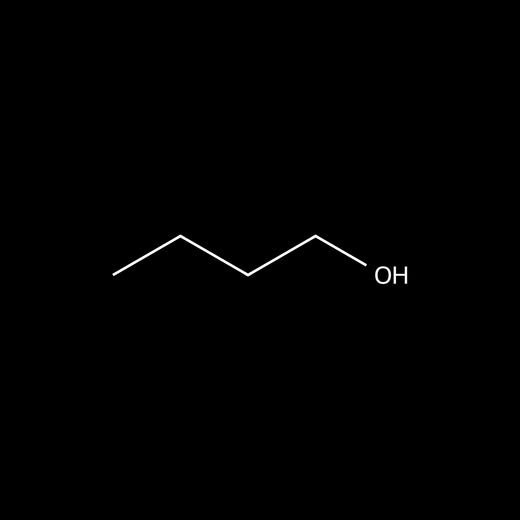
1-Butanol has the IUPAC name butan-1-ol. Its CAS number is 71-36-3. Its molecular formula is C₄H₁₀O and its molecular weight is 74.12 g/mol. It is a primary alcohol, namely butane in which a hydrogen of one of the methyl groups is substituted by a hydroxy group.
Odour
The odour is winey, alcoholic and fermented, with sweet and oily sides. It has a strong, characteristic, mildly alcoholic odour. At 10 % in dipropylene glycol it is described as fusel oil, sweet, balsam and whiskey. The odour is mild and fusel-like, more volatile and more choking than fusel oil itself, and somewhat winey but nondescript. Its odour strength is medium, and its substantivity is 4 hours at 100 %.
Occurrence in nature
It has been found in Aloe arborescens, Annona muricata, Arabidopsis thaliana, Astragalus membranaceus, Cichorium endivia, Citrullus lanatus, Escherichia coli and Fragaria.
Production
It is obtained by fermentation of glycerol, mannite, starches and sugars, using Bacillus butylicus sometimes together with Clostridium acetobutyricum. It can also be made synthetically from acetylene. It is manufactured from ethylene oxide and triethylaluminum, by oxidation of tributylborane, by hydrogenation of butyraldehyde, or from crotonaldehyde.
Use in perfumery
It is a fragrance ingredient. Cosmetic rules class it as a perfuming ingredient, alongside denaturant and solvent functions.
Use in flavours
It is used as a flavouring agent, with a banana and fusel taste. Its flavour profile is fruit, and its taste is also described as dry and burning. In the United States it is a flavouring agent or adjuvant, and a solvent or vehicle. The Joint FAO/WHO Expert Committee on Food Additives has not evaluated it.
Properties
It boils at 117 to 119 °C at 760 mmHg. It melts at −89 to −88 °C. Its flash point is 35 °C. Its logP is 0.88. Its vapour pressure is 6.7 mmHg at 25 °C.
Safety and IFRA
As of the 51st Amendment, no IFRA Standard covers this material itself. Its INCI name is N-BUTYL ALCOHOL. Its EC number is 200-751-6, and it is registered under REACH. It carries the hazard statement H318, causes serious eye damage.
1-Butanol · Technical Sheet
Molecular weight
74.12 g/mol Heavier than 53 of the 546 other entries at the same place of the pyramid that store a weight; 3 weigh the same.
2,572 entries store a molecular weight. By place in the pyramid: Top 547, Top · Heart 406, Heart 886, Heart · Base 455, Base 278.
Identity
- Type
- Ingredient
- Category
- Aroma chemicals
Classification
- Chemical class
- Alcohol
Chemical data
- Formula
- C4H10O
- CAS
- 71-36-3
- PubChem CID
- 263, compound record on PubChem
- InChIKey
- LRHPLDYGYMQRHN-UHFFFAOYSA-N
- Wikidata · Wikipedia
- 1-Butanol: Q16391, item on Wikidata · Wikipedia, English article
Physical properties
- Boiling point
- 117 to 119 °C at 760 mmHg
- Melting point
- −89 to −88 °C at 760 mmHg
- Flash point
- 35 °C (95 °F)
- Vapour pressure
- 6.7 mmHg at 25 °C
- Log P
- 0.88
- Tenacity
- 4 hour(s) at 100 %
Performance and rules
- Odour threshold
- 7.9 ppb to 2.0 ppm in air (4 studies) · Abraham et al. 2012
- Available as
- synthetic
- IFRA status
- No IFRA Standard for the material itself (51st Amendment)
1-Butanol · See Also
Entries related to 1-Butanol, by their place in the pyramid. “shared” marks a scent word 1-Butanol has too.
Top notes

tert-Amyl alcohol
camphoraceous · minty · alcoholic (shared) Aromatic / Same cluster / Natural & Synthetic / 88.15 g/mol
2-Methyl-2-butanol acetate
fruity · minty · banana Aromatic / Top · Heart / Same subfamily / 130.18 g/mol
Butyl Acetate
banana · fruity · ethereal Fruity / Natural & Synthetic / 116.16 g/mol
Butyl butyrate
fruity · banana · pineapple Fruity / Top · Heart / 144.21 g/mol
1-Pentanol
solvent (shared) · sweet (shared) · alcoholic (shared) Gourmand / Natural & Synthetic / 88.15 g/mol
3-Mercapto-2-methyl-1-butanol
green · meaty · onion Green / 120.22 g/mol
Ethylene Oxide
ethereal Fruity / Natural & Synthetic / 44.05 g/mol


Heart notes

Butyl anthranilate
floral · fruity · berry Fruity / 193.24 g/mol
beta,2,2,3-Tetramethylcyclopent-3-ene-1-butanol
herbal · nutty · sandalwood Woods / Heart · Base / 196.33 g/mol
Methylcyclohexenyl butanol
floral · rose · sweet (shared) Florals / 168.28 g/mol


1-Butanol · Sources
- PubChem 1-Butanol
- ChEBI 1-Butanol: chemical classification record
- Pyrfume Arctander, Perfume and Flavor Chemicals: odour descriptions (Pyrfume archive)
- Pyrfume Good Scents odour data (Pyrfume archive)
- Pyrfume Leffingwell odour data (Pyrfume archive)
- The Good Scents Company Information System 1-Butanol: data sheet
- Wikidata (LOTUS natural products data) 1-Butanol: organisms it is reported in, with the papers
- European Commission, CosIng 1-Butanol: cosmetic ingredient record
- IFRA Standards, 51st Amendment
- European Chemicals Agency 1-Butanol: substance record
Cite as PREMIEREPEAU Glossary, “1-Butanol”, https://premierepeau.com/
