


2-Ethylhexanoic Acid
Keywords: cheesy · fatty · fruity
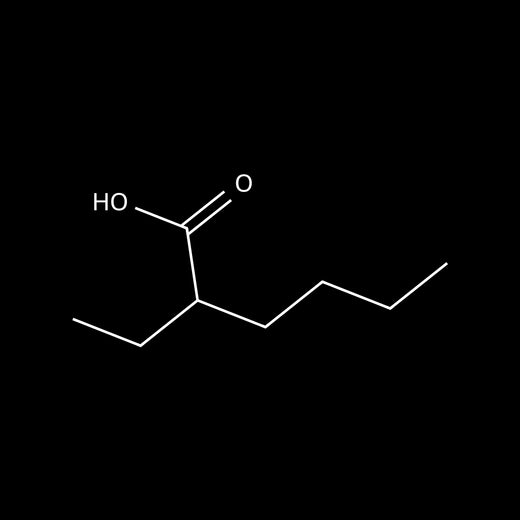
2-Ethylhexanoic Acid is a branched-chain fatty acid that smells cheesy, fatty and fruity. It is a colourless to light yellow liquid with a mild odour.
- Olfactive family
- Gourmand · 476 entries of the glossary in this family Subfamily: Creamy gourmands · 84 entries in this subfamily Cluster: Classic gourmands · 168 entries in this cluster
- Material
- Synthetic
- Pyramid
- Top · Heart · Volatility: Top · Heart Note
Family, subfamily and cluster: PREMIEREPEAU house classification, version 2026‑11.
2-Ethylhexanoic Acid · Facets
Entries of the glossary that carry each facet, of 3,979:
- cheesy 73
- fatty 265
- fruity 1,301
- herbal 757
- musty 126
- sour 45
2-Ethylhexanoic Acid · Scent
It smells cheesy and fatty, with fruity, herbal, musty and sour facets.
2-Ethylhexanoic Acid · In Perfumery
It has a cheesy, fatty and fruity odour.
Pyramid
2-Ethylhexanoic Acid: Top · Heart. Entries of the glossary stored at each place of the pyramid, of 4,006 (42 store no place):
- Top 718
- Top · Heart 497
- Heart 1,641
- Heart · Base 514
- Base 594
2-Ethylhexanoic Acid · Extraction & Chemistry
It is produced by the aldol route from butyraldehyde in three steps: aldol condensation, hydrogenation of the carbon-carbon double bond, and oxidation of the branched-chain saturated aldehyde to 2-ethylhexanoic acid. Its metallic salts are used as driers for paints and varnishes and as gelling agents for hydrocarbons. It also serves as a cosolvent and defoamer in pesticides.
- Appearance
- Colourless to light yellow liquid
2-Ethylhexanoic Acid · In Depth
Identity
2-Ethylhexanoic Acid has the CAS number 149-57-5 and the molecular formula C₈H₁₆O₂. Its molecular weight is 144.21 g/mol.
Odour
It smells cheesy and fatty, with fruity, herbal, musty and sour facets.
Occurrence in nature
It is found in Artemisia arborescens.
Production
It is produced by the aldol route from butyraldehyde in three steps: aldol condensation, hydrogenation of the carbon-carbon double bond, and oxidation of the branched-chain saturated aldehyde to 2-ethylhexanoic acid. Its metallic salts are used as driers for paints and varnishes and as gelling agents for hydrocarbons. It also serves as a cosolvent and defoamer in pesticides.
Use in perfumery
It has a cheesy, fatty and fruity odour.
Use in flavours
It belongs to the food additive class of flavouring agents.
Properties
It boils at 228 °C at 760 mmHg and melts at −59 °C. Its flash point is 114 °C in a closed cup. It is slightly soluble in water, burns though it may take some effort to ignite, and is corrosive to metals and tissue.
Safety and IFRA
No IFRA Standard covers this material itself. Its INCI name is 2-ethylhexanoic acid and its salts with the exception of those specified elsewhere in Annex VI to Regulation (EC) No 1272/2008. Its EC number is 205-743-6 and it is registered under REACH. Among hazard reports, 86.3 % say it is suspected of damaging fertility or the unborn child and 10.4 % say it may damage the unborn child.
2-Ethylhexanoic Acid · Technical Sheet
Molecular weight
144.21 g/mol Heavier than 307 of the 402 other entries at the same place of the pyramid that store a weight; 24 weigh the same.
2,515 entries store a molecular weight. By place in the pyramid: Top 537, Top · Heart 403, Heart 861, Heart · Base 452, Base 262.
Identity
- Type
- Ingredient
- Category
- Aroma chemicals
Classification
- Chemical class
- Carboxylic acid
Chemical data
- Formula
- C8H16O2
- CAS
- 149-57-5
- Reported in plants
- Vitis vinifera (1 paper; one: Front Microbiol 2017, Vitis vinifera) · LOTUS
- PubChem CID
- 8697, compound record on PubChem
- InChIKey
- OBETXYAYXDNJHR-UHFFFAOYSA-N
- Wikidata · Wikipedia
- 2-Ethylhexanoic Acid: Q209384, item on Wikidata · Wikipedia, English article
Labelling
- EU cosmetics annexes
- CosIng, Annex II, entry 1024 · prohibited in cosmetic products
“2-ethylhexanoic acid and its salts with the exception of those specified elsewhere in Annex VI to Regulation (EC) No 1272/2008.”
Physical properties
- Boiling point
- 228 °C at 760 mmHg
- Melting point
- −59 °C
- Flash point
- 114 °C in a closed cup
Performance and rules
- Available as
- synthetic
- IFRA status
- No IFRA Standard for the material itself (51st Amendment)
2-Ethylhexanoic Acid · See Also
Entries related to 2-Ethylhexanoic Acid, by their place in the pyramid. “shared” marks a scent word 2-Ethylhexanoic Acid has too.
Top notes

2-Methylheptanoic acid
cheesy (shared) · fatty (shared) · sour (shared) Gourmand / Top · Heart / Same cluster / 144.21 g/mol
2-Ethylbutyric acid
fruity (shared) · dairy · berry Gourmand / Same cluster / 116.16 g/mol
2-Ethylhexanal
fruity (shared) · green · fatty (shared) Green / Top · Heart / Synthetic / 128.21 g/mol
2-Methylhexanoic Acid
cheesy (shared) · fatty (shared) · fruity (shared) Fruity / Top · Heart / 130.18 g/mol
Heptanoic Acid
sour (shared) · fatty (shared) · fermented Top · Heart / Synthetic / 130.18 g/mol


Heart notes

Nonanoic Acid
fatty (shared) · nutty · cheesy (shared) Gourmand / Same cluster / 158.24 g/mol
Vinyl
plastic note Woods / Synthetic
Ethyl 2-ethylhexanoate
fruity (shared) · orris · herbal (shared) Fruity / 172.26 g/mol


2-Ethylhexanoic Acid · Sources
- PubChem 2-Ethylhexanoic Acid
- ChEBI 2-Ethylhexanoic Acid: chemical classification record
- Pyrfume Leffingwell odour data (Pyrfume archive)
- Wikidata (LOTUS natural products data) 2-Ethylhexanoic Acid: organisms it is reported in, with the papers
- IFRA Standards, 51st Amendment
- European Commission, CosIng 2-Ethylhexanoic Acid: cosmetic ingredient record
- European Chemicals Agency 2-Ethylhexanoic Acid: substance record
Cite as PREMIEREPEAU Glossary, “2-Ethylhexanoic Acid”, https://premierepeau.com/
