


Ashberry
Keywords: fruity · bitter · astringent
Ashberry is a fantasy or concept accord of the fruity, fresh and bitter family, in the category fruits, vegetables and nuts. Rowan berries are often bitter and astringent, although sweet-fruited varieties have also been selected for cultivation.
- Olfactive family
- Fruity · 717 entries of the glossary in this family Subfamily: Berry notes · 74 entries in this subfamily
- Material
- Natural Fruit
- Pyramid
- Heart Note
- Strength
- Medium Step 3 of 5 · shared by 1,469 of 2,161 graded entries Graded entries at each step, from 1 to 5: 4, 117, 1,469, 507, 40. 24 more sit between two steps.
- Also called
- Rowan, European rowan, mountain-ash, European mountain-ash, quickbeam, rowan-berry
Ashberry · Facets
Entries of the glossary that carry each facet, of 3,979:
- floral 1,551
- green 1,444
- sweet 1,990
- fruity 1,307
- warm 1,109
- fresh 1,392
- bitter 75
Ashberry · Scent
Fruit of the 'Konzentra' cultivar are mildly aromatic. Fruit of the 'Rosina' cultivar are aromatic. Fruit of the 'Titan' cultivar have no typical aroma.
Ashberry · In Perfumery
Pyramid
Ashberry: Heart. Entries of the glossary stored at each place of the pyramid, of 4,000 (35 store no place):
- Top 718
- Top · Heart 501
- Heart 1,646
- Heart · Base 512
- Base 588
Role in the formula
Ashberry: roles in the formula. Entries of the glossary that share each role, of 4,000:
- Modifier 1,168
- Signature note 898
- Lifting agent 568
- Blender 1,041
- Volume builder 780
- Freshness 720
- Fruity accent fewer than 40 entries
PREMIEREPEAU collection: Extrait de parfum
Ashberry · Terroir & Origins
- Producing countries
- Native range: most of Europe, the British Isles, Iceland, Russia and northern China, with parts of Asia and northern Africa
Ashberry · Extraction & Chemistry
Phenolic compounds can be recovered from rowanberry pomace with acetone, ethanol or water, which give almost the same total phenolic content (10.94, 10.43 and 9.60 mg/g).
Available as
Ashberry: available as.
- synthetic accord
- fantasy note
- fresh fruit
- dried fruit
- juice
- pomace extract
- Appearance
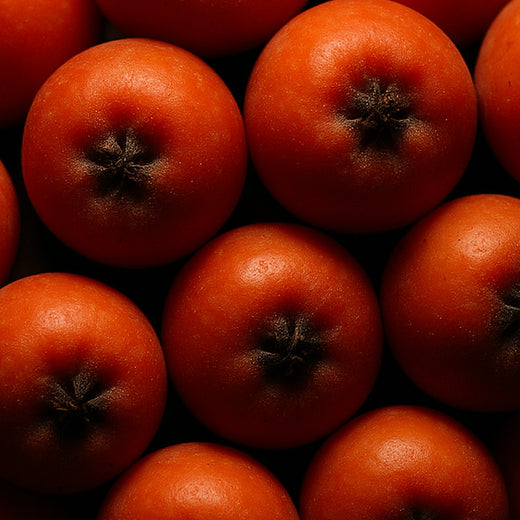
- Round pomes 8 to 10 mm in diameter, typically orange or scarlet when ripe
Ashberry · Did You Know?
The fruit are eaten by about 60 bird species and several mammals. The species name aucuparia describes the use of the fruit as bait for fowling.
Ashberry · In Depth
The tree and its fruit
Sorbus aucuparia is the type species of the genus Sorbus, which belongs to the rose family, Rosaceae. It flowers from May to June in dense corymbs of small creamy-white flowers and develops small red pomes as fruit that ripen from August to October. The berries are round pomes between 8 and 10 mm in diameter.
The fruit are green before they ripen and then typically turn to orange or scarlet when ripe. The sepals persist as a black, five-pointed star on the ripe fruit. The flowers have an unpleasant trimethylamine smell.
Origin and Production
The range extends from Madeira, the British Isles and Iceland to Russia and northern China. The plant is frost hardy and colonises disrupted and inaccessible places as a short-lived pioneer species. Sweet rowanberry cultivars have been evolved from rowanberries and hybrids of rowanberry with Malus, Pyrus, Aronia or Mespilus.
The fruit are red in August but are usually harvested only in October, after the first frost, by cutting the corymbs. The 'Konzentra' cultivar bears small to medium-sized, tart fruit with a thicker peel that are used for juicing, while the fruit of 'Rosina' are larger, sweet and tart, and are candied or used in compote.
Chemistry
The flesh of the fruit contains carotenoids, citric acid, malic acid, parasorbic acid, pectin, provitamin A, sorbitol, tannin and vitamin C. Parasorbic acid is the cyclic lactone of sorbic acid, and thermal treatment or hydrolysis converts the lactone to sorbic acid. The parasorbic acid irritates the gastric mucosa. Debittering can be accomplished by freezing, cooking, or drying, which degrades the parasorbic acid. The fruit contain sorbitol, which can be used as a sugar substitute by diabetics.
Uses
The fruit and foliage have been used in the creation of dishes and beverages, as a folk medicine, and as fodder for livestock. Raw rowan berries are normally not very palatable because of their bitterness, but debittered berries can be made into compote, jelly, jam, a tart syrup or chutney, or pressed into juice. They are also used to make wine, liqueurs, teas and flour.
Fruit are served as a side dish to lamb or game. Sorbus aucuparia fruits have been used in the traditional Austrian medicine internally (as tea, syrup, jelly or liqueur) for treatment of disorders of the respiratory tract, fever, infections, colds, flu, rheumatism and gout. In folk medicine they are used as a laxative, against rheumatism and kidney disease, and as a gargled juice against hoarseness. Its tough and flexible wood has traditionally been used for woodworking.
Ashberry · History
The common name mountain ash dates from the 16th century. It was first used by John Gerard in 1597, translating it directly from the then botanists' Latin Montana fraxinus. Russian botanist Ivan Vladimirovich Michurin began in 1905 to crossbreed common S. aucuparia with other species to create fruit trees.
Ashberry · Technical Sheet
Identity
- Botanical
- Sorbus aucuparia
- IPNI
- Sorbus aucuparia L., Sp. Pl. 1: 477 (1753) — Carl Linnaeus (1707-1778)
- Type
- Ingredient
- Category
- Fruits, vegetables and nuts
In Nature
- Growth form
- Tree · POWO
- Native range
- Northern Europe · Middle Europe · Southwestern Europe · Southeastern Europe · Eastern Europe · Siberia · Russian Far East · Middle Asia · 5 more regions · POWO
- Introduced to
- 47 regions · Northern America 42 · Australasia 3 · Southern America 1 · Antarctic 1
- Flowering
- May · north of the equator · iNaturalist
- Recorded altitude
- 50–1,550 m · median 750 m · 159,855 records with an altitude · GBIF
- Wild or cultivated
- 65,932 native · 338 introduced · 5,209 cultivated among 1,295,030 records (the rest carry no such mark) · GBIF
- Recorded in
- 96 of 512 squares of the world grid; a brighter dot holds more records · GBIF
- Also from this genus
- Sorbus: Rowanberry
- Also from this botanical family
- Rosaceae: Almond · Almond Blossom · Almond tree · Amaretto · Apothecary Rose · Apple · 63 more entries
In Print
- In English books
- most mentioned in the 1980s · Google Books Ngram
Classification
- Cluster
- Berry notes · 65 entries in this cluster
- Chemical class
- Fantasy note
Chemical data
- Formula
- Key compounds: sorbic acid (C₆H₈O₂), parasorbic acid (C₆H₈O₂)
- INCI names (CosIng)
- SORBUS AUCUPARIA SEED OIL (ANTI-SEBORRHEIC, SKIN CONDITIONING - EMOLLIENT, HAIR CONDITIONING, NAIL CONDITIONING)SORBUS AUCUPARIA FRUIT EXTRACT (SKIN CONDITIONING)SORBUS AUCUPARIA FRUIT/LEAF EXTRACT (HAIR CONDITIONING, HUMECTANT, SKIN CONDITIONING)
Physical properties
- Note
- Sorbus aucuparia (rowan/mountain ash) berries; limited perfumery use, primarily as a fantasy/gourmand note
Performance and rules
- IFRA status
- No IFRA Standard for the material itself (51st Amendment)
Ashberry · See Also
Entries related to Ashberry, by their place in the pyramid. « shared » marks a scent word Ashberry has too.
Top notes

Lingonberry
fruity (shared) · fresh (shared) · bitter (shared) Fruity / Same cluster / Natural
Yumberry
fruity (shared) · fresh (shared) · green (shared) Fruity / Same cluster / Natural
Cherry
fruity (shared) · almond · sweet (shared) Fruity / Top · Heart / Fantasy/Concept
Lychee
fruity (shared) · floral (shared) · rosy Fruity / Natural
Trimethylamine
fishy · oily · pungent Green / Natural & Synthetic-
Sorbic Acid
almond · apple · herbaceous Gourmand


Heart notes

Rowanberry
fruity (shared) · bitter (shared) · astringent (shared) Fruity / Same cluster / Natural
Acai Berry
fruity (shared) · sweet (shared) · earthy Fruity / Same cluster / Fantasy/Concept
Silverberry
fruity (shared) · sweet (shared) · earthy Fruity / Same cluster / Fantasy/Concept


Ashberry · Sources
- GBIF Sorbus aucuparia
- Antioxidants (2023) Total Phenolic and Total Flavonoid Content, Individual Phenolic Compounds and Antioxidant Activity in Sweet Rowanberry Cultivars
- Antioxidants (2020) The Sorbus spp.-Underutilised Plants for Foods and Nutraceuticals: Review on Polyphenolic Phytochemicals and Antioxidant Potential
- Molecules (2025) Supercritical Fluid Extraction of Lipids from Rowanberry Pomace with Pure CO(2) and Its Mixtures with Ethanol Followed by the On-Line Separation of Fractions
- Antioxidants (2021) Antioxidants Characterization of the Fruit, Juice, and Pomace of Sweet Rowanberry (Sorbus aucuparia L.) Cultivated in Estonia
- IFRA Standards, 51st Amendment
- Wikipedia Sorbus aucuparia
- Wikipedia Parasorbic acid
- Wikipedia Sorbus
Cite as PREMIEREPEAU Glossary, “Ashberry”, https://premierepeau.com/pages/glossary-terms/ashberry Updated 2026-11-20
