


Malic Acid
Keywords: caramel · gourmand · acidic
Malic Acid is a white or nearly white crystalline powder with almost no smell. It is soluble in water and has a tart, sour taste.
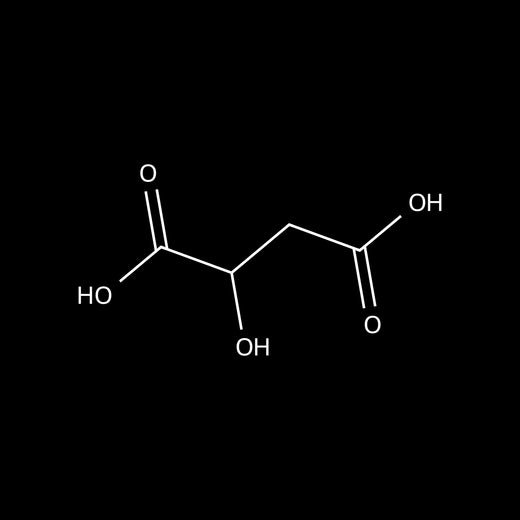
Malic Acid · Facets
Entries of the glossary that carry each facet, of 3,979:
- caramel 38
- gourmand 91
- acidic 15
Malic Acid · Scent
It has almost no smell, only a very faint caramellic and acrid note. Undiluted, it is odourless.
Malic Acid · In Perfumery
It is used as a fragrance ingredient, and its odour is at most a very faint caramellic note.
Pyramid
Malic Acid: Top · Heart. Entries of the glossary stored at each place of the pyramid, of 4,000 (36 store no place):
- Top 718
- Top · Heart 497
- Heart 1,641
- Heart · Base 514
- Base 594
Malic Acid · In Depth
Identity
Malic Acid has the CAS number 617-48-1, the formula C₄H₆O₅ and a molecular weight of 134.09 g/mol. Its IUPAC name is 2-hydroxybutanedioic acid.
Odour
It has almost no smell, only a very faint caramellic and acrid note. Undiluted, it is odourless.
Use in perfumery
It is used as a fragrance ingredient.
Use in flavours
It is a flavouring agent, flavour enhancer and acidulant in foods. Its taste is smoothly tart, sour and strongly acidic. It belongs to a group with an acceptable daily intake covering malic acid and its sodium, potassium and calcium salts.
Properties
It melts at 127 to 132 °C. It decomposes between 225 and 235 °C, so its boiling point cannot be determined. In water it dissolves at 55.8 g per 100 g of water at 20 °C, and 1 g dissolves in 0.8 ml of water. 1 g dissolves in 1.4 ml of alcohol. Its density is 1.601 g per cubic centimetre at 20 °C and its log Kow is −1.26; another source gives an estimated logP of −1.37. It also serves as a chelating and buffering agent.
Safety and IFRA
No IFRA Standard covers this material itself in the 51st Amendment. About 74.2 % of hazard reports give H315, causes skin irritation, 10.5 % give H318, causes serious eye damage, and 89.2 % give H319, causes serious eye irritation. Its EC number is 210-514-9 and it is registered under REACH.
Malic Acid · Technical Sheet
Molecular weight
134.09 g/mol Heavier than 116 of the 402 other entries at the same place of the pyramid that store a weight.
2,515 entries store a molecular weight. By place in the pyramid: Top 537, Top · Heart 403, Heart 861, Heart · Base 452, Base 262.
Identity
- Type
- Ingredient
- Category
- Aroma chemicals
- Also called
- d,l-Malic acid, R,S(+-)-Malic acid, Hydroxy Succinic Acid, Apple acid
Classification
- Olfactive family
- Gourmand · 472 entries of the glossary in this family
- Subfamily
- Caramel notes · 81 entries in this subfamily
- Cluster
- Caramel-like gourmands · 80 entries in this cluster
- Chemical class
- Carboxylic acid
Chemical data
- Formula
- C4H6O5
- CAS
- 617-48-1
- PubChem CID
- 525, compound record on PubChem
- InChIKey
- BJEPYKJPYRNKOW-UHFFFAOYSA-N
- Wikidata · Wikipedia
- Malic Acid: Q190143, item on Wikidata · Wikipedia, English article
Physical properties
- Appearance
- White or nearly white crystalline powder or granules
- Melting point
- 127 to 132 °C
- Flash point
- 153.33 °C (308 °F)
- Density
- 1.601
- Vapour pressure
- 0.000071 mmHg at 25 °C (estimated)
- Log P
- −1.37 (estimated)
Performance and rules
- Pyramid
- Top · Heart Note
- IFRA status
- No IFRA Standard for the material itself (51st Amendment)
Malic Acid · See Also
Entries related to Malic Acid, by their place in the pyramid.
Top notes

Maleic Acid
caramellic · winey Gourmand / Same cluster / Synthetic / 116.07 g/mol
Rhubarb
green · tart · fruity Fruity / Fantasy/Concept


Heart notes

Cider Apple
fruity · fresh · sweet Fruity / Fantasy/Concept
DL-Tartaric acid
odourless 150.09 g/mol
Diethyl malate
fruity · herbal · winey Fruity / 190.19 g/mol


Other entries · Place in the pyramid not stored

Purslane
earthy · fresh · green Aromatic / Natural

Malic Acid · Sources
- PubChem Malic Acid
- Pyrfume Arctander, Perfume and Flavor Chemicals: odour descriptions (Pyrfume archive)
- The Good Scents Company Information System Malic Acid: data sheet
- IFRA Standards, 51st Amendment
- European Chemicals Agency Malic Acid: substance record
Cite as PREMIEREPEAU Glossary, “Malic Acid”, https://premierepeau.com/
