


Caffeine
Keywords: vanilla
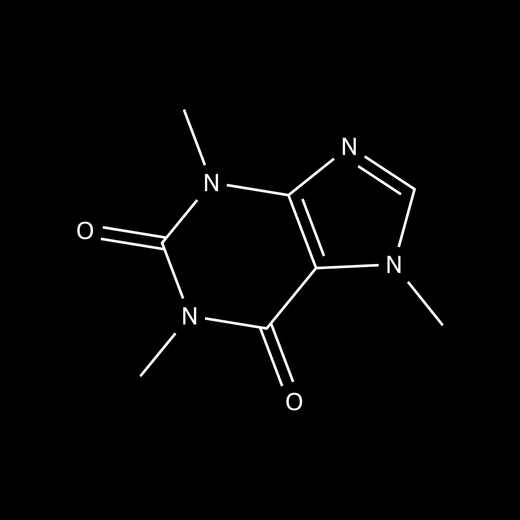
Caffeine is a purine alkaloid, a trimethylxanthine with its three methyl groups at positions 1, 3 and 7. It is odourless and forms white crystals with a bitter taste.
- Olfactive family
- Gourmand · 494 entries of the glossary in this family Subfamily: Vanilla family · 63 entries in this subfamily Cluster: Vanilla-like gourmands · 56 entries in this cluster
- Material
- Natural & Synthetic
- Pyramid
- Heart Note
Caffeine · Facets
Entries of the glossary that carry each facet, of 3,979:
- vanilla 78
Caffeine · Scent
Caffeine is odourless.
Caffeine · In Perfumery
Caffeine is a perfuming ingredient in cosmetics, although it has no odour of its own.
Pyramid
Caffeine: Heart. Entries of the glossary stored at each place of the pyramid, of 4,000 (35 store no place):
- Top 718
- Top · Heart 501
- Heart 1,646
- Heart · Base 512
- Base 588
Caffeine · Extraction & Chemistry
It is usually obtained from tea dust, which holds up to 5% of it, or as a by-product of making caffeine-free coffee. It can also be prepared synthetically, starting with dimethylurea and malonic acid.
- Appearance
- White, prismatic crystals, or a white powder
Caffeine · Did You Know?
Brewed coffee holds about 100-150 mg of caffeine per 180 mL, and tea 40-100 mg per 180 mL.
Caffeine · In Depth
Identity
Caffeine has the systematic name 1,3,7-trimethylpurine-2,6-dione and the CAS number 58-08-2. Its molecular weight is 194.19. It is a purine alkaloid and a trimethylxanthine.
Odour
Caffeine is odourless. Its taste is bitter and astringent.
Occurrence in nature
Caffeine occurs naturally in tea and coffee. It is also found in Paullinia cupana, Asimina triloba, Aspalathus linearis, Bidens pilosa and several Camellia species, among them Camellia japonica, Camellia sasanqua and Camellia oleifera.
Production
It is usually obtained from tea dust, which holds up to 5% of it, or as a by-product of making caffeine-free coffee. It can also be prepared synthetically, starting with dimethylurea and malonic acid.
Use in perfumery
In cosmetics caffeine has the functions of perfuming and skin conditioning.
Use in flavours
Caffeine is a flavouring agent. It is used as a flavouring ingredient in alcoholic beverages at levels of up to 200 parts per million.
Properties
It sublimes at 178 °C and melts at 236.2 °C. Water dissolves 2.17 g of it per 100 mL, and the solubility rises with alkali benzoates, cinnamates, citrates or salicylates. It is soluble in pyridine. Its logP is -0.07. Its vapour pressure is 15 mmHg at 89 °C.
Safety and IFRA
Its INCI name is CAFFEINE, its EC number is 200-362-1 and it is registered under REACH.
No IFRA Standard covers caffeine itself, as of the 51st Amendment.
It carries the hazard statement H302, harmful if swallowed, with the signal word Warning.
Caffeine · Technical Sheet
Molecular weight
194.19 g/mol Heavier than 825 of the 887 other entries at the same place of the pyramid that store a weight
2,572 entries store a molecular weight. By place in the pyramid: Top 547, Top · Heart 411, Heart 888, Heart · Base 454, Base 272.
Identity
- Type
- Ingredient
- Category
- Aroma chemicals
Chemical data
- Formula
- C8H10N4O2
- CAS
- 58-08-2
- PubChem CID
- 2519, compound record on PubChem
- InChIKey
- RYYVLZVUVIJVGH-UHFFFAOYSA-N
Physical properties
- Boiling point
- 416.79 °C at 760 mmHg (estimated)
- Melting point
- 235 to 237.5 °C at 760 mmHg
- Flash point
- > 176.67 °C (> 350 °F)
- Vapour pressure
- 15 mmHg at 89 °C
- Log P
- -0.07
Performance and rules
- Available as
- synthetic
- IFRA status
- No IFRA Standard for the material itself (51st Amendment)
Caffeine · See Also


Caffeine · Sources
- PubChem Caffeine
- ChEBI Caffeine: chemical classification record
- European Commission, CosIng Caffeine: cosmetic ingredient record
- The Good Scents Company Information System Caffeine: data sheet
- Wikidata (LOTUS natural products data) Caffeine: organisms it is reported in, with the papers
- European Chemicals Agency Caffeine: substance record
- IFRA Standards, 51st Amendment
Cite as PREMIEREPEAU Glossary, “Caffeine”, https://premierepeau.com/pages/glossary-terms/caffeine Updated 2026-11-19
