


Citronellyl Acetate
Keywords: fruity · rose · floral
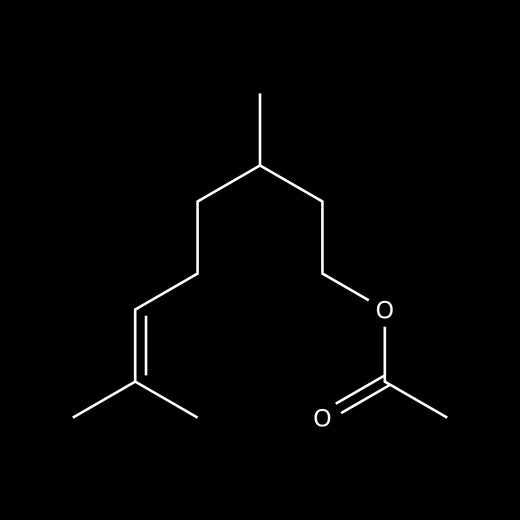
Citronellyl Acetate is a monoterpenoid, the acetate ester of citronellol, with a fresh, rosy, fruity odour somewhat reminiscent of geranium. It is a colourless liquid.
- Olfactive family
- Florals · 783 entries of the glossary in this family Subfamily: Classic florals · 312 entries in this subfamily Cluster: Rose-like florals · 146 entries in this cluster
- IFRA status
- Restricted
- Pyramid
- Heart-to-Base
- Strength
- Medium Step 3 of 5 · shared by 1,462 of 2,149 graded entries Graded entries at each step, from 1 to 5: 4, 118, 1,462, 501, 40. 24 more sit between two steps.
- Also called
- 3,7-Dimethyloct-6-enyl acetate, Citronellol acetate, 1-Acetoxy-3,7-dimethyloct-6-ene, 3,7-Dimethyl-6-octen-1-ol acetate, beta-Citronellyl acetate, beta-Citronellol acetate
Citronellyl Acetate · Facets
Entries of the glossary that carry each facet, of 3,979:
- fruity 1,299
- rose 214
- floral 1,547
- citrus 488
- geranium 28
- fresh 1,390
Citronellyl Acetate · Scent
It smells fresh, rosy and fruity, somewhat reminiscent of geranium, with a floral and citrus edge.
Citronellyl Acetate · In Perfumery
It is a fragrance ingredient with a fresh, rosy, fruity and floral odour.
Pyramid
Citronellyl Acetate: Heart · Base. Entries of the glossary stored at each place of the pyramid, of 4,000 (35 store no place):
- Top 718
- Top · Heart 496
- Heart 1,644
- Heart · Base 513
- Base 594
Citronellyl Acetate · In Depth
Identity
Citronellyl Acetate has the systematic name 3,7-dimethyloct-6-enyl acetate, and its CAS number is 150-84-5. Its molecular formula is C₁₂H₂₂O₂ and its molecular weight is 198.3. It is a monoterpenoid and an acetate ester, the acetate ester of citronellol.
Odour
Citronellyl Acetate smells fruity, rosy and floral, with a fresh citrus and geranium lift. Undiluted it also shows green, woody and tropical fruit facets. Its odour strength is medium, and the odour lasts 8 hours at full strength.
Occurrence in nature
Citronellyl Acetate occurs in Agathosma betulina, Alpinia galanga, Boswellia carteri, Boswellia sacra and Citrus hystrix. It has been isolated from Citrus hystrix and acts as a plant metabolite.
Use in perfumery
It is a fragrance ingredient. In cosmetics it also serves as a masking agent.
Use in flavours
It is used as a flavouring agent, with a flavour profile of floral, fragrant and rose. The Joint FAO/WHO Expert Committee on Food Additives found no safety concern at current levels of intake when it is used as a flavouring agent.
Properties
It boils at 229 °C at 760 mmHg. Its density is 0.883 to 0.893, its refractive index is 1.44 to 1.45 and its logP is 4.22. Its flash point is 103.33 °C and its vapour pressure is 0.05 mmHg at 20 °C. It is soluble in alcohol and most fixed oils, and insoluble in glycerol, propylene glycol and water.
Safety and IFRA
Under the 51st Amendment in force, an IFRA Standard « Citronellyl acetate » exists and the material is restricted under it. Its INCI name is CITRONELLYL ACETATE, its cosmetic function is fragrance and its EC number is 205-775-0. It is registered under REACH. Its signal word is Warning, because it causes skin irritation and serious eye irritation, and it is toxic to aquatic life with long lasting effects.
Citronellyl Acetate · Technical Sheet
Molecular weight
198.30 g/mol Heavier than 68 of the 454 other entries at the same place of the pyramid that store a weight; 23 weigh the same.
2,572 entries store a molecular weight. By place in the pyramid: Top 547, Top · Heart 406, Heart 886, Heart · Base 455, Base 278.
Identity
- Type
- Ingredient
- Category
- Aroma chemicals
Classification
- Chemical class
- Ester
Chemical data
- Formula
- C12H22O2
- CAS
- 150-84-5
- PubChem CID
- 9017, compound record on PubChem
- InChIKey
- JOZKFWLRHCDGJA-UHFFFAOYSA-N
- Wikidata
- Citronellyl Acetate: Q27138814, item on Wikidata · Wikipedia, English article
- Appearance
- Colourless liquid
Physical properties
- Boiling point
- 229 °C at 760 mmHg
- Flash point
- 103.33 °C (218 °F)
- Density
- 0.883–0.893
- Refractive index
- 1.440–1.450
- Vapour pressure
- 0.05 mmHg at 20 °C
- Log P
- 4.22
- Tenacity
- 8 hour(s) at 100 %
Performance and rules
- IFRA status
- Restricted — IFRA Standard « Citronellyl acetate » (Amendment 51)
Citronellyl Acetate · See Also
Entries related to Citronellyl Acetate, by their place in the pyramid. « shared » marks a scent word Citronellyl Acetate has too.
Top notes

Kumquat
citrus (shared) · sweet · fresh (shared) Citrus / Natural
Kaffir Lime
citrus (shared) · fresh (shared) · green Citrus / Natural


Heart notes

Rhodinyl acetate
rose (shared) · leafy · floral (shared) Florals / Heart · Base / Same cluster / 198.3 g/mol
Sinodor
floral (shared) · geranium (shared) · rose red rose Florals / Heart · Base / Same cluster / 238.37 g/mol
Citronellyl propionate
fruity (shared) · rose (shared) · berry Florals / Heart · Base / Same cluster / 212.33 g/mol
Citronellyl isobutyrate
fruity (shared) · citrus (shared) · rose (shared) Florals / Heart · Base / Same cluster / 226.35 g/mol
Citronellyl butyrate
fruity (shared) · rose (shared) · leafy Fruity / Heart · Base / 226.35 g/mol
2,4-Dimethylcyclohexylmethyl acetate
sweet · cortex · floral (shared) Earthy / 184.27 g/mol
(6Z)-6-Nonenyl acetate
melon · green · pear Fruity / 184.27 g/mol
Allyl isononylate
fruity (shared) · rose (shared) · sweet Fruity / Heart · Base / 198.3 g/mol
1-Octen-3-yl butyrate
buttery · earthy · mushroom Earthy / Heart · Base / 198.3 g/mol


Citronellyl Acetate · Sources
- PubChem Citronellyl Acetate
- ChEBI Citronellyl Acetate: chemical classification record
- Pyrfume Arctander, Perfume and Flavor Chemicals: odour descriptions (Pyrfume archive)
- Pyrfume Good Scents odour data (Pyrfume archive)
- Pyrfume Leffingwell odour data (Pyrfume archive)
- The Good Scents Company Information System Citronellyl Acetate: data sheet
- Wikidata (LOTUS natural products data) Citronellyl Acetate: organisms it is reported in, with the papers
- IFRA Standards, 51st Amendment
- European Commission, CosIng Citronellyl Acetate: cosmetic ingredient record
- European Chemicals Agency Citronellyl Acetate: substance record
Cite as PREMIEREPEAU Glossary, “Citronellyl Acetate”, https://premierepeau.com/
