


Diphenylamine
Keywords: floral · gassy · sweet
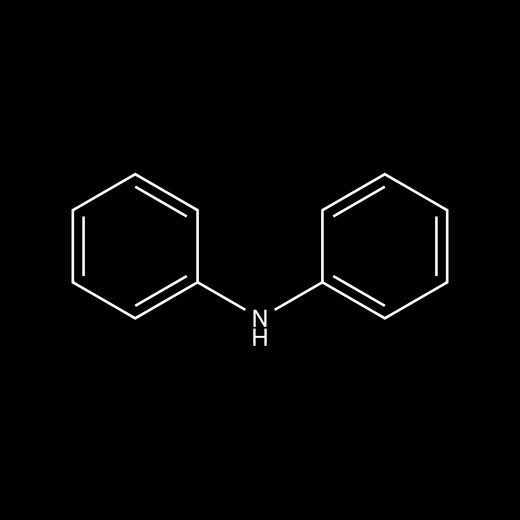
Diphenylamine is an aromatic amine containing two phenyl substituents, a crystalline solid that smells faintly sweet and floral. Most commercial lots carry a chemical note that varies from gassy to fishy.
- Olfactive family
- Florals · 779 entries of the glossary in this family Subfamily: Classic florals · 313 entries in this subfamily
- Material
- Synthetic
- IFRA status
- Prohibited
- Pyramid
- Heart · Volatility: Heart Note
- Also called
- N,N-Diphenylamine
Family, subfamily and cluster: PREMIEREPEAU house classification, version 2026‑11.
Diphenylamine · Facets
Entries of the glossary that carry each facet, of 3,979:
- floral 1,546
- gassy 34
- sweet 1,988
- faint 4
Diphenylamine · Scent
Diphenylamine has a faint, sweet, floral odour, with a gassy note in most commercial lots.
Diphenylamine · In Perfumery
It is a fragrance ingredient in cosmetics with a faint, sweet, floral odour.
Pyramid
Diphenylamine: Heart. Entries of the glossary stored at each place of the pyramid, of 4,006 (42 store no place):
- Top 718
- Top · Heart 497
- Heart 1,641
- Heart · Base 514
- Base 594
Diphenylamine · Extraction & Chemistry
It is made by heating equal formula weights of aniline and aniline hydrochloride in an autoclave, boiling the product with dilute hydrochloric acid to remove the unaltered aniline, and distilling the residue. It is also manufactured by heating aniline by itself, or with phenol, with an acid catalyst at high temperatures.
- Appearance
- Colourless, tan, amber or brown crystalline solid
Diphenylamine · In Depth
Identity
Diphenylamine is an aromatic amine containing two phenyl substituents. Its systematic name is N-phenylaniline, its CAS number is 122-39-4, its formula is C₁₂H₁₁N and its molecular weight is 169.22 g/mol.
It is an antioxidant, a radical scavenger and a ferroptosis inhibitor. It has been used as a fungicide for the treatment of superficial scald in apples and pears, but is no longer approved for this purpose within the European Union. It is also used in rubber antioxidants and accelerators, pesticides, dyes and pharmaceuticals, and as a stabilizer for nitrocellulose.
Odour
The pure material has a faint, sweet, floral odour, while commercial lots often display a chemical note varying from gassy to fishy.
Occurrence in nature
It is found in Allium cepa, Artemisia monosperma, Camellia sinensis and Trigonella foenum-graecum.
Production
It is made by heating equal formula weights of aniline and aniline hydrochloride in an autoclave, boiling the product with dilute hydrochloric acid to remove the unaltered aniline, and distilling the residue. It is also manufactured by heating aniline by itself, or with phenol, with an acid catalyst at high temperatures.
Use in perfumery
In cosmetics it is covered by the INCI name Diphenylamine when used as a fragrance ingredient.
Properties
It boils at 302 °C at 760 mmHg. It melts at 53 °C. Its flash point is 153 °C in an open cup. Its logP is 3.5. It dissolves in water to 53 mg/L at 20 °C and sinks in water. It crystallises as monoclinic leaflets from dilute alcohol.
Safety and IFRA
It is prohibited under the IFRA Standard “Diphenylamine” (Amendment 38). Its EC number is 204-539-4 and it is registered under REACH.
Diphenylamine · Technical Sheet
Molecular weight
169.22 g/mol Heavier than 403 of the 860 other entries at the same place of the pyramid that store a weight.
2,515 entries store a molecular weight. By place in the pyramid: Top 537, Top · Heart 403, Heart 861, Heart · Base 452, Base 262.
Identity
- Type
- Ingredient
- Category
- Aroma chemicals
Classification
- Cluster
- Classic florals · 245 entries in this cluster
- Chemical class
- Nitrogen compound
Chemical data
- Formula
- C12H11N
- CAS
- 122-39-4
- Reported in plants
- Camellia sinensis (1 paper; one: J Nat Prod 1984) · Trigonella foenum-graecum (1 paper; one: Planta Med 1985) · LOTUS
- PubChem CID
- 11487, compound record on PubChem
- InChIKey
- DMBHHRLKUKUOEG-UHFFFAOYSA-N
- Wikidata · Wikipedia
- Diphenylamine: Q412265, item on Wikidata · Wikipedia, English article
Labelling
- EU cosmetics annexes
- CosIng, Annex II, entry 434 · prohibited in cosmetic products
“Diphenylamine, when used as a fragrance ingredient”
Physical properties
- Boiling point
- 302 °C at 760 mmHg
- Melting point
- 53 °C
- Flash point
- 153 °C in an open cup
- Vapour pressure
- 0.001 mmHg at 25 °C (estimated)
- Log P
- 3.5
Performance and rules
- Available as
- synthetic
- IFRA status
- Prohibited — IFRA Standard “Diphenylamine” (Amendment 38)
Diphenylamine · See Also
Entries related to Diphenylamine, by their place in the pyramid. “shared” marks a scent word Diphenylamine has too.
Top notes

Diphenyl Oxide
green · geranium · floral (shared) Green / Top · Heart / Synthetic / 170.21 g/mol

Diphenylamine · Sources
- PubChem Diphenylamine
- ChEBI Diphenylamine: chemical classification record
- Pyrfume Arctander, Perfume and Flavor Chemicals: odour descriptions (Pyrfume archive)
- The Good Scents Company Information System Diphenylamine: data sheet
- European Commission, CosIng Diphenylamine: cosmetic ingredient record
- Pyrfume Good Scents odour data (Pyrfume archive)
- Wikidata (LOTUS natural products data) Diphenylamine: organisms it is reported in, with the papers
- IFRA Standards, 51st Amendment
- European Chemicals Agency Diphenylamine: substance record
Cite as PREMIEREPEAU Glossary, “Diphenylamine”, https://premierepeau.com/

