


Phenol
Keywords: phenolic · medicinal · honey
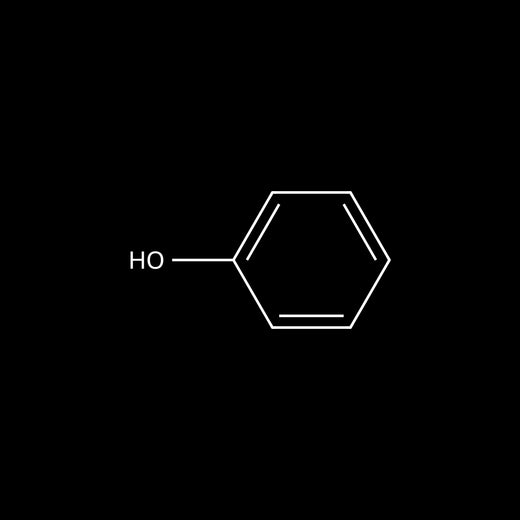
Phenol is an organic hydroxy compound that consists of benzene bearing a single hydroxy substituent. It smells phenolic and medicinal.
- Olfactive family
- Leather · 31 entries of the glossary in this family Subfamily: Smoky leathers · 25 entries in this subfamily Cluster: Smoky leather · 26 entries in this cluster
- Material
- Natural & Synthetic
- Pyramid
- Top Note
- Also called
- Phenyl alcohol, Phenol alcohol
Phenol · Facets
Entries of the glossary that carry each facet, of 3,979:
- phenolic 94
- medicinal 83
- honey 96
- rose 215
- plastic 13
- rubbery 11
Phenol · Scent
Phenol · In Perfumery
It is a fragrance ingredient with a phenolic, medicinal character.
Pyramid
Phenol: Top. Entries of the glossary stored at each place of the pyramid, of 4,000 (35 store no place):
- Top 718
- Top · Heart 501
- Heart 1,646
- Heart · Base 512
- Base 588
Phenol · Extraction & Chemistry
It is made by the cumene oxidation (Hock) process, in which cumene is oxidised with oxygen to cumene hydroperoxide, and the hydroperoxide is cleaved in an acidic medium to phenol and acetone. Its primary use is in the production of phenolic resins, and it is also used as a slimicide, as a disinfectant, and in ear and nose drops, throat lozenges and mouthwashes.
- Appearance
- Colourless to light pink crystalline solid
Phenol · In Depth
Identity
Phenol is an organic hydroxy compound that consists of benzene bearing a single hydroxy substituent, and it is the parent of the class of phenols. Its systematic name is phenol and its CAS number is 108-95-2. Its molecular formula is C₆H₆O and its molecular weight is 94.11 g/mol. It acts as an antiseptic drug and a disinfectant.
Odour
It smells phenolic and medicinal, with honey, rose, plastic and rubbery facets. Its odour is distinct, aromatic, somewhat sickeningly sweet and acrid, and it can be perceived at 0.5 to 5 ppm. It also has a sweet, tarry side. At 0.01 % in dipropylene glycol it reads phenolic, plastic and rubber.
Occurrence in nature
It occurs in Agaricus xanthodermus, Aronia melanocarpa, Aspalathus linearis, Capsicum annuum and Cinnamomum verum.
Production
It is made by the cumene oxidation (Hock) process, in which cumene is oxidised with oxygen to cumene hydroperoxide, and the hydroperoxide is cleaved in an acidic medium to phenol and acetone. Its primary use is in the production of phenolic resins, and it is also used as a slimicide, as a disinfectant, and in ear and nose drops, throat lozenges and mouthwashes.
Use in perfumery
It is used as a fragrance ingredient. It has a fragrance function in cosmetics.
Use in flavours
It is used as a flavouring agent, with no safety concern at current levels of intake. Its taste is sharp and burning, and sweetish in very weak solution.
Properties
It forms a white crystalline mass of hygroscopic, translucent needle-shaped crystals that turn pink or red when impure and darken on exposure to light. It liquefies when mixed with about 8% water. It boils at 181.8 °C and melts at 38 to 41 °C. Its flash point is 79.44 °C and its logP is 1.46. It is bacteriostatic at about 0.2%, bactericidal above 1% and fungicidal above 1.3%.
Safety and IFRA
No IFRA Standard covers this material itself, as of the 51st Amendment. Its INCI name is PHENOL, and its cosmetic functions are antimicrobial, denaturant, deodorant, fragrance, oral care and preservative. It appears in Annex II, entry 1175, of the EU Cosmetics Regulation, which lists prohibited substances. Its EC number is 203-632-7 and it is registered under REACH. Its GHS signal word is Danger.
Phenol · Technical Sheet
Molecular weight
94.11 g/mol Heavier than 139 of the 546 other entries at the same place of the pyramid that store a weight; 1 weigh the same
2,572 entries store a molecular weight. By place in the pyramid: Top 547, Top · Heart 411, Heart 888, Heart · Base 454, Base 272.
Identity
- Type
- Ingredient
- Category
- Aroma chemicals
Classification
- Chemical class
- Alcohol
Chemical data
- Formula
- C6H6O
- CAS
- 108-95-2
- PubChem CID
- 996, compound record on PubChem
- InChIKey
- ISWSIDIOOBJBQZ-UHFFFAOYSA-N
Physical properties
- Boiling point
- 181 to 182 °C at 760 mmHg
- Melting point
- 38 to 41 °C at 760 mmHg
- Flash point
- 79.44 °C (175 °F)
- Vapour pressure
- 0.614 mmHg at 25 °C (estimated)
- Log P
- 1.46
Performance and rules
- Odour threshold
- 5.6 ppb in air · Abraham et al. 2012
- Available as
- synthetic
- IFRA status
- No IFRA Standard for the material itself (51st Amendment)
Phenol · See Also
Entries related to Phenol, by their place in the pyramid.
Top notes

2-Hexen-1-ol
green · fruity · leafy Green / 100.16 g/mol
trans-3-Hexen-1-ol
green · fatty · leafy Green / 100.16 g/mol


Phenol · Sources
- PubChem Phenol
- ChEBI Phenol: chemical classification record
- Pyrfume Good Scents odour data (Pyrfume archive)
- Pyrfume Leffingwell odour data (Pyrfume archive)
- The Good Scents Company Information System Phenol: data sheet
- Wikidata (LOTUS natural products data) Phenol: organisms it is reported in, with the papers
- European Commission, CosIng Phenol: cosmetic ingredient record
- IFRA Standards, 51st Amendment
- European Chemicals Agency Phenol: substance record
Cite as PREMIEREPEAU Glossary, “Phenol”, https://premierepeau.com/pages/glossary-terms/phenol Updated 2026-11-18
