


Plastic
Keywords: fresh · earthy · metallic
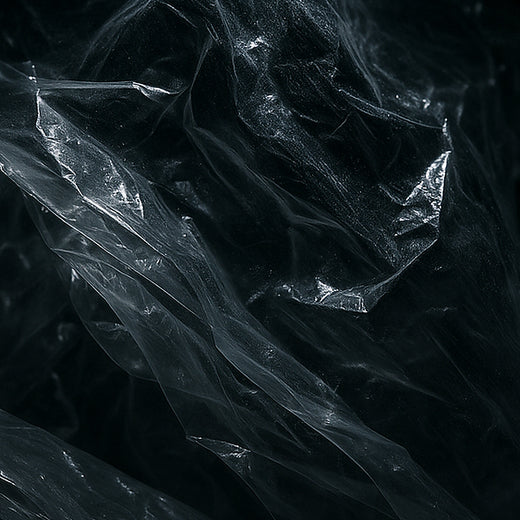
Plastics are synthetic or semisynthetic materials made up mainly of polymers. The new car smell is caused by gases emitted from manufactured materials such as leather, plastics and textiles.
- Olfactive family
- Aromatic · 495 entries of the glossary in this family Subfamily: Classic aromatics · 157 entries in this subfamily Cluster: Camphoraceous aromatics · 116 entries in this cluster
- Material
- Fantasy/Concept Synthetic molecule
- Pyramid
- Base Note
- Strength
- N/A — no measured strength for a fantasy accord Not on the graded scale
- Producing countries
- N/A — olfactory concept
- Also called
- SYNTHETIC POLYMER
Plastic · Facets
Entries of the glossary that carry each facet, of 3,979:
- floral 1,551
- earthy 657
- warm 1,109
- fresh 1,392
- metallic 101
Editorial note We own no rights to this material, its name or its trademark. This entry is independent editorial journalism, published under freedom of expression.
Plastic · Scent
Burning polyethylene gives off an odour of paraffin, similar to a candle flame.
Evolution over time
Plastic: scent over time.
- Immediately
N/A — no documented evolution for a fantasy accord
- After a few days
N/A
Plastic · In Perfumery
Some fragrance compositions are made to approximate the notes of new plastics, vinyl, adhesives and treated leather. Automobile dealerships and professional detailers commonly apply commercial fragrance products designed to mimic or enhance the new car scent. Such scents generally consist of blended synthetic aroma chemicals in a carrier solvent or propellant, sometimes combined with odor-neutralizing agents. Such scents do not replicate the exact mixture of volatile organic compounds released by factory materials.
Pyramid
Plastic: Base. Entries of the glossary stored at each place of the pyramid, of 4,000 (35 store no place):
- Top 718
- Top · Heart 501
- Heart 1,646
- Heart · Base 512
- Base 588
Role in the formula
Plastic: roles in the formula. Entries of the glossary that share each role, of 4,000:
- N/A — no documented formula role 360
Plastic · Extraction & Chemistry
Low-density polyethylene is produced by free-radical polymerization.
Available as
Plastic: available as.
- synthetic accord
- fantasy note
- Appearance
- N/A — olfactory concept
Plastic · Did You Know?
Plastic · In Depth
What plastics are
Most plastics are made from natural gas and petroleum, and a growing minority are made from renewable resources such as polylactic acid. Plasticity, their defining characteristic, lets them be molded, extruded or pressed into a range of solid forms. Commodity plastics, which are produced in high volumes for packaging, food containers and household products, include polyethylene, polypropylene, polystyrene, polyvinyl chloride, poly(methyl methacrylate) and polyethylene terephthalate. Polystyrene is a synthetic polymer built from monomers of styrene, an aromatic hydrocarbon.
Additives and outgassing
Without plasticizers PVC is hard and brittle. Phthalates, diesters of phthalic acid, are the most common class of plasticizers used in PVC. Phthalates are not covalently bound to the polymer matrix, so they are highly susceptible to leaching. Diethyl phthalate, one of the common phthalate plasticizers, is used in fragrances as a carrier and extender/fixative.
Outgassing is the release of a gas that was dissolved, trapped, frozen or absorbed in some material. Vinyl products initially release chemical gases into the air. The new car smell is often attributed to plasticizers or their degradation products, but multiple studies of its makeup do not find phthalates in appreciable amounts. Chemicals found in new cars include benzene, cyclohexanone and styrene.
Styrene and polystyrene
Styrene is a colorless, oily liquid that evaporates easily. Polystyrene burns to give carbon dioxide and water vapor, along with other thermal degradation by-products. Depolymerizing polystyrene into its monomer, styrene, is called pyrolysis.
Explore all seven extraits in the Discovery Set.
—
Related: Tires · Diving Suit · Plastic Bag · Saffiano Leather
Plastic · History
Plastic · Technical Sheet
Identity
- Botanical
- N/A — olfactory concept
- Type
- Accord
- Category
- Accords and curiosities
Classification
- Chemical class
- Synthetic aroma chemical
Chemical data
- Formula
- N/A — olfactory concept
Physical properties
- Note
- Plastic in perfumery is an abstract olfactory descriptor. Synthetic, slightly sweet, polymeric character. Can be evoked by certain aldehydes and esters.
Performance and rules
- IFRA status
- No IFRA Standard for the material itself (51st Amendment)
Plastic · See Also
Entries related to Plastic, by their place in the pyramid. « shared » marks a scent word Plastic has too.
Top notes

Nail Polish
fruity · sweet Aromatic / Fantasy/Concept
Steam Accord
fresh (shared) · aquatic · marine Aquatic / Top · Heart / Fantasy/Concept-
Methyl Methacrylate
fruity · apple · grape Fruity / Natural & Synthetic 
Brown Scotch Tape
synthetic · complex · particular Synthetic / Top · Heart / Fantasy/Concept
Spray Paint
sweet · pungent Citrus / Fantasy/Concept


Heart notes

Airy Note
fresh (shared) · floral (shared) · citrus Aquatic / Fantasy/Concept
Diethyl Phthalate
hazelnut · meaty · earthy (shared) Gourmand / Heart · Base / Natural & Synthetic
Tennis Ball
rubber · glue Florals / Fantasy/Concept


Base notes

Caoutchouc
natural rubber · latex Woods / Natural

Plastic · Sources
- Scientific reports (2017) Characterization of off-odours and potentially harmful substances in a fancy dress accessory handbag for children
- FAO AGRIS 65df8f607c7033e84bee1e28
- IFRA Standards, 51st Amendment
- Wikipedia New car smell
- Wikipedia Plastic
- Wikipedia Polystyrene
- Wikipedia Polyvinyl chloride
- Wikipedia Styrene
- Wikipedia Polyethylene
- Wikipedia Plasticizer
- Wikipedia Outgassing
Cite as PREMIEREPEAU Glossary, “Plastic”, https://premierepeau.com/pages/glossary-terms/plastic Updated 2026-11-20
