


Liquidambar
Keywords: balsamic · sweet · woody
Liquidambar is a genus of trees commonly called sweetgum. Storax, often sold commercially as styrax, is a natural fragrant resin isolated from the wounded bark of Liquidambar orientalis and Liquidambar styraciflua. Storax has a balsamic, floral/lilac, and leathery smell.
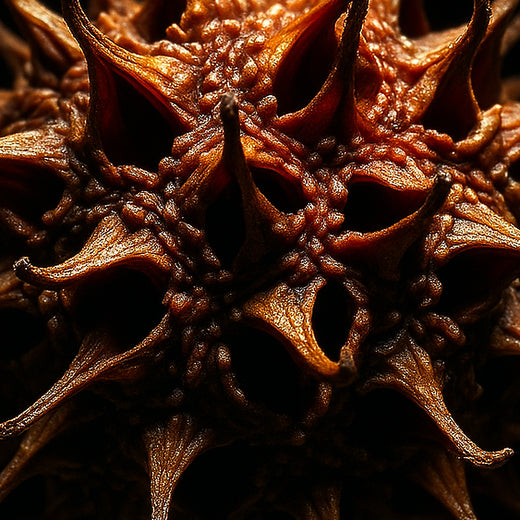
- Olfactive family
- Resinous · 93 entries of the glossary in this family Subfamily: Sweet balsams · 61 entries in this subfamily Cluster: Classic resins · 71 entries in this cluster
- Material
- Natural Resin/balsam
- IFRA status
- Restricted
- Pyramid
- Base · Volatility: Base Note
- Strength
- Medium Step 3 of 5 · shared by 1,462 of 2,148 graded entries Graded entries at each step, from 1 to 5: 4, 118, 1,462, 500, 40. 24 more sit between two steps.
- Also called
- styrax, sweetgum, American storax, liquid amber, copalm balsam
Liquidambar · Facets
Entries of the glossary that carry each facet, of 3,979:
- woody 792
- floral 1,546
- earthy 660
- sweet 1,988
- balsamic 343
- fruity 1,301
- warm 1,108
- resinous 199
Liquidambar · Scent
The resin of Liquidambar styraciflua has a pleasant smell like ambergris. The aroma of the resinoid is very rich, sweet-balsamic, faintly floral and somewhat spicy, with resinous, animalic, amber-like undertones. Its styrene top note has a hydrocarbon character, a characteristic ‘gasoline-type’ odor that some call ‘metallic’. This top note mellows to a great extent with time and usually becomes odorless. The gum of Liquidambar orientalis and the absolute of Liquidambar styraciflua both have a balsamic storax odor.
Evolution over time
Liquidambar: scent over time.
- Immediately
A styrene top note of hydrocarbon character, gasoline-type, which some call metallic
- After a few hours
Sweet-balsamic, faintly floral and somewhat spicy
Scent words: floral · sweet · balsamic · spicy - After a few days
Resinous, animalic, amber-like undertones
Scent words: resinous · amber · animalic
Liquidambar · In Perfumery
Storax and its derivatives, the resinoid, essential oil and absolute, are used as flavors and fragrances.
Pyramid
Liquidambar: Base. Entries of the glossary stored at each place of the pyramid, of 4,000 (36 store no place):
- Top 718
- Top · Heart 497
- Heart 1,641
- Heart · Base 514
- Base 594
Role in the formula
Liquidambar: roles in the formula. Entries of the glossary that share each role, of 4,000:
- Fixative 340
- Modifier 1,167
- Signature note 897
- Lifting agent 567
- Blender 1,040
- Naturalizer 162
Liquidambar · Terroir & Origins
- Producing countries
- Turkey, Greece
- Other countries of origin
- United States
- Regions
- Central America
Liquidambar · Extraction & Chemistry
Wounding the trunk of Liquidambar orientalis causes sap to emerge, and the thick sap is obtained in the period June to September by gradually stripping a quarter of the total trunk lengthwise. The stripped sap is put in boiling water to soften, then pressed. By steam distillation, a light yellow oil is obtained. The resin of Liquidambar styraciflua is produced by stripping, boiling, and pressing the tree’s bark.
Available as
Liquidambar: available as.
- standard form
- resin
- resinoid
- essential oil
- absolute
- Appearance
- Amber to amber brown semi-solid to solid
Liquidambar · Did You Know?
The hydrocarbon styrene is named for Levant styrax from Liquidambar orientalis, from which it was first isolated, and not for the genus Styrax. The Nahuatl name of the American sweetgum, Ocotzocuahuitl, translates to ‘tree that gives pine resin’.
Liquidambar · In Depth
The trees
Liquidambar is the only extant genus in the flowering plant family Altingiaceae and has 15 species. Its scientific name combines the Latin liquidus with the Arabic word for amber and refers to a fragrant liquid, or balsam.
Liquidambar orientalis, the oriental sweetgum, is a deciduous tree native to the eastern Mediterranean region. It occurs as pure stands mainly in the floodplains of southwestern Turkey and on the Greek island of Rhodes. Liquidambar styraciflua is a deciduous tree native to warm temperate areas of eastern North America and tropical montane regions of Mexico and Central America.
The resin
Storax is distinct from benzoin (also called “storax”), a similar resin obtained from the Styracaceae plant family. The name storax has long been confusingly applied to the aromatic gum or resin of L. styraciflua, to that of L. orientalis of Turkey, and to the resin better known as benzoin. The gum resin of L. styraciflua exudes from the bark of the tree when it is wounded. It may be clear, reddish, or yellow. As the resin ages, it solidifies, the form in which it was historically exported in barrels.
Composition
Purified storax contains about 33–50% storesin, an alcoholic resin, 5–15% cinnamic acid, 5–15% cinnamyl cinnamate and about 10% phenylpropyl cinnamate. It also holds small amounts of ethyl cinnamate, benzyl cinnamate and styrene. Some may contain traces of vanillin or triterpenic acids.
Other uses and safety
Storax is also used in pharmaceuticals. American storax resin, when used as a gum, is meant to work as a breath freshener and clean teeth. Storax resin is “generally regarded as safe” at low levels.
Explore all seven extraits in the Discovery Set.
Related: Amberever · Tolu Balsam
Liquidambar · History
Ancient and medieval sources
Mnesimachus, Aristotle, Theophrastus, Herodotus and Strabo mention the storax tree and its balsam. Pliny notes the use of storax as a perfume, while Scribonius Largus drank wine flavored with storax. Dioscorides reports its use as incense, similar to frankincense, with expectorant and soothing properties. Al-Masudi listed storax gum as a spice in his book Meadows of Gold, published in the 10th century. Chao Ju-Kuan, a trade commissioner in Fukien province, said in the 13th century that liquid storax gum had come from the Arabs.
Egyptian use and Mediterranean trade
The oil of Liquidambar orientalis was used as a love potion and perfume by the Egyptian Queen Cleopatra in the past. The ancient Egyptians also used the oil during embalming. Amphorae filled with oil unearthed from sunken Phoenician ships show that sweetgum oil occupied an important place in Mediterranean trade in the past.
Liquidambar · Technical Sheet
Identity
- Botanical
- Liquidambar orientalis Mill. / Liquidambar styraciflua L.
- Taxonomy
- Saxifragales order › Altingiaceae family › Liquidambar genus · GBIF
- Botanical records
- Liquidambar orientalis: POWO, Liquidambar orientalis · IPNI, Liquidambar orientalis · GBIF, Liquidambar orientalis · Wikidata, Liquidambar orientalis · Wikipedia, Liquidambar orientalis · IUCN Endangered (EN), Liquidambar orientalis
- IPNI
- Liquidambar orientalis Mill., Gard. Dict., ed. 8. n. 2 (1768) — Philip Miller (1691–1771)
- Type
- Ingredient
- Category
- Resins and balsams
In Nature
- Growth form
- Tree · POWO
- Native range
- Western Asia · POWO
- Recorded altitude
- 0–250 m · median 150 m · 63 records with an altitude · GBIF
- Wild or cultivated
- 3 native · 82 cultivated among 542 records (the rest carry no such mark) · GBIF
- Recorded in
- 12 of 512 squares of the world grid; a brighter dot holds more records · GBIF
- Also from this genus
- Liquidambar: Styrax · Styrax Resinoid
In Print
- Timeline
- first described 1768 · earliest aroma paper in Europe PMC, 2008
- In English books
- most mentioned in the 1890s · Google Books Ngram
Classification
- Chemical class
- Resin containing storesin, cinnamic acid and cinnamates
Chemical data
- Formula
- Complex natural mixture (key constituents: storesin; cinnamic acid; cinnamyl cinnamate; phenylpropyl cinnamate; styrene)
- Most reported compounds
- Cinnamic Acid (1 paper; one: Mutat Res 1992) · Cinnamyl cinnamate (1 paper; one: Mutat Res 1992) · Abietic Acid (1 paper; one: Mutat Res 1992) · Cinnamyl ricinoleate (1 paper; one: Mutat Res 1992) · LOTUS
- Structure
- Cinnamic Acid, Cinnamyl cinnamate, Styrene:

Cinnamic Acid
PubChem, Cinnamic Acid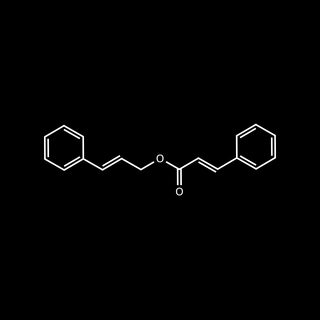
Cinnamyl cinnamate
PubChem, Cinnamyl cinnamate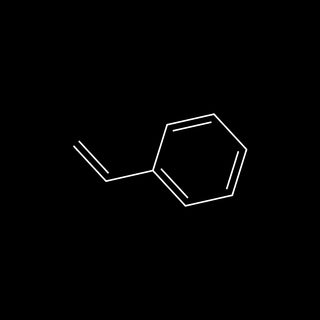
Styrene
PubChem, Styrene - CAS
- 8046-19-3
- EC
- 232-458-4
- INCI names (CosIng)
- LIQUIDAMBAR ORIENTALIS BALSAM OIL (PERFUMING)LIQUIDAMBAR STYRACIFLUA OIL (FRAGRANCE, PERFUMING)LIQUIDAMBAR ORIENTALIS RESIN EXTRACT (SKIN CONDITIONING)LIQUIDAMBAR STYRACIFLUA BALSAM EXTRACT (PERFUMING)LIQUIDAMBAR STYRACIFLUA FRUIT EXTRACT (SKIN CONDITIONING)

Labelling
- EU cosmetics annexes
- Liquidambar styraciflua oil and extract (styrax) · CosIng, Annex III, entry 181, Liquidambar styraciflua oil and extract (styrax) · restricted Maximum concentration:
“0.6%”
Physical properties
- Flash point
- > 212.00 °F.
Performance and rules
- IFRA status
- Restricted — IFRA Standard “Styrax” (Amendment 49)
Liquidambar · See Also
Entries related to Liquidambar, by their place in the pyramid. “shared” marks a scent word Liquidambar has too.
Base notes

Propolis
resinous (shared) · aromatic · floral (shared) Resinous / Same cluster / Natural
Canadian Balsam
balsamic (shared) · woody (shared) · warm (shared) Resinous / Same cluster / Natural
Gurjun Balsam
balsamic (shared) · woody (shared) · sweet (shared) Resinous / Same cluster / Natural
Copaiba Balm
balsamic (shared) · warm (shared) · woody (shared) Resinous / Same cluster / Natural
Grass Tree
balsamic (shared) · resinous (shared) Resinous / Same cluster / Natural-
Styrax Resinoid
balsamic (shared) · sweet (shared) · warm (shared) Resinous / Same cluster / Natural 
Styrax
balsamic (shared) · woody (shared) · warm (shared) Resinous / Same subfamily / Natural
Oud
woody (shared) · animalic · smoky Woods / Natural
Vetiver
earthy (shared) · woody (shared) · smoky Woods / Natural
Patchouli
Woods / Natural
Sandalwood
woody (shared) · floral (shared) Woods / Natural


Liquidambar · Sources
Read the science
- IFRA Standards, 51st Amendment
- Wikipedia Storax
- Wikipedia Liquidambar styraciflua
- Wikipedia Liquidambar
- Wikipedia Liquidambar orientalis
Cite as PREMIEREPEAU Glossary, “Liquidambar”, https://premierepeau.com/
