


Tennis Ball
Keywords: rubber · glue
Tennis ball is the smell of a new can of tennis balls, which a tennis-themed fragrance can recall.
- Olfactive family
- Florals · 782 entries of the glossary in this family Subfamily: Fresh florals · 106 entries in this subfamily Cluster: Classic florals · 247 entries in this cluster
- Material
- Fantasy/Concept Fantasy accord (reconstituted from rubber, felt and slightly green-ozonic notes)
- Pyramid
- Heart · Volatility: Heart Note
- Strength
- N/A — no measured strength for a fantasy accord Not on the graded scale
- Also called
- Synthetic rubber · Felt
Tennis Ball · Facets
Entries of the glossary that carry each facet, of 3,979:
- fresh 1,387
Editorial note We own no rights to this material, its name or its trademark. This entry is independent editorial journalism, published under freedom of expression.
Tennis Ball · Scent
Hints of rubber and glue immediately recall a new can of tennis balls.
Evolution over time
Tennis Ball: scent over time.
- Immediately
N/A — no documented evolution for a fantasy accord
- After a few hours
N/A
- After a few days
N/A
Tennis Ball · In Perfumery
One tennis-themed fragrance takes a more abstract approach than other tennis-inspired scents. Its perfumer set out to capture the vibe of tennis instead of mimicking the smell of tennis balls. In this fragrance the tennis-ball note is rendered by hints of rubber and glue, and the composition ventures beyond what is immediately recognizable. Newly mown grass, rosemary and a whisper of white florals create a crisp, citrusy effect. A woody, ambery note softens the sharp opening of the fragrance. Its perfumer calls this note “hard court”.
Pyramid
Tennis Ball: Heart. Entries of the glossary stored at each place of the pyramid, of 4,000 (36 store no place):
- Top 718
- Top · Heart 497
- Heart 1,641
- Heart · Base 514
- Base 594
Role in the formula
Tennis Ball: roles in the formula. Entries of the glossary that share each role, of 4,000:
- N/A — no documented formula role 361
Tennis Ball · Extraction & Chemistry
Before the rubber was formed into a sphere by machinery, chemicals that react to produce a gas were added, and they built pressure in the hollow once the sphere was assembled. Vulcanization, a range of processes for hardening rubber, originally meant treating natural rubber with sulfur and heat, which remains the most common practice. It works by forming cross-links between sections of the polymer chain, which makes the rubber more rigid and durable. The process is generally irreversible.
Available as
Tennis Ball: available as.
- synthetic accord
- fantasy note
- Appearance
- N/A — tennis ball is an olfactory descriptor evoking rubbery, slightly sulfurous, plasticky-fresh notes
Tennis Ball · Did You Know?
A tennis ball generally has 12 pounds per square inch more of a nitrogen and oxygen mixture than the sea level ambient air pressure. Tennis balls begin to lose their bounce as soon as the tennis ball can is opened. Balls from the Wimbledon Championships are now recycled to provide field homes for the nationally threatened Eurasian harvest mouse.
Tennis Ball · In Depth
The Ball Itself
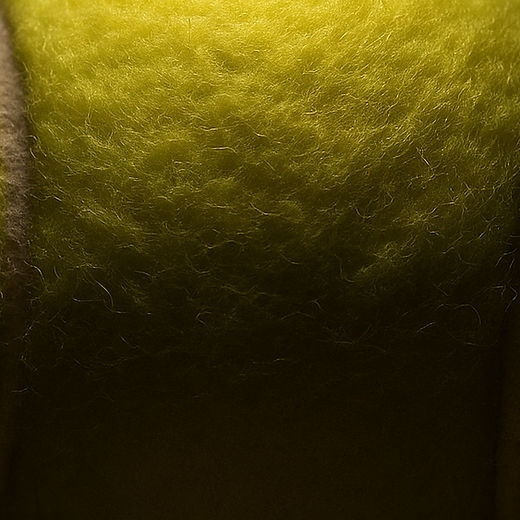
A tennis ball is a small, hollow ball used in games of tennis and real tennis. Tennis balls are covered in a fibrous felt, which modifies their aerodynamic properties. Tennis ball felts comprise wool, nylon, and cotton in a mixture surrounding the rubber edge. The felt delays flow separation in the boundary layer, which reduces aerodynamic drag and gives the ball better flight properties.
The International Tennis Federation defines the official diameter as 6.54–6.86 cm. Balls must have masses in the range 56.0–59.4 g.
Many balls carry a number as well as the brand name, which tells one set from another of the same brand on an adjacent court. Yellow and white are the only colors approved by the International Tennis Federation.
Making the Ball
The switch to the modern method of joining two hemispheres was done to improve uniformity of wall thickness.
Pressure and Testing
Modern regulation tennis balls are kept under pressure, at approximately two atmospheres, until they are first used. Balls meant for high altitudes have a lower initial pressure, and inexpensive practice balls are made without internal pressurization. A ball is tested for bounce by dropping it from a height of 254 cm onto concrete. A bounce between 135 and 147 cm is acceptable at sea level, 20 °C and 60% relative humidity.
Slower Balls
The International Tennis Federation recommends a progression that uses slower balls and smaller courts to introduce the game to adults and children. The slowest balls, marked red or using half-red felt, are oversized and unpressurized or made from foam rubber. The next, in orange, are unpressurized normal-sized balls. The last, in green, are half pressured and normal-sized.
The Sealed Can
Tennis balls are shipped and sold in a pressurized pop-top container. The rubber used isn’t airtight, and air can therefore escape from inside the ball to the outside. Putting them in a sealed can forces the ball to retain its internal pressure.
The hollow rubber core is filled with air or gas and pressurized to around 27 pounds per square inch. Sold loose, the balls would quickly lose their internal pressure, whereas sealed in the can they are as pressurized and bouncy on opening as when they were made. Air still finds its way out of the cans, so an old canister may no longer have its bounce. Play speeds the loss, since every hit and bounce forces more air out.
Waste
Explore all seven extraits in the Discovery Set.
Related: Caoutchouc · latex · Tires · Plastic · Neoprene · Diving Suit
Tennis Ball · History
Lawn tennis, as the modern game was originally known, was developed in the early 1870s as a new version of the courtly game of real tennis. Before 1925, tennis balls were packaged in wrapped paper and paperboard boxes. In 1926 a hermetically sealed pressurized metal tube that held three balls was released. In 1972, the International Tennis Federation introduced yellow balls, as these were easier to see on television.
Tennis Ball · Technical Sheet
Identity
- Botanical
- N/A — tennis ball is an olfactory concept in perfumery, not derived from a plant
- Type
- Accord
- Category
- Accords and curiosities
- Producing countries
- N/A — tennis ball is an olfactory concept described by perfumers, not a produced raw material
- Note
- Tennis ball is an olfactory descriptor in perfumery evoking the characteristic rubbery, slightly sulfurous, plasticky-fresh scent of new tennis balls. The smell comes from vulcanized rubber compounds and felt adhesives. Not a tradeable perfumery ingredient.
Chemical data
- Formula
- N/A — the characteristic tennis ball scent is a complex blend of rubber vulcanization by-products and felt adhesives
Performance and rules
- IFRA status
- No IFRA Standard for the material itself (51st Amendment)
Tennis Ball · See Also
Entries related to Tennis Ball, by their place in the pyramid. “shared” marks a scent word Tennis Ball has too.
Top notes

Toothpaste
fresh (shared) · spicy · sweet Aromatic / Fantasy/Concept-
Industrial Glue
chemical · solvent · sharp Aquatic / Fantasy/Concept

Heart notes

Hivernal Neo
fresh (shared) · mineral Florals / Heart · Base / Same subfamily / Synthetic
Orange Blossom
floral · honeyed · citrus Florals / Natural
Violet
floral · violet Florals / Natural & Synthetic
Jasmine
floral Florals / Natural


Base notes

Iris
powdery · earthy · violet Florals / Natural

Other entries · Place in the pyramid not stored

Carnation
floral · spicy · clove Florals / Same cluster / Natural

Tennis Ball · Sources
- IFRA Standards, 51st Amendment
- Wikipedia Tennis ball
- Wikipedia Vulcanization
Cite as PREMIEREPEAU Glossary, “Tennis Ball”, https://premierepeau.com/
