


Alpha-Amylcinnamaldehyde
Keywords: floral · jasmine · powdery
Alpha-amylcinnamaldehyde is a synthetic aroma compound used in perfumes. Its odour is sweet, floral and jasmine-like.

- Olfactive family
- Florals · 783 entries of the glossary in this family Subfamily: White florals · 95 entries in this subfamily Cluster: Classic florals · 243 entries in this cluster
- Material
- Synthetic
- IFRA status
- Restricted
- Pyramid
- Heart · Base
- Producing countries
- Manufactured globally (China, India, Europe)
- Also called
- amyl cinnamal, amylcinnamaldehyde, 2-benzylideneheptanal, jasminaldehyde, jasmine aldehyde, α-pentylcinnamaldehyde
Alpha-Amylcinnamaldehyde · Facets
Entries of the glossary that carry each facet, of 3,979:
- floral 1,547
- sweet 1,987
- powdery 195
Alpha-Amylcinnamaldehyde · Scent
The odour is sweet, floral, fruity, tropical and green, with a powdery nuance. It has a jasmine-like odour. It is reminiscent of many types of natural flowers, but mostly of jasmine, gardenia and tuberose. Old or oxidized material has an objectionable, rancid-fatty odour.
Evolution over time
Alpha-Amylcinnamaldehyde: scent over time.
- Immediately
Sweet, fruity, tropical and green
Scent words: green · fruity · tropical · sweet - After a few hours
Floral and jasmine-like, with oily and herbal touches
Scent words: herbal · floral - After a few days
A powdery nuance
Scent words: powdery
Alpha-Amylcinnamaldehyde · In Perfumery
Alpha-Amylcinnamaldehyde blends excellently and assists in fixation of the fragrance. It introduces jasmine-like floralness when accompanied by more volatile chemicals of floral character. It occurs in perfumes, toilet waters, aftershaves and various perfumed cosmetics. Alpha-Amylcinnamaldehyde appears on the IFRA Transparency List under CAS 122-40-7.
Pyramid
Alpha-Amylcinnamaldehyde: Heart · Base. Entries of the glossary stored at each place of the pyramid, of 4,000 (35 store no place):
- Top 718
- Top · Heart 496
- Heart 1,644
- Heart · Base 513
- Base 594
Role in the formula
Alpha-Amylcinnamaldehyde: roles in the formula. Entries of the glossary that share each role, of 4,000:
- Modifier 1,168
- Blender 1,041
- Volume builder 780
Alpha-Amylcinnamaldehyde · Extraction & Chemistry
Its origin is synthetic. The material used in industry is commonly derived not from jasmine essential oil but ultimately from the castor bean plant. Cracking of ricinoleic acid, the principal constituent of castor oil, gives heptanal. The distilled heptanal is reacted with benzaldehyde in the presence of a basic catalyst in an aldol condensation, which gives the aldehyde and water. Self-condensation of heptanal gives the unwanted byproduct 2-pentylnon-2-enal.
- Appearance
- Pale yellow to yellow clear liquid
Alpha-Amylcinnamaldehyde · Did You Know?
Cracking ricinoleic acid from castor oil yields undecylenic acid, used mainly to produce Nylon 11, as well as the heptanal needed here. The unwanted byproduct of the synthesis, 2-pentylnon-2-enal, smells foul.
Alpha-Amylcinnamaldehyde · In Depth
A typical assay is 97.00 to 100.00 % sum of isomers. The material can contain both the E and Z isomers of alpha-amyl cinnamaldehyde. It is insoluble in water and soluble in 6 volumes of 80% alcohol. It is very susceptible to oxidation unless properly treated with an antioxidant, which most manufacturers conventionally add. Storage is by refrigeration in tightly sealed containers, under nitrogen.
It occurs in flower oils and serves as a flavouring agent and flavour enhancer, for example in jasmine tea. Under the EU Cosmetic Products Regulation, amyl cinnamal must be individually listed on a cosmetic product label. Labelling is required when a substance is present above 0.01 % in rinse-off products and above 0.001 % in leave-on products.
Amyl cinnamal is one of the ingredients of fragrance mix I, which has been used for several decades in patch testing. In a human repeated insult patch test with 109 subjects, alpha-amylcinnamaldehyde gave a negative conclusion.
Explore all seven extraits in the Discovery Set.
Related: Cananga · Jasmolactone · Methyl Jasmonate · Phenyl Propanol · Benzyl Acetate · Benzyl Propionate · Orange Cassia Tree · Cinnamyl Formate
Alpha-Amylcinnamaldehyde · History
Amyl cinnamal was already on the EU list of fragrance allergens that must be named on cosmetic labels when Regulation (EU) 2023/1545 of 26 July 2023 widened that list.
Alpha-Amylcinnamaldehyde · Technical Sheet
Molecular weight
202.29666000 g/mol Heavier than 126 of the 454 other entries at the same place of the pyramid that store a weight.
2,572 entries store a molecular weight. By place in the pyramid: Top 547, Top · Heart 406, Heart 886, Heart · Base 455, Base 278.
Identity
- Botanical
- N/A (synthetic aldehyde)
- Source
- Synthetic molecule
- Type
- Ingredient
- Category
- Flowers
Classification
- Chemical class
- α,β-unsaturated aldehyde
Chemical data
- Formula
- C14H18O
- Structure
- Alpha-Amylcinnamaldehyde:
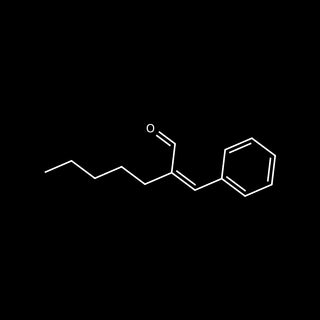 PubChem
- CAS
- 122-40-7
- PubChem CID
- 31209, compound record on PubChem
- InChIKey
- HMKKIXGYKWDQSV-UHFFFAOYSA-N
- Wikidata · Wikipedia
- Alpha-Amylcinnamaldehyde: Q48248351, item on Wikidata · Wikipedia, English article
Physical properties
- Boiling point
- 287.00 to 290.00 °C. at 760.00 mm Hg
- Melting point
- 80.00 °C. at 760.00 mm Hg
- Flash point
- > 212.00 °F. TCC (> 100.00 °C.)
- Specific gravity
- 0.96300 to 0.97100 at 25.00 °C.
- Refractive index
- 1.55500 to 1.55900 at 20.00 °C.
- Vapour pressure
- 0.002000 mmHg at 25.00 °C. (est)
- Log P
- 4.357 (est)
- Strength
- Medium
- Tenacity
- 256 hour(s) at 100.00 %
Performance and rules
- Available as
- synthetic
- IFRA status
- Restricted — IFRA Standard “alpha-Amyl cinnamic aldehyde” (Amendment 49)
Alpha-Amylcinnamaldehyde · See Also
Entries related to Alpha-Amylcinnamaldehyde, by their place in the pyramid. “shared” marks a scent word Alpha-Amylcinnamaldehyde has too.
Heart notes

Aurantiol
floral (shared) · orange blossom Florals / Heart · Base / Same cluster / Synthetic / 305.4 g/mol
Hexyl Cinnamal
floral (shared) · jasmine (shared) Florals / Heart · Base / Same cluster / Synthetic / 216.32 g/mol
Coffee Blossom
floral (shared) · gourmand · roasted Florals / Same cluster / Natural
Melati
floral (shared) · fruity · warm Florals / Same cluster / Natural
Lily
floral (shared) · green · waxy Florals / Same subfamily / Synthetic
Orange Blossom
floral (shared) · honeyed · citrus Florals / Same subfamily / Natural
Jasmine
floral (shared) Florals / Same subfamily / Natural
Violet
floral (shared) · violet Florals / Natural & Synthetic
Cis-Jasmone
floral (shared) · jasmine (shared) · herbal Florals / Natural & Synthetic / 164.24 g/mol
alpha-Amylcinnamyl formate
green · herbal · balsamic Gourmand / Heart · Base / 232.32 g/mol


Base notes

alpha-Amylcinnamaldehyde dimethyl acetal
floral (shared) · green · jasmine (shared) Florals / Same subfamily / 248.36 g/mol
Iris
powdery (shared) · earthy · violet Florals / Natural
alpha-Amylcinnamyl acetate
balsamic · floral (shared) · fruity Green / 246.34 g/mol


Alpha-Amylcinnamaldehyde · Sources
- Allergologie select (2017) Contact allergy to fragrances: current clinical and regulatory trends
- Dermatitis : contact, atopic, occupational, drug (2021) Fragrance Skin Sensitization Evaluation and Human Testing: 30-Year Experience
- PubChem Amylcinnamaldehyde
- IFRA Standards, 51st Amendment
- Perflavory Alpha-amyl cinnamaldehyde
- COSMILE Europe AMYL CINNAMAL
- Wikipedia Jasminaldehyde
- IFRA Transparency list
- Pyrfume The Good Scents Company odour descriptors (Pyrfume archive)
- Pyrfume Leffingwell odour dataset (Pyrfume archive)
- The Good Scents Company Alpha-amyl cinnamaldehyde
Cite as PREMIEREPEAU Glossary, “Alpha-Amylcinnamaldehyde”, https://premierepeau.com/
