


Aurantiol
Keywords: floral · orange blossom
Aurantiol is the Schiff base of hydroxycitronellal and methyl anthranilate. It has an orange blossom and neroli character.
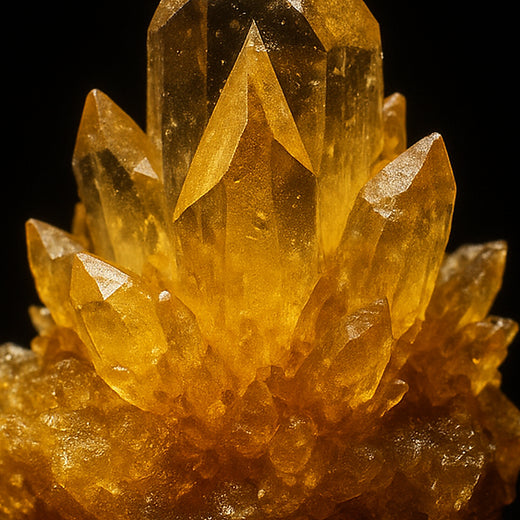
- Olfactive family
- Florals · 785 entries of the glossary in this family Subfamily: White florals · 94 entries in this subfamily Cluster: Classic florals · 245 entries in this cluster
- Material
- Synthetic
- Pyramid
- Heart-to-Base
- Strength
- High Step 4 of 5 · shared by 507 of 2,161 graded entries Graded entries at each step, from 1 to 5: 4, 117, 1,469, 507, 40. 24 more sit between two steps.
- Producing countries
- N/A — synthetic molecule
- Also called
- Hydroxycitronellal methyl anthranilate, Aurantium, Aurantine, Aurantion, Auralva, Hydroxycitronellylidene methyl anthranilate
Aurantiol · Facets
Entries of the glossary that carry each facet, of 3,979:
- floral 1,551
- sweet 1,990
- fresh 1,392
- powdery 197
- balsamic 343
- fruity 1,307
Aurantiol · Scent
The odour is floral, of orange blossom, slightly sweet, powdery and faintly balsamic. The aroma is reminiscent of orange blossom absolute, with soft fruity-floral nuances and balsamic undertones. It has a powerful floral-orange blossom aroma. Its odour has also been described as lily and orangeflower.
Evolution over time
Aurantiol: scent over time.
- Immediately
Floral, orange blossom and neroli, with soft fruity-floral nuances.
Scent words: floral · fruity - After a few hours
Slightly sweet and powdery.
Scent words: powdery · sweet - After a few days
Balsamic undertones.
Scent words: balsamic
- Tenacity
- 400 hours at 100%
Aurantiol · In Perfumery
Aurantiol is used extensively in a large variety of floral notes, such as orange-blossom, linden-blossom and tuberose. Schiff bases of methyl anthranilate with four aldehydes, hydroxycitronellal among them, may be applied as profragrances, which release the aldehyde and methyl anthranilate on hydrolysis. Aurantiol appears on the IFRA Transparency List under CAS 89-43-0.
Pyramid
Aurantiol: Heart · Base. Entries of the glossary stored at each place of the pyramid, of 4,000 (35 store no place):
- Top 718
- Top · Heart 501
- Heart 1,646
- Heart · Base 512
- Base 588
Role in the formula
Aurantiol: roles in the formula. Entries of the glossary that share each role, of 4,000:
- Modifier 1,168
- Blender 1,041
- Volume builder 780
Aurantiol · Extraction & Chemistry
When methyl anthranilate reacts with an aldehyde, water is released and a single, heavier compound is formed. Schiff bases can be synthesized from odorant aldehydes and primary amines through a condensation reaction. The Schiff base of hydroxycitronellal and methyl anthranilate can be prepared by direct condensation of the neat liquid reagents at 110 °C, without solvents or dehydrating agents. Of four methyl anthranilate Schiff bases made in one study, three gave their best yield with a 2:1 excess of the aldehyde, and one with a 2:1 excess of methyl anthranilate. Perfumers can also add methyl anthranilate as a separate ingredient alongside an aldehyde such as hydroxycitronellal, so that the Schiff base forms gradually inside the finished compound over weeks or months, in a process known as maceration.
- Appearance
- Pale yellow to amber viscous liquid
Aurantiol · Did You Know?
Schiff bases are named after the chemist Hugo Schiff, who discovered them. The reaction between methyl anthranilate and an aldehyde continues even after a perfume has been bottled, so older samples may show Schiff bases that were not present when the fragrance was originally formulated.
Aurantiol · In Depth
Chemical name and amine
Aurantiol has the IUPAC name methyl 2-[(7-hydroxy-3,7-dimethyloctylidene)amino]benzoate. Methyl anthranilate is one of the two amines most commonly used to form Schiff bases in the fragrance industry, the other being ethyl anthranilate.
What a Schiff base is
A Schiff base is a compound with the general structure R1R2C=NR3, in which R3 is an alkyl or aryl group but not hydrogen. Schiff bases can be considered a sub-class of imines.
Stability and hydrolysis
Schiff bases of methyl anthranilate are typically yellow-to-orange, viscous liquids that are more stable than their parent aldehydes and have greater tenacity on skin, though they darken over time. Formation of a Schiff base is reversible, and the compound can be readily hydrolyzed back to its starting materials in aqueous environments, mainly in acidic conditions. In water-ethanol solutions the hydrolysis is very slow, while it is very fast when an acid is added, as it is complete within 24 hours.
Related Schiff bases
Other Schiff bases of methyl anthranilate are known. Verdantiol, formed with Lilial, has a linden blossom character with orange blossom undertones. Lyrame, formed with the aldehyde Lyral, has a fresh lily-of-the-valley character with notes of orange blossom.
Explore all seven extraits in the Discovery Set.
—
Related: Alpha-Amylcinnamaldehyde · Mandarin Orange Blossom · Chinotto blossom
Aurantiol · History
Aurantiol was discovered in 1908, and its first use in a commercial fragrance came in 1912. Schiff bases have become less common in modern perfumery, in part because of the strong color many of them produce.
Aurantiol · Technical Sheet
Molecular weight
305.4 g/mol Heavier than 453 of the 453 other entries at the same place of the pyramid that store a weight
2,572 entries store a molecular weight. By place in the pyramid: Top 547, Top · Heart 411, Heart 888, Heart · Base 454, Base 272.
Identity
- Botanical
- N/A — synthetic molecule (Schiff base of hydroxycitronellal and methyl anthranilate)
- Source
- Synthetic
- Type
- Ingredient
- Category
- Flowers
Classification
- Chemical class
- Schiff base
Chemical data
- Formula
- C18H27NO3
- Structure
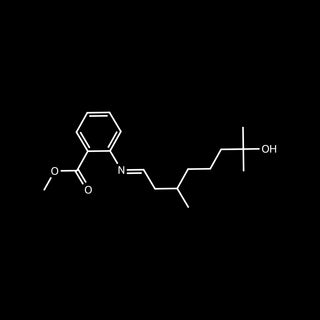 PubChem
- CAS
- 89-43-0
- PubChem CID
- 98118, compound record on PubChem
- InChIKey
- BFBPISPWJZMWJN-UHFFFAOYSA-N
- Wikidata
- Q115948357, item on Wikidata
Physical properties
- Boiling point
- 162.00 °C. @ 101.00 mm Hg
- Flash point
- 201.00 °F. TCC ( 93.89 °C. )
- Specific gravity
- 1.02160 to 1.02730 @ 25.00 °C.
- Refractive index
- 1.50360 to 1.51090 @ 20.00 °C.
- Log P
- 3.3
Performance and rules
- Available as
- synthetic
- IFRA status
- No IFRA Standard for the material itself (51st Amendment)
Aurantiol · See Also
Entries related to Aurantiol, by their place in the pyramid. « shared » marks a scent word Aurantiol has too.
Top notes

Methyl Anthranilate
floral (shared) · fruity (shared) · grape Florals / Top · Heart / Same subfamily / Synthetic / 151.16 g/mol

Heart notes

Alpha-Amylcinnamaldehyde
floral (shared) · jasmine · powdery (shared) Florals / Heart · Base / Same cluster / Synthetic / 202.3 g/mol
Benzyl Acetate
floral (shared) · jasmine · fruity (shared) Florals / Same cluster / Natural & Synthetic / 150.17 g/mol
Orange Blossom
floral (shared) · honeyed · citrus Florals / Same subfamily / Natural
Violet
floral (shared) · violet Florals / Natural & Synthetic
Tuberose
floral (shared) · narcotic · creamy Florals / Natural


Base notes

Iris
powdery (shared) · earthy · violet Florals / Natural

Other entries · Place in the pyramid not stored

Carnation
floral (shared) · spicy · clove Florals / Same cluster / Natural

Aurantiol · Sources
- International journal of molecular sciences (2022) Controlled Hydrolysis of Odorants Schiff Bases in Low-Molecular-Weight Gels
- PubChem Aurantiol
- IFRA Standards, 51st Amendment
- Wikipedia Methyl anthranilate
- Wikipedia Hydroxycitronellal
- Wikipedia Schiff base
- Wikipedia Hugo Schiff
- IFRA Transparency list
- Pyrfume The Good Scents Company odour descriptors (Pyrfume archive)
- The Good Scents Company hydroxycitronellal / methyl anthranilate schiff's base
- Pyrfume Leffingwell odour dataset (Pyrfume archive)
Cite as PREMIEREPEAU Glossary, “Aurantiol”, https://premierepeau.com/pages/glossary-terms/aurantiol Updated 2026-11-18
