


Ethyl Acrylate
Keywords: fruity · rum · sharp
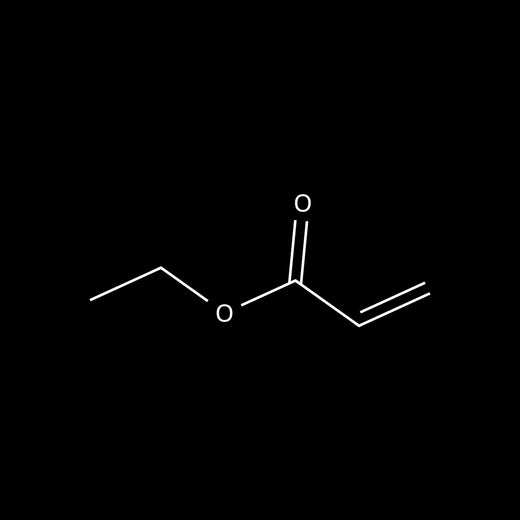
Ethyl Acrylate is an enoate ester, a colourless liquid. It smells fruity and sharp, with a plastic edge.
- Olfactive family
- Fruity · 696 entries of the glossary in this family Subfamily: Classic fruits · 422 entries in this subfamily Cluster: Mixed fruit notes · 346 entries in this cluster
- Material
- Synthetic
- IFRA status
- Prohibited
- Pyramid
- Top · Volatility: Top Note
- Strength
- High Step 4 of 5 · shared by 498 of 2,156 graded entries Graded entries at each step, from 1 to 5: 4, 119, 1,473, 498, 39. 23 more sit between two steps.
Family, subfamily and cluster: PREMIEREPEAU house classification, version 2026‑11.
Ethyl Acrylate · Facets
Entries of the glossary that carry each facet, of 3,979:
- fruity 1,301
- rum 29
- sharp 44
- plastic 13
- acrylate 3
Ethyl Acrylate · Scent
It smells fruity and sharp, with notes of rum, plastic and acrylate.
Ethyl Acrylate · In Perfumery
It brings a harsh, acrid, fruity odour that is very diffusive and high in strength.
Pyramid
Ethyl Acrylate: Top. Entries of the glossary stored at each place of the pyramid, of 4,006 (42 store no place):
- Top 718
- Top · Heart 497
- Heart 1,641
- Heart · Base 514
- Base 594
Ethyl Acrylate · Extraction & Chemistry
It is made by reacting nickel carbonyl and acetylene with ethyl alcohol in the presence of an acid, or by esterification of acrylic acid with ethyl alcohol. It is also prepared from ethylene chlorohydrin or acrylonitrile, ethanol and sulfuric acid. Vinyl chloride reacts at 270 °C with ethanol, in the presence of a cobalt and palladium catalyst, to give ethyl acrylate in 17% yield. It is a monomer for acrylic resins, used in water-based latex paints and adhesives, textile and paper coatings, leather finish resins and acrylic fibres. It imparts flexibility to hard films.
- Appearance
- Colourless liquid
Ethyl Acrylate · In Depth
Identity
Ethyl Acrylate has the CAS number 140-88-5, the molecular formula C₅H₈O₂ and a molecular weight of 100.12 g/mol. Its systematic name is ethyl prop-2-enoate, and it belongs to the enoate esters.
Odour
It smells fruity and sharp, with notes of rum, plastic and acrylate. At 1 % in dipropylene glycol it smells harsh, with plastic, acrylate and fruity facets. Its odour is acrid and penetrating, and very diffusive. It is a lachrymator with an intense, harsh, fruity aroma, and its odour is also sour, pungent and reminiscent of hot plastic. Its odour lasts 4 hours at 100 %, and its strength is high, so it is best smelled in a 0.1 % solution or less.
Production
It is made by reacting nickel carbonyl and acetylene with ethyl alcohol in the presence of an acid, or by esterification of acrylic acid with ethyl alcohol. It is also prepared from ethylene chlorohydrin or acrylonitrile, ethanol and sulfuric acid. Vinyl chloride reacts at 270 °C with ethanol, in the presence of a cobalt and palladium catalyst, to give ethyl acrylate in 17% yield. It is a monomer for acrylic resins, used in water-based latex paints and adhesives, textile and paper coatings, leather finish resins and acrylic fibres.
It imparts flexibility to hard films.
Use in flavours
It is used as a flavouring agent. It raises no safety concern at current levels of intake when used as a flavouring agent.
Properties
It is a colourless, clear liquid. It boils at 99.4 °C and melts at −71.2 °C. Its flash point is 15.56 °C and its logP is 1.32. It polymerises on distillation.
Safety and IFRA
An IFRA Standard named Ethyl acrylate exists, and the material is prohibited under it. Its INCI name is ETHYL ACRYLATE and its function in cosmetics is plasticiser. It appears in Annex II, entry 435, of the EU Cosmetics Regulation, which lists prohibited substances. Its EC number is 205-438-8 and it is registered under REACH.
Ethyl Acrylate · Technical Sheet
Molecular weight
100.12 g/mol Heavier than 164 of the 536 other entries at the same place of the pyramid that store a weight; 12 weigh the same.
2,515 entries store a molecular weight. By place in the pyramid: Top 537, Top · Heart 403, Heart 861, Heart · Base 452, Base 262.
Identity
- Type
- Ingredient
- Category
- Aroma chemicals
Classification
- Chemical class
- Ester
Chemical data
- Formula
- C5H8O2
- CAS
- 140-88-5
- PubChem CID
- 8821, compound record on PubChem
- InChIKey
- JIGUQPWFLRLWPJ-UHFFFAOYSA-N
- Wikidata · Wikipedia
- Ethyl Acrylate: Q343014, item on Wikidata · Wikipedia, English article
Labelling
- EU cosmetics annexes
- CosIng, Annex II, entry 435 · prohibited in cosmetic products
“Ethyl acrylate, when used as a fragrance ingredient”
Physical properties
- Boiling point
- 99.4 °C
- Melting point
- −71.2 °C
- Flash point
- 15.56 °C (60 °F)
- Vapour pressure
- 38.181999 mmHg at 25 °C (estimated)
- Log P
- 1.32
Performance and rules
- Tenacity
- 4 hours at 100 %
- Odour threshold
- 260 ppt in air · Abraham et al. 2012
- Available as
- synthetic
- IFRA status
- Prohibited — IFRA Standard “Ethyl acrylate” (Amendment 40)
Ethyl Acrylate · See Also
Entries related to Ethyl Acrylate, by their place in the pyramid. “shared” marks a scent word Ethyl Acrylate has too.
Top notes

Ethyl Propionate
fruity (shared) · ethereal · rum (shared) Fruity / Same cluster / Synthetic / 102.13 g/mol
Isopropyl Acetate
fruity (shared) · ethereal · sweet Fruity / Same cluster / 102.13 g/mol
Methyl Methacrylate
fruity (shared) · apple · grape Fruity / Same cluster / Synthetic / 100.12 g/mol
Ethyl Methacrylate
gassy · herbal · apple Aromatic / Synthetic / 114.14 g/mol


Ethyl Acrylate · Sources
- PubChem Ethyl Acrylate
- ChEBI Ethyl Acrylate: chemical classification record
- The Good Scents Company Information System Ethyl Acrylate: data sheet
- Pyrfume Arctander, Perfume and Flavor Chemicals: odour descriptions (Pyrfume archive)
- Pyrfume Good Scents odour data (Pyrfume archive)
- Pyrfume Leffingwell odour data (Pyrfume archive)
- IFRA Standards, 51st Amendment
- European Commission, CosIng Ethyl Acrylate: cosmetic ingredient record
- European Chemicals Agency Ethyl Acrylate: substance record
Cite as PREMIEREPEAU Glossary, “Ethyl Acrylate”, https://premierepeau.com/
